Mate selection: How does she know he'll take care of the kids?
June 18, 2009 Mate selection: How does she know he'll take care of the kids?

Enlarge

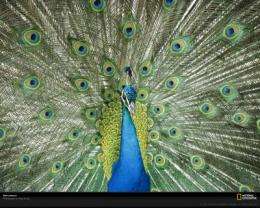
The male peacock's display attracts mates. Credit: National Geographic Society

Throughout the animal kingdom brilliant colors or elaborate behavioral displays serve as "advertisements" for attracting mates. But, what do the ads promise, and is there truth in advertizing? Researchers at Yale theorize that when males must provide care for the survival of their offspring, the males' signals will consistently be honest — and they may devote more of their energy to caring for their offspring than to being attractive.

The idea that males showcase their best qualities to attract for mating isn't a new one, nor is the idea that they might be deceptive in what they are promoting. Instead, the new findings better predict the requirement for honesty in advertising as a function of the male's suitability for parenting, according to Natasha Kelly, a graduate student in ecology and evolutionary biology at Yale and lead author of the study.

The peacock's ornate fanned tail — or the primping and posturing of a guy in a bar — are "advertisements" or mating displays that take substantial energy to maintain. When a male's energy is heavily focused on keeping up his appearance, he may have little energy to devote to caring for offspring. But that may be okay, say the researchers — in species where he does not really need to tend to the kids.

Previous research suggested that, under certain circumstances, males could be dishonest about their parenting skills and still have high . This new model, now appearing in the online version of the Proceedings of the Royal Society B, examines the reliability of males' mating signals when they must care for offspring — an aspect that was missing in earlier studies.

There are many species in which males could, but do not have to, provide parental care — because females will pick up the slack. The Yale researchers focused on those species, like stickleback fish, where females cannot pick up the slack and males who do not provide care risk the survival of their offspring.

"This new work shows that when males can not escape the cost of failing to provide care, their advertisements will tend to tend to reliably indicate how much care they will provide," said senior author Suzanne Alonzo, assistant professor of ecology and evolutionary biology at Yale.

"The qualifier in this case is where are obligated to provide care," said Kelly. "In that case, the quiet guy in the corner might be giving the more reliable advertisement for fatherhood."

Source: Yale University (news : web)


print this article email this article download pdf blog this article bookmark this article     Stumble it Digg this share on Facebook retweet share on Reddit add to delicious
Rate this story - 2.5 /5 (2 votes)


June 18, 2009 all stories

Comments: 0

2.5 /5 (2 votes)
  • Stumble this up

  • Digg this

  • share this

  • hide
  • Related Stories

  • Males caring for offspring is a good reproductive strategy
    created Mar 28, 2007 | popularity not rated yet | comments 0
  • Research shows why parents are born and not made
    created Nov 03, 2008 | popularity not rated yet | comments 0
  • Like father, like son: Attractiveness is hereditary
    created Nov 20, 2007 | popularity not rated yet | comments 0
  • Mating that causes injuries
    created Feb 20, 2009 | popularity not rated yet | comments 0
  • Fruit flies sick from mating
    created Feb 19, 2009 | popularity not rated yet | comments 0


  • hide
  • Relevant PhysicsForums posts

  • What is transpulmonary pressure?
    created Nov 24, 2009
  • Is there a gay gene?
    created Nov 23, 2009
  • Super quick question about Starling forces?
    created Nov 22, 2009
  • Questions about diffusion
    created Nov 22, 2009
  • More from Physics Forums - Biology

Other News

Variable Temperatures Leave Insects wtih a Frosty Reception

Biology / Plants & Animals

created 11 hours ago | popularity not rated yet | comments 0

(PhysOrg.com) -- For the first time, scientists at The University of Western Ontario have shown that insects exposed to repeated periods of cold will trade reproduction for immediate survival.


When camouflage is a plant's best protection

Rare woodland plant uses 'cryptic coloration' to hide from predators

Biology / Plants & Animals

created 13 hours ago | popularity 4.3 / 5 (3) | comments 0

It is well known that some animal species use camouflage to hide from predators. Individuals that are able to blend in to their surroundings and avoid being eaten are able to survive longer, reproduce, and ...


Cells defend themselves from viruses, bacteria with armor of protein errors

Biology / Cell & Microbiology

created 15 hours ago | popularity 5 / 5 (7) | comments 0

When cells are confronted with an invading virus or bacteria or exposed to an irritating chemical, they protect themselves by going off their DNA recipe and inserting the wrong amino acid into new proteins to defend them ...


Researchers discover biological basis of 'bacterial immune system'

Biology / Cell & Microbiology

created 15 hours ago | popularity 4.7 / 5 (3) | comments 0

Bacteria don't have easy lives. In addition to mammalian immune systems that besiege the bugs, they have natural enemies called bacteriophages, viruses that kill half the bacteria on Earth every two days.


'Safety valve' protects photosynthesis from too much light

Biology / Cell & Microbiology

created 14 hours ago | popularity 4.7 / 5 (3) | comments 0

Photosynthetic organisms need to cope with a wide range of light intensities, which can change over timescales of seconds to minutes. Too much light can damage the photosynthetic machinery and cause cell death. Scientists ...