An easy way to find a needle in a haystack by removing the haystack
June 18, 2009
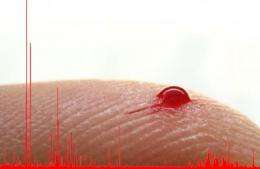
One drop of blood is sufficient for detailed metabolomic analysis by MAILD mass spectrometry. Credit: MPI for Chemical Ecology, Aleš Svatoš
Researchers at the Max Planck Institute for Chemical Ecology in Jena and their colleagues from the Czech Academy of Sciences in Prague have developed a new method to quickly and reliably detect metabolites, such as sugars, fatty acids, amino acids and other organic substances from plant or animal tissue samples. One drop of blood -- less than one micro liter -- is sufficient to identify certain blood related metabolites.
The new technique, called MAILD, is based on classical mass spectrometry (MALDI-TOF/MS) and enables researchers to measure a large number of metabolites in biological samples, opening doors for targeted and high-throughput metabolomics. Because of its versatile applications, also in medical diagnostics, the invention is protected by patent.
Mass spectrometry is an analytical technique used to elucidate the molecular composition and structure of chemical compounds. In the last two decades mass spectrometry found vast applications in biology, especially for analyzing of large biomolecules. Matrix-Assisted Laser Desorption/Ionization (MALDI), wherein bio-molecules (e.g. proteins) are co-crystallized with a chemical substance called a matrix subsequently irradiated with a laser leads to the formation of protein ions which can be analyzed and detected.
However, matrices used in the MALDI technique have a substantial disadvantage: the laser beam not only forms ions from the substances of interest; it also forms low-mass ions (<500 da) originating from the matrix. "because of these small interfering ions we were not able to analyze small molecules that play crucial roles in the metabolism of organisms," explains aleš svatoš, head of the mass spectrometry/proteomics research group at the max planck institute. "the ions that originated from conventional matrices were like a haystack in which we wanted to find a few and important needles." therefore the maldi technique found only limited application in the field of "metabolomics".
Instead of improving the search for the "needles", i.e. metabolites such as sugars, fatty acids, amino acids, and other organic acids, the scientists began to alter the matrices with which the samples were applied so that no more interfering matrix-related ions were generated. In other words: they tried to remove the haystack to make the needles visible. The researchers succeeded with the help of physical and organic chemistry, based on the Brønsted-Lowry acid-base theory, and formulated conditions for rational selection of matrices that did not generate interfering ions but provided rich mass spectra of particular kinds of metabolites in real samples.
With the new experimental protocols they called "Matrix-Assisted Ionization/Laser Desorption - MAILD", the scientists were able to quickly and reliably determine more than 100 different analytes from single and small-sized samples. "The analysis of a very small plant leaf sample from Arabidopsis thaliana, in fact a circle area with a radius of just about 0.5 millimeter, revealed over a hundred analyte peaks, among which 46 metabolites could be identified. Interestingly, among them were eight of a total of eleven intermediates of the citric acid cycle, which is vital for most organisms," says Rohit Shroff, a native of India, who was a PhD student at the "International Max Planck Research School" and conducted the experiments.
The new MAILD method allows measurements from diverse biological and medical materials. Apart from plant and insect samples the scientists also studied a clinical sample: they were able to determine a wide range of blood-specific organic acids in one drop of human blood, smaller than a micro liter. In medical diagnostics such measurements are still conducted with intricate methods. If the scientists succeed in not only identifying, but also quantifying the metabolites, MAILD could develop into a fast method for medical and biological diagnostics.
Source: Max Planck Institute for Chemical Ecology
-
Bio-imaging mass spectrometry techniques reveal molecular details about complex systems
Sep 25, 2008 |
not rated yet |
0
-
Purdue creates simpler alternative for mass spectrometers
Apr 14, 2006 |
not rated yet |
0
-
Mass Spectrometry of Living Subjects
Sep 21, 2007 |
not rated yet |
0
-
Images develop clinical applications for new DESI technology
Oct 05, 2006 |
not rated yet |
0
-
Tastier Tomatoes in the Future?
Mar 24, 2006 |
not rated yet |
0
-
Engineers build first sub-10-nm carbon nanotube transistor
Feb 01, 2012 |
4.9 / 5 (30) |
30
-
Something old, something new: Evolution and the structural divergence of duplicate genes
Jan 31, 2012 |
4.6 / 5 (7) |
1
-
The hidden nanoworld of ice crystals: Revealing the dynamic behavior of quasi-liquid layers
Jan 30, 2012 |
5 / 5 (3) |
1
-
Stock market network reveals investor clustering
Jan 27, 2012 |
3.9 / 5 (23) |
8
-
Of microchemistry and molecules: Electronic microfluidic device synthesizes biocompatible probes
Jan 26, 2012 |
5 / 5 (1) |
0
-
Stoichiometry
7 hours ago
-
Boiling and melting point of impure substances
8 hours ago
-
Safe nitrogen compound to decompose a 500 deg C in a furnace?
15 hours ago
-
[ask]electron inside drinking water
Feb 08, 2012
-
How to avoid formation of Lithium Chromate ???
Feb 08, 2012
-
how to choose a reduced or oxidated form in a redox
Feb 08, 2012
- More from Physics Forums - Chemistry
More news stories
Under the microscope #7
In this video Dr Ingrid Graz shows us a thin layer of gold on top of rubber. Cracks in the gold allow it to stretch and we can use this for stretchable electronics.
33 minutes ago |
not rated yet |
0
Hydrogen from acidic water: Researchers develop potential low cost alternative to platinum for splitting water
A technique for creating a new molecule that structurally and chemically replicates the active part of the widely used industrial catalyst molybdenite has been developed by researchers with the Lawrence Berkeley ...
18 hours ago |
5 / 5 (11) |
11
|
Flexible paper robots
(PhysOrg.com) -- These inexpensive robots can stretch, bend and twist under control, and lift objects up to 120 times their own weight. Being soft, they can apply gentle and even pressure, and adapt to varied ...
16 hours ago |
5 / 5 (5) |
3
|
New method makes culture of complex tissue possible in any lab
Scientists at the University of California, San Diego have developed a new method for making scaffolds for culturing tissue in three-dimensional arrangements that mimic those in the body. This advance, published online in ...
15 hours ago |
5 / 5 (4) |
0
|
Materials that shrink when heated
One common reason that people with fillings experience toothache is that their fillings expand at a different rate to the original tooth when, for example, drinking a hot drink. Contrary to intuition, however, ...
17 hours ago |
5 / 5 (2) |
1
New error-correcting codes guarantee the fastest possible rate of data transmission
Error-correcting codes are one of the triumphs of the digital age. Theyre a way of encoding information so that it can be transmitted across a communication channel such as an optical fiber o ...
A frank discussion of the power law and linking correlation to causation
(PhysOrg.com) -- Michael Stumpf a mathematics professor at Imperial College in London, and Mason Porter a lecturer at Oxford have teamed together to write and publish a perspective piece in Science regarding the in ...
Mars Science Laboratory computer issue resolved
(PhysOrg.com) -- Engineers have found the root cause of a computer reset that occurred two months ago on NASA's Mars Science Laboratory and have determined how to correct it.
Advanced power-grid model finds low-cost, low-carbon future in West
(PhysOrg.com) -- The least expensive way for the Western U.S. to reduce greenhouse gas emissions enough to help prevent the worst consequences of global warming is to replace coal with renewable and other ...
Small modular reactor design could be a 'SUPERSTAR'
(PhysOrg.com) -- Though most of today's nuclear reactors are cooled by water, we've long known that there are alternatives; in fact, the world's first nuclear-powered electricity in 1951 came from a reactor ...
Clam fields found at deep, low-temperature Mariana vents
(PhysOrg.com) -- Scientists have marveled at the unusual life forms thriving at high temperature hydrothermal vents of the deep ocean.