IBEX spacecraft detects fast neutral hydrogen coming from the moon
June 18, 2009 IBEX spacecraft detects fast neutral hydrogen coming from the moon

Enlarge

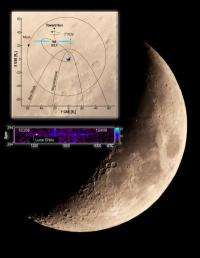
NASA's Interstellar Boundary Explorer has made the first detection of neutral atoms coming from the Moon (background image). The color-coded data toward the bottom shows the neutral particles and geometry measured at the Moon on Dec. 3, 2008. IBEX spins at four rotations per minute with its field of view sweeping over the moon each spin over about 10 hours. The neutral atoms are summed in 6 degree bins with the lunar direction indicated by the white arrow. IBEX detects particles produced by reflection and neutralization of the incident solar wind protons at toward the spacecraft. The Earth, moon and spacecraft shown toward the top are not to scale. Credit: Southwest Research Institute

NASA's Interstellar Boundary Explorer (IBEX) spacecraft has made the first observations of very fast hydrogen atoms coming from the moon, following decades of speculation and searching for their existence.

During spacecraft commissioning, the IBEX team turned on the IBEX-Hi instrument, built primarily by Southwest Research Institute (SwRI) and the Los Alamos National Laboratory, which measures atoms with speeds from about half a million to 2.5 million miles per hour. Its companion sensor, IBEX-Lo, built by Lockheed Martin, the University of New Hampshire, NASA Goddard Space Flight Center, and the University of Bern in Switzerland, measures atoms with speeds from about one hundred thousand to 1.5 million mph.

"Just after we got IBEX-Hi turned on, the moon happened to pass right through its field of view, and there they were," says Dr. David J. McComas, IBEX principal investigator and assistant vice president of the SwRI Space Science and Engineering Division. "The instrument lit up with a clear signal of the neutral atoms being detected as they backscattered from the moon."

The , the supersonic stream of charged particles that flows out from the sun, moves out into space in every direction at speeds of about a million mph. The Earth's strong magnetic field shields our planet from the solar wind. The moon, with its relatively weak magnetic field, has no such protection, causing the solar wind to slam onto the moon's sunward side.

From its vantage point in space, IBEX sees about half of the moon -- one quarter of it is dark and faces the nightside (away from the sun), while the other quarter faces the dayside (toward the sun). Solar wind particles impact only the dayside, where most of them are embedded in the , while some scatter off in different directions. The scattered ones mostly become neutral atoms in this reflection process by picking up electrons from the lunar surface.

The IBEX team estimates that only about 10 percent of the solar wind ions reflect off the sunward side of the moon as neutral atoms, while the remaining 90 percent are embedded in the lunar surface. Characteristics of the lunar surface, such as dust, craters and rocks, play a role in determining the percentage of particles that become embedded and the percentage of neutral particles, as well as their direction of travel, that scatter.

McComas says the results also shed light on the "recycling" process undertaken by particles throughout the solar system and beyond. The solar wind and other charged particles impact dust and larger objects as they travel through space, where they backscatter and are reprocessed as neutral atoms. These atoms can travel long distances before they are stripped of their electrons and become ions and the complicated process begins again.

The combined scattering and neutralization processes now observed at the moon have implications for interactions with objects across the solar system, such as asteroids, Kuiper Belt objects and other moons. The plasma-surface interactions occurring within protostellar nebula, the region of space that forms around planets and stars -- as well as exoplanets, planets around other stars -- also can be inferred.

IBEX's primary mission is to observe and map the complex interactions occurring at the edge of the solar system, where the million miles per hour solar wind runs into the interstellar material from the rest of the galaxy. The spacecraft carries the most sensitive neutral atom detectors ever flown in space, enabling researchers to not only measure particle energy, but also to make precise images of where they are coming from.

Around the end of the summer, the team will release the spacecraft's first all-sky map showing the energetic processes occurring at the edge of the . The team will not comment until the image is complete, but McComas hints, "It doesn't look like any of the models."

Source: Southwest Research Institute (news : web)


print this article email this article download pdf blog this article bookmark this article     Stumble it Digg this share on Facebook retweet share on Reddit add to delicious
Rate this story - 4.9 /5 (11 votes)

Rank Filter

Move the slider to adjust rank threshold, so that you can hide some of the comments.


Display comments: newest first

  • nkalanaga - Jun 18, 2009
    • Rank: not rated yet
    If 90% of the solar wind hydrogen remains in the lunar surface, how much hydrogen does that represent after four billion years? Would there be enough to make it practical to recover the hydrogen as a byproduct of metal or oxygen production? If so, the moon could supply both fuel and oxygen for spacecraft.
  • thermodynamics - Jun 18, 2009
    • Rank: not rated yet
    Good question nkalanaga. There should be a lot of hydrogen, but even more interesting is that this shows indirect proof that there should also be plenty of helium 3. helium 3 is a relatively rare isotope that is formed in the sun. It is also an isotope that is expected to be a great fuel for the next generation (if there is a first generation) of fusion reactors. Take a look at the helium-3 page in Wikipedia for the interesting physics involved. The idea is that by confirming the hydrogen they are indirectly confirming the He-3 flux. That will give hydrogen and He-3 for the second generation fusion reactors as well as hydrogen for fuel. The idea of hydrogen for a combustion fuel is not that important because they also have both hydrogen and oxygen in the form of ice (which they are pretty certain exists at the poles).
  • nkalanaga - Jun 18, 2009
    • Rank: not rated yet
    True, on both counts. But if the hydrogen can be recovered as a byproduct of other operations, at or near the equator, it will be easier than hauling it from the poles. Most plans have called for landing and settling in the equatorial regions, because there is some savings in fuel over landing at the poles.

    Also, if the ice at the poles ISN'T there, it would be good to know there's another option! If the ice is there, it would be limited in area, and the first to develop it could have a monopoly on lunar fuel. This could prevent such a situation.

    If nothing else, it could be used as a backup power supply for the colonies. Smelt the metals, breathe the oxygen, burn the hydrogen to provide power at night. During the day, solar power would convert the water back to H2 and O2. And, it would allow the colony to meet at least some of its water needs without hauling it, or the hydrogen, from Earth.

    We'd still need carbon and nitrogen, but it would reduce the shipping needed to build a colony. IF there's enough there, which is still a big question.

    As for the carbon, the most compact way of hauling it would be coal. The lunar oxygen could be used to burn it, and the CO2 used to grow plants. Later, it could be used as a source of carbon for chemicals and steel making. I will admit, though, that the idea of hauling coal to the Moon sounds a little strange!

    For nitrogen, take it as ammonia, maybe? that would also be a source of hydrogen. Which holds more nitrogen per cubic meter, liquid nitrogen or ammonia? If the liquid N2 is better, would the cost of refrigerating the liquid N2, and the mass of the cooling equipment, make it more expensive in the long run?

    But that's getting WAAAAY off topic!
  • Soylent - Jun 19, 2009
    • Rank: 1 / 5 (1)
    Would there be enough to make it practical to recover the hydrogen as a byproduct of metal or oxygen production? If so, the moon could supply both fuel and oxygen for spacecraft.


    When you make oxygen gas from water you automatically get as much hydrogen gas as you need, additional hydrogen is redundant.
  • nkalanaga - Jun 19, 2009
    • Rank: not rated yet
    True, but except possibly at the poles, the Moon is seriously deficient in water. Thus, for most areas, it will have to be either imported, from the poles or from Earth, or made from lunar oxygen and hydrogen from somewhere. Once it's made, yes, solar power can split it back to H2/O2 for reuse as often as one likes.

    Also, since oxygen is abundant in lunar rocks, having a source of hydrogen would allow it to be used as fuel without having to split water, which would be more efficient. You can't reuse spacecraft fuel, because there's no way to recover the exhaust.
  • E_L_Earnhardt - Jun 19, 2009
    • Rank: 5 / 5 (1)
    So now we spend billions to "mine the moon"? That is almost as crazy as going there in the first place!
  • nkalanaga - Jun 19, 2009
    • Rank: not rated yet
    Not if you want to go anywhere else in the Solar System for more than a quick visit. Once we have a colony on the Moon, it will be less expensive to produce metals and fuel there than to lift it from Earth. Getting it off the Moon and into space is much cheaper, as it takes a lot less energy, and for non-living payloads, it can be done with magnetic launchers instead of rockets. With solar power, it would cost very little, especially compared with using rockets from Earth.

    Not to mention that there wouldn't be any neighbors to annoy with the noise, smoke, and aborted launches!
  • nkalanaga - Jun 20, 2009
    • Rank: not rated yet
    OK, some numbers. Mining the moon for hydrogen may not be practical, depending on how much dirt you want to move. Given the annual mass loss in the solar wind, and the portion intercepted by the Moon, the total hydrogen capture over the last 4 billion years should be about 25 kilograms per square meter. With no information on how deeply it can penetrate, that hardly seems to be worth a mining project, just for the hydrogen. It may be worth capturing the hydrogen as a byproduct, but it probably can't supply the colony's needs, much less fuel a fleet of rockets.

    On the other hand, if you're moving thousands of cubic meters of regolith a day through your smelters, it could still add up to a sizeable amount, considering that it would be, essentially, free.

June 18, 2009 all stories

Comments: 8

4.9 /5 (11 votes)
  • Stumble this up

  • Digg this

  • share this

  • hide
  • Related Stories


  • hide
  • Relevant PhysicsForums posts

  • Sideral question
    created 13 hours ago
  • Doppler shifted blackbody spectrum
    created 16 hours ago
  • Earth v. Moon
    created 18 hours ago
  • help me with coordinates and orbits
    created 18 hours ago
  • basic 'our universe' question..
    created Nov 20, 2009
  • deriving keplers law
    created Nov 19, 2009
  • More from Physics Forums - General Astronomy

Other News

Astronauts finish another spacewalk, still no baby (AP)

Astronauts finish another spacewalk, still no baby

Space & Earth / Space Exploration

created 4 hours ago | popularity 3 / 5 (2) | comments 0

(AP) -- A spacewalking astronaut put aside the impending birth of his daughter and blazed through his first-ever venture outside the International Space Station on Saturday.


Unseasonably hot and dry weather combined with strong winds to fan scores of blazes in the country's southeastern states

Australia issues 'catastrophic' alerts as fires rage

Space & Earth / Environment

created 11 hours ago | popularity 4.5 / 5 (2) | comments 0

Australia has issued "catastrophic" alerts after record-breaking temperatures and wild lightning storms sparked more than 100 fires across the country, officials said Saturday.


Commuters wait on the platform shrouded by fog in London

Climate change not man-made, say majority of Britons: poll

Space & Earth / Environment

created Nov 15, 2009 | popularity 3.3 / 5 (15) | comments 45

Less than half of Britons believes that human activity is to blame for global warming, according to a poll carried out for The Times newspaper and published on Saturday.


Mysteriously warm times in Antarctica

Mysteriously warm times in Antarctica

Space & Earth / Earth Sciences

created Nov 18, 2009 | popularity 4.2 / 5 (21) | comments 28

(PhysOrg.com) -- A new study of Antarctica's past climate reveals that temperatures during the warm periods between ice ages (interglacials) may have been higher than previously thought. The latest analysis ...


UN: Fight climate change with free condoms (AP)

UN: Fight climate change with free condoms

Space & Earth / Environment

created Nov 18, 2009 | popularity 3.1 / 5 (11) | comments 22

(AP) -- The battle against global warming could be helped if the world slowed population growth by making free condoms and family planning advice more widely available, the U.N. Population Fund said Wednesday.