Autonomous robot detects shrapnel
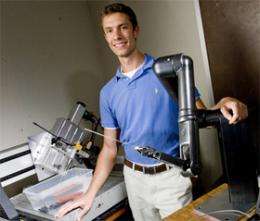
Bioengineers at Duke University have developed a laboratory robot that can successfully locate tiny pieces of metal within flesh and guide a needle to its exact location -- all without the need for human assistance.
The successful proof-of-feasibility experiments lead the researchers to believe that in the future, such a robot could not only help treat shrapnel injuries on the battlefield, but might also be used for such medical procedures as placing and removing radioactive "seeds" used in the treatment of prostate and other cancers.
In their latest experiments, the engineers started with a rudimentary tabletop robot whose "eyes" are a novel 3-D ultrasound technology developed at Duke. An artificial intelligence program served as the robot's "brain" by taking the real-time 3-D information, processing it and giving the robot specific commands to perform. In their simulations, the researchers used tiny (2 millimeter) pieces of needle because, like shrapnel, they are subject to magnetism.
"We attached an electromagnet to our 3-D probe, which caused the shrapnel to vibrate just enough that its motion could be detected," said A.J. Rogers, who just completed an undergraduate degree in bioengineering at Duke. "Once the shrapnel's coordinates were established by the computer, it successfully guided a needle to the site of the shrapnel."
By proving that the robot could guide a needle to an exact location, it would simply be a matter of replacing the needle probe with a tiny tool, such as a grabber, the researchers said.
Rogers worked in the laboratory of Stephen Smith, director of the Duke University Ultrasound Transducer Group and senior member of the research team. The results of the experiments were published early online in the July issue of the journal IEEE Transactions on Ultrasonics, Ferroelectrics and Frequency Control.
Since the researchers achieved positive results using a rudimentary robot and a basic artificial intelligence program, they are encouraged that simple and reasonably safe procedures will become routine in the near future as robot and artificial intelligence technology improves.
"We showed that in principle, the system works," Smith said. "It can be very difficult using conventional means to detect small pieces of shrapnel, especially in the field. The military has an extensive program of exploring the use of surgical robots in the field, and this advance could play a role."
In addition to its applications recovering the radioactive seeds used in treating prostate cancer, Smith said the system could also prove useful in removing foreign, metallic objects from the eye.
Advances in ultrasound technology have made these latest experiments possible, the researchers said, by generating detailed, 3-D moving images in real-time. The Duke team has a long track record of modifying traditional 2-D ultrasound - like that used to image babies in utero - into the more advanced 3-D scans. Since inventing the technique in 1991, the team has shown its utility by developing specialized catheters and endoscopes for real-time imaging of blood vessels in the heart and brain.
In the latest experiments, the robot successfully performed its main task: locating a tiny piece of metal in a water bath, then directing a needle on the end of the robotic arm to it. The researchers had previously used this approach to detect micro-calcifications in simulated breast tissue. In the latest experiments, Rogers added an electromagnet to the end of the transducer, or wand, the device that sends out and receives the ultrasonic waves.
"The movement caused by the electromagnet on the shrapnel was not visible to the human eye," Rogers said. "However, on the 3-D color Doppler system, the moving shrapnel stood out plainly as bright red."
The robot used in these experiments is a tabletop version capable of moving in three axes. For the next series of tests, the Duke researchers plan to use a robotic arm with six-axis capability.
Source: Duke University (news : web)


