Mystery of the Missing Sunspots, Solved?
June 18, 2009 by Dr. Tony Phillips Mystery of the Missing Sunspots, Solved?

Enlarge

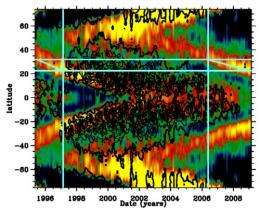
A helioseismic map of the solar interior. Tilted red-yellow bands trace solar jet streams. Black contours denote sunspot activity. When the jet streams reach a critical latitude around 22 degrees, sunspot activity intensifies.

The sun is in the pits of a century-class solar minimum, and sunspots have been puzzlingly scarce for more than two years. Now, for the first time, solar physicists might understand why.

At an American Astronomical Society press conference today in Boulder, Colorado, researchers announced that a jet stream deep inside the sun is migrating slower than usual through the star's interior, giving rise to the current lack of sunspots.

Rachel Howe and Frank Hill of the National Solar Observatory (NSO) in Tucson, Arizona, used a technique called helioseismology to detect and track the jet stream down to depths of 7,000 km below the surface of the sun. The sun generates new jet streams near its poles every 11 years, they explained to a room full of reporters and fellow scientists. The streams migrate slowly from the poles to the equator and when a jet stream reaches the critical latitude of 22 degrees, new-cycle sunspots begin to appear.

Howe and Hill found that the stream associated with the next has moved sluggishly, taking three years to cover a 10 degree range in latitude compared to only two years for the previous solar cycle.

The jet stream is now, finally, reaching the critical latitude, heralding a return of in the months and years ahead.

"It is exciting to see", says Hill, "that just as this sluggish stream reaches the usual active latitude of 22 degrees, a year late, we finally begin to see new groups of sunspots emerging."

The current solar minimum has been so long and deep, it prompted some scientists to speculate that the sun might enter a long period with no sunspot activity at all, akin to the Maunder Minimum of the 17th century. This new result dispells those concerns. The sun's internal magnetic dynamo is still operating, and the sunspot cycle is not "broken."

Because it flows beneath the surface of the sun, the jet stream is not directly visible. Hill and Howe tracked its hidden motions via helioseismology. Shifting masses inside the sun send pressure waves rippling through the stellar interior. So-called "p modes" (p for pressure) bounce around the interior and cause the sun to ring like an enormous bell. By studying the vibrations of the sun's surface, it is possible to figure out what is happening inside. Similar techniques are used by geologists to map the interior of our planet.

In this case, researchers combined data from GONG and SOHO. GONG, short for "Global Oscillation Network Group," is an NSO-led network of telescopes that measures solar vibrations from various locations around Earth. SOHO, the Solar and Heliospheric Observatory, makes similar measurements from space.

"This is an important discovery," says Dean Pesnell of NASA's Goddard Space Flight Center. "It shows how flows inside the sun are tied to the creation of sunspots and how jet streams can affect the timing of the solar cycle."

There is, however, much more to learn.

"We still don't understand exactly how jet streams trigger sunspot production," says Pesnell. "Nor do we fully understand how the jet streams themselves are generated."

To solve these mysteries, and others, NASA plans to launch the Solar Dynamics Observatory (SDO) later this year. SDO is equipped with sophisticated helioseismology sensors that will allow it to probe the solar interior better than ever before.

"The Helioseismic and Magnetic Imager (HMI) on SDO will improve our understanding of these jet streams and other internal flows by providing full disk images at ever-increasing depths in the sun," says Pesnell.

Continued tracking and study of solar jet streams could help researchers do something unprecedented--accurately predict the unfolding of future solar cycles. Stay tuned for that!

Source: Science@NASA


print this article email this article download pdf blog this article bookmark this article     Stumble it Digg this share on Facebook retweet share on Reddit add to delicious
Rate this story - 4.7 /5 (20 votes)

Rank Filter

Move the slider to adjust rank threshold, so that you can hide some of the comments.


Display comments: newest first

  • PinkElephant - Jun 18, 2009
    • Rank: 4.3 / 5 (7)
    Does the slow-moving jet stream also mean that aside from slower onset, we're also bound for an extended period of increased sunspot activity? (As the jet stream will linger in the sunspot-generating position for a longer period of time...)
  • Velanarris - Jun 18, 2009
    • Rank: not rated yet
    Does the slow-moving jet stream also mean that aside from slower onset, we're also bound for an extended period of increased sunspot activity? (As the jet stream will linger in the sunspot-generating position for a longer period of time...)

    I would say that assumption is in line with the unstated views of the researchers.
  • mattytheory - Jun 18, 2009
    • Rank: 5 / 5 (1)
    Does the slow-moving jet stream also mean that aside from slower onset, we're also bound for an extended period of increased sunspot activity? (As the jet stream will linger in the sunspot-generating position for a longer period of time...)


    I would say that assumption is in line with the unstated views of the researchers.


    Agreed. An interesting comment PinkElephant.
  • deatopmg - Jun 18, 2009
    • Rank: 5 / 5 (1)
    and all driven by the angular momentum of the solar system.
  • omatumr - Jun 18, 2009
    • Rank: 1 / 5 (2)
    SOLAR STREAMS CARRIED UPWARD BY DEEP MAGNETIC FIELDS

    Solar surface surface activity is an indication of deep-seated magnetic fields protruding through the visible solar surface as sunspots.

    These magnetic fields accelerate a stream of protons upward from the solar core, where the protons are produced by neutron-decay.

    The upward flow of protons is the carrier gas that maintains mass separation of elements and isotopes in the Sun.

    When ordinary stars enter a long period with no sunspot activity, like the Maunder Minimum, mass fractionation is diminished and the stellar surfaces become iron-rich.

    This was predicted in a 2002 paper ["Superfluidity in the solar interior: Implications for solar eruptions and climate," Journal of Fusion Energy 21 (2002) 193-198] and observed in a 2004 UC-Berkeley survey of Maunder Minimum stars: http://tinyurl.com/nkpylz

    With kind regards,
    Oliver K. Manuel
    http://www.omatumr.com

  • fleem - Jun 19, 2009
    • Rank: 2.3 / 5 (3)
    My goodness the sun certainly is profoundly variable over spans of centuries.

    *SMACK*

    Ouch the IPCC just hit me.
  • vanderMerwe - Jun 19, 2009
    • Rank: 2.3 / 5 (3)
    LOL! I'm expecting to see these clowns start sacrificing goats and virgins, if they can find any, any old time now.
  • lengould100 - Jun 19, 2009
    • Rank: 3.7 / 5 (3)
    That wasn't the IPCC smacking you, it was reality. You just haven't figured it out yet.
  • smiffy - Jun 20, 2009
    • Rank: not rated yet
    Does the slow-moving jet stream also mean that aside from slower onset, we're also bound for an extended period of increased sunspot activity? (As the jet stream will linger in the sunspot-generating position for a longer period of time...)
    If this correlation of jetstreams with sunspot activity has only just been discovered then I don't see how its progress can be predicted just yet. You would need to have data from a number of 11-year cycles to start looking for a pattern that could be used for prediction - and presumably we don't have that yet (SOHO and GONG have only been going for 13-15 years). Slower than usual (or more accurately slower than last time) migration of jet streams could just as easily mean that they will not migrate as far, and that therefore sunspots will be less frequent in this coming cycle. Time will tell.

    Let's face it, they're trying to do a 'weather' forecast for a body 93 million miles away! Look at how much trouble we have with long-term forecasts down here on Earth.
  • david_42 - Jun 20, 2009
    • Rank: not rated yet
    March 6, 2006

    BOULDER%u2014The next sunspot cycle will be 30-50% stronger than the last one and begin as much as a year late

    ...

    expect the cycle to begin in late 2007 or early 2008 ...

    I would say there is much to be discovered in the future.
  • Fazer - Jun 21, 2009
    • Rank: not rated yet
    Wow, how long have scientists puzzled over the mystery of the sunspot cycle? And now a promising new theory. I don't like seeing tax money wasted on frivolous projects, but this kind of research is well worth paying for.

    Regarding Pink's comment: It will be very interesting to see if this cycle lasts longer or if the stream gets "snapped" back up north more quickly as it comes into conflict with the underlying forces that cause the cycle.

    Anyone know of any good sites, like spaceweather.com where we can keep tabs on this?

June 18, 2009 all stories

Comments: 11

4.7 /5 (20 votes)
  • Stumble this up

  • Digg this

  • share this

  • hide
  • Related Stories

  • Spotless Sun: Blankest Year of the Space Age
    created Oct 01, 2008 | popularity not rated yet | comments 0
  • NASA Satellites Capture Start of New Solar Cycle
    created Jan 11, 2008 | popularity not rated yet | comments 0
  • The Sun Shows Signs of Life
    created Nov 10, 2008 | popularity not rated yet | comments 0
  • Is a New Solar Cycle Beginning?
    created Dec 17, 2007 | popularity not rated yet | comments 0
  • The Sun Loses its Spots
    created Jul 24, 2007 | popularity not rated yet | comments 0


  • hide
  • Relevant PhysicsForums posts

  • Are there green, purple and pink stars?
    created 12 hours ago
  • Sideral question
    created Nov 21, 2009
  • Doppler shifted blackbody spectrum
    created Nov 21, 2009
  • Earth v. Moon
    created Nov 21, 2009
  • More from Physics Forums - General Astronomy

Other News

How green is your house? Recycling favorite activity among Brits says new survey

Space & Earth / Environment

created 40 minutes ago | popularity not rated yet | comments 1

Seventy percent of households always separate their rubbish for recycling, but only 2 percent buy their energy on a green tariff, according to the early findings of a major new annual household survey, called "Understanding ...


Is global warming unstoppable?

Space & Earth / Environment

created 1hour ago | popularity not rated yet | comments 2

In a provocative new study, a University of Utah scientist argues that rising carbon dioxide emissions - the major cause of global warming - cannot be stabilized unless the world's economy collapses or society builds the ...


Astronaut suit problem delays spacewalk No. 3 (AP)

Astronaut suit problem delays spacewalk No. 3

Space & Earth / Space Exploration

created 3 hours ago | popularity not rated yet | comments 0

(AP) -- The third and final spacewalk of space shuttle Atlantis' mission is being held up by a suit problem.


The shore of Deception Island in Antarctica, in 2008

Antarctic ice loss vaster, faster than thought: study

Space & Earth / Earth Sciences

created 16 hours ago | popularity 3 / 5 (16) | comments 19

The East Antarctic icesheet, once seen as largely unaffected by global warming, has lost billions of tonnes of ice since 2006 and could boost sea levels in the future, according to a new study.


Denmark: 65 world leaders for UN climate summit (AP)

Denmark: 65 world leaders for UN climate summit

Space & Earth / Environment

created 16 hours ago | popularity 2.3 / 5 (3) | comments 2

(AP) -- Sixty-five world leaders have said they will attend the Copenhagen climate summit in December, and several more have responded positively to invitations, Danish officials said Sunday.