Scientists capture the first image of memories being made
June 18, 2009
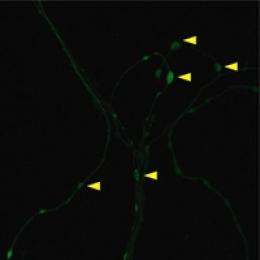
The increase in green fluorescence represents the imaging of local translation at synapses during long-term synaptic plasticity. Credit: Science
The ability to learn and to establish new memories is essential to our daily existence and identity; enabling us to navigate through the world. A new study by researchers at the Montreal Neurological Institute and Hospital (The Neuro), McGill University and University of California, Los Angeles has captured an image for the first time of a mechanism, specifically protein translation, which underlies long-term memory formation.
The finding provides the first visual evidence that when a new memory is formed new proteins are made locally at the synapse - the connection between nerve cells - increasing the strength of the synaptic connection and reinforcing the memory. The study published in Science, is important for understanding how memory traces are created and the ability to monitor it in real time will allow a detailed understanding of how memories are formed.
When considering what might be going on in the brain at a molecular level two essential properties of memory need to be taken into account. First, because a lot of information needs to be maintained over a long time there has to be some degree of stability. Second, to allow for learning and adaptation the system also needs to be highly flexible.
For this reason, research has focused on synapses which are the main site of exchange and storage in the brain. They form a vast but also constantly fluctuating network of connections whose ability to change and adapt, called synaptic plasticity, may be the fundamental basis of learning and memory.
"But, if this network is constantly changing, the question is how do memories stay put, how are they formed? It has been known for some time that an important step in long-term memory formation is "translation", or the production, of new proteins locally at the synapse, strengthening the synaptic connection in the reinforcement of a memory, which until now has never been imaged," says Dr. Wayne Sossin, neuroscientist at The Neuro and co-investigator in the study. "Using a translational reporter, a fluorescent protein that can be easily detected and tracked, we directly visualized the increased local translation, or protein synthesis, during memory formation. Importantly, this translation was synapse-specific and it required activation of the post-synaptic cell, showing that this step required cooperation between the pre and post-synaptic compartments, the parts of the two neurons that meet at the synapse. Thus highly regulated local translation occurs at synapses during long-term plasticity and requires trans-synaptic signals."
Long-term memory and synaptic plasticity require changes in gene expression and yet can occur in a synapse-specific manner. This study provides evidence that a mechanism that mediates this gene expression during neuronal plasticity involves regulated translation of localized mRNA at stimulated synapses. These findings are instrumental in establishing the molecular processes involved in long-term memory formation and provide insight into diseases involving memory impairment.
-
Mechanisms of memory identified
Apr 23, 2008 |
not rated yet |
0
-
New insight into Alzheimer’s disease
Dec 24, 2008 |
not rated yet |
0
-
Research sheds light on memory by erasing it
May 08, 2007 |
not rated yet |
0
-
Astrocytes and synaptic plasticity
Oct 13, 2008 |
not rated yet |
0
-
Study of marine snail leads to new insights into long-term memory
Jun 19, 2008 |
not rated yet |
0
-
Engineers build first sub-10-nm carbon nanotube transistor
Feb 01, 2012 |
5 / 5 (21) |
19
-
Something old, something new: Evolution and the structural divergence of duplicate genes
Jan 31, 2012 |
4.6 / 5 (7) |
1
-
The hidden nanoworld of ice crystals: Revealing the dynamic behavior of quasi-liquid layers
Jan 30, 2012 |
5 / 5 (2) |
1
-
Stock market network reveals investor clustering
Jan 27, 2012 |
4.1 / 5 (21) |
8
-
Of microchemistry and molecules: Electronic microfluidic device synthesizes biocompatible probes
Jan 26, 2012 |
not rated yet |
0
-
Nutrition label stuffs and diets
Feb 02, 2012
-
Lowe syndrom genetic test
Feb 02, 2012
-
Bill Doyle: Treating cancer with electric fields
Feb 01, 2012
-
Colonoscopy - which drugs are better?
Jan 31, 2012
-
Blunt Force Trauma
Jan 31, 2012
-
Cyberknife VSI, one touched recently, another about to be...
Jan 30, 2012
- More from Physics Forums - Medical Sciences
More news stories
Whole exome sequencing identifies cause of metabolic disease
Sequencing a patient's entire genome to discover the source of his or her disease is not routine yet. But geneticists are getting close.
6 hours ago |
5 / 5 (7) |
0
|
Hearing metaphors activates brain regions involved in sensory experience
When a friend tells you she had a rough day, do you feel sandpaper under your fingers? The brain may be replaying sensory experiences to help understand common metaphors, new research suggests.
Medicine & Health / Neuroscience
6 hours ago |
5 / 5 (1) |
1
|
New procedure repairs severed nerves in minutes, restoring limb use in days or weeks
American scientists believe a new procedure to repair severed nerves could result in patients recovering in days or weeks, rather than months or years. The team used a cellular mechanism similar to that used by many invertebrates ...
Medicine & Health / Neuroscience
17 hours ago |
5 / 5 (14) |
7
|
Researchers weigh methods to more accurately measure genome sequencing
Lost in the euphoria of the 2003 announcement that the human genome had been sequenced was a fundamental question: how can we be sure that an individual's genome has been read correctly?
5 hours ago |
not rated yet |
0
Why two new studies represent important breakthrough in Alzheimer's disease research
Two different research groups have independently made the same important discoveries on how Alzheimer's disease spreads in the brain. The groups' findings have the potential to give us a much more sophisticated understanding ...
Medicine & Health / Neuroscience
6 hours ago |
5 / 5 (2) |
0
Amazon fungi found that eat polyurethane, even without oxygen
(PhysOrg.com) -- Until now polyurethane has been considered non-biodegradable, but a group of students from Yale University in the US has found fungi that will not only eat and digest it, they will do so even in the absence ...
Scientists chart high-precision map of Milky Way's magnetic fields
(PhysOrg.com) -- Scientists at the Naval Research Laboratory (NRL) are part of an international team that has pooled their radio observations into a database, producing the highest precision map to date of ...
Renowned physicist invents microscope that can peer at living brain cells
(PhysOrg.com) -- Ever since scientists began studying the brain, theyve wanted to get a better look at what was going on. Researchers have poked and prodded and looked at dead cells under electron microscopes, ...
New kind of high-temperature photonic crystal could someday power everything from smartphones to spacecraft
A team of MIT researchers has developed a way of making a high-temperature version of a kind of materials called photonic crystals, using metals such as tungsten or tantalum. The new materials which ...
Hackers intercept FBI, Scotland Yard call (Update)
(AP) -- Trading jokes and swapping leads, investigators from the FBI and Scotland Yard spent the conference call strategizing about how to bring down the hacking collective known as Anonymous, responsible ...
Discovery of extremely long-lived proteins may provide insight into cell aging
One of the big mysteries in biology is why cells age. Now scientists at the Salk Institute for Biological Studies report that they have discovered a weakness in a component of brain cells that may explain ...
Jun 18, 2009
Rank: not rated yet
Jun 19, 2009
Rank: not rated yet