Sudden Collapse in Ancient Biodiversity: Was Global Warming the Culprit?
June 18, 2009 Sudden Collapse in Ancient Biodiversity: Was Global Warming the Culprit?

Enlarge

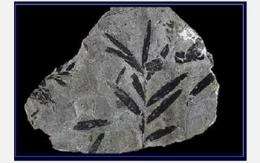
Ancient fossil leaves tell a story of sudden loss of biodiversity that may have future parallels.

Scientists have unearthed striking evidence for a sudden ancient collapse in plant biodiversity. A trove of 200 million-year-old fossil leaves collected in East Greenland tells the story, carrying its message across time to us today.

Results of the research appear in this week's issue of the journal Science.

The researchers were surprised to find that a likely candidate responsible for the loss of plant life was a small rise in the greenhouse gas carbon dioxide, which caused Earth's temperature to rise.

Global warming has long been considered as the culprit for extinctions--the surprise is that much less carbon dioxide gas in the atmosphere may be needed to drive an ecosystem beyond its tipping point than previously thought.

"Earth's deep time climate history reveals startling discoveries that shake the foundations of our knowledge and understanding of in modern times," says H. Richard Lane, program director in the National Science Foundation (NSF)'s Division of Earth Sciences, which partially funded the research.

Jennifer McElwain of University College Dublin, the paper's lead author, cautions that sulfur dioxide from extensive volcanic emissions may also have played a role in driving the plant extinctions.

"We have no current way of detecting changes in sulfur dioxide in the past, so it's difficult to evaluate whether , in addition to a rise in carbon dioxide, influenced this pattern of extinction," says McElwain.

The time interval under study, at the boundary of the Triassic and Jurassic periods, has long been known for its plant and animal extinctions.

Until this research, the pace of the extinctions was thought to have been gradual, taking place over millions of years.

It has been notoriously difficult to tease out details about the pace of extinction using fossils, scientists say, because fossils can provide only snap-shots or glimpses of organisms that once lived.

Using a technique developed by scientist Peter Wagner of the Smithsonian Institution National Museum of Natural History in Washington, D.C., the researchers were able to detect, for the first time, very early signs that these ancient ecosystems were already deteriorating--before plants started going extinct.

The method reveals early warning signs that an ecosystem is in trouble in terms of extinction risk.

"The differences in species abundances for the first 20 meters of the cliffs [in East Greenland] from which the fossils were collected," says Wagner, "are of the sort you expect. "But the final 10 meters show dramatic loses of diversity that far exceed what we can attribute to sampling error: the ecosystems were supporting fewer and fewer species."

By the year 2100, it's expected that the level of carbon dioxide in the modern atmosphere may reach as high as two and a half times today's level.

"This is of course a 'worst case scenario,'" says McElwain. "But it's at exactly this level [900 parts per million] at which we detected the ancient biodiversity crash.

"We must take heed of the early warning signs of deterioration in modern ecosystems. We've learned from the past that high levels of species extinctions--as high as 80 percent--can occur very suddenly, but they are preceded by long interval of ecological change."

The majority of modern ecosystems have not yet reached their tipping point in response to climate change, the scientists say, but many have already entered a period of prolonged ecological change.

"The signs of deterioration are blindingly obvious," says McElwain. "The biggest threats to maintaining current levels of biodiversity are land use change such as deforestation. "But even relatively small changes in and global temperature can have unexpectedly severe consequences for the health of ecosystems."


print this article email this article download pdf blog this article bookmark this article     Stumble it Digg this share on Facebook retweet share on Reddit add to delicious
Rate this story - 4.1 /5 (17 votes)

Rank Filter

Move the slider to adjust rank threshold, so that you can hide some of the comments.


Display comments: newest first

  • Bob_Kob - Jun 18, 2009
    • Rank: 3.7 / 5 (6)
    GLOBAL BORING
  • dachpyarvile - Jun 19, 2009
    • Rank: 4 / 5 (6)
    Yet, Earth experienced a plant diversity explosion when CO2 levels were at 7,000 ppm.

    Things that make one go, "Hmmmm..."
  • DeadCorpse - Jun 19, 2009
    • Rank: 2.3 / 5 (3)
    Co2 concentrations are a trailing indicator. Increased CO2 production from human sources accounts for a "less than margin of error" effect on the mean temp for the entire globe.

    200 million years ago? Musta been those pesky coal burning power plants and SUVs... Let's send Algore back in time to sell them carbon credits.
  • vanderMerwe - Jun 19, 2009
    • Rank: 3.7 / 5 (3)
    I blame it on our educational system. I had the difference between correlation and causality pounded into my head by my high school biology teacher. That apparently hasn't happened in recent decades.
  • Velanarris - Jun 22, 2009
    • Rank: not rated yet
    I blame it on our educational system. I had the difference between correlation and causality pounded into my head by my high school biology teacher. That apparently hasn't happened in recent decades.
    Agreed.

June 18, 2009 all stories

Comments: 5

4.1 /5 (17 votes)
  • Stumble this up

  • Digg this

  • share this

  • hide
  • Related Stories

  • Sulfur dioxide may have helped maintain a warm early Mars
    created Dec 20, 2007 | popularity not rated yet | comments 0
  • Scientists say biodiversity is crucial to ecosystem productivity
    created Apr 24, 2008 | popularity not rated yet | comments 0
  • Ancient climate change may portend toasty future
    created Dec 07, 2006 | popularity not rated yet | comments 0
  • Deep sea algae connect ancient climate, carbon dioxide and vegetation
    created Jun 22, 2005 | popularity not rated yet | comments 0
  • Fossil Fuels May Decrease Earth's Natural Capacity to Store Carbon
    created Aug 02, 2005 | popularity not rated yet | comments 0


  • hide
  • Relevant PhysicsForums posts

  • cycles
    created 4 hours ago
  • The Origin of the term 'fossil' fuels
    created Nov 05, 2009
  • co2
    created Nov 03, 2009
  • Early Earths Sulfidic Ocean Conditions
    created Oct 30, 2009
  • vegetation
    created Oct 29, 2009
  • climate change
    created Oct 29, 2009
  • More from Physics Forums - Earth

Other News

Deep creep means milder, more frequent earthquakes along Southern California's San Jacinto fault

Deep creep means milder, more frequent earthquakes along Southern California's San Jacinto fault

Space & Earth / Earth Sciences

created 3 hours ago | popularity 4 / 5 (1) | comments 0

With an average of four mini-earthquakes per day, Southern California's San Jacinto fault constantly adjusts to make it a less likely candidate for a major earthquake than its quiet neighbor to the east, the ...


Success in 'space elevator' competition (AP)

Success in 'space elevator' competition (Update 3)

Space & Earth / Space Exploration

created Nov 05, 2009 | popularity 4.3 / 5 (33) | comments 50

(AP) -- A robot powered by a ground-based laser beam climbed a long cable dangling from a helicopter on Wednesday to qualify for prize money in a $2 million competition to test the potential reality of the ...


'Dropouts' pinpoint earliest galaxies

'Dropouts' pinpoint earliest galaxies

Space & Earth / Astronomy

created Nov 06, 2009 | popularity 4.1 / 5 (9) | comments 12

Astronomers, conducting the broadest survey to date of galaxies from about 800 million years after the Big Bang, have found 22 early galaxies and confirmed the age of one by its characteristic hydrogen signature ...


Space hotel taking bookings for 2012 opening

Space hotel taking bookings for 2012 opening

Space & Earth / Space Exploration

created Nov 05, 2009 | popularity 4.4 / 5 (20) | comments 11

(PhysOrg.com) -- The first orbiting space hotel is on track to open for its first customers in 2012, but hurry, as bookings are filling fast.


In a Galaxy Far, Far Away...

In a Galaxy Far, Far Away...

Space & Earth / Astronomy

created Nov 06, 2009 | popularity 4.8 / 5 (4) | comments 12

(PhysOrg.com) -- Astronomers have published the discovery of the farthest known object in the cosmos: a star that exploded when the universe was only 630 million years old -- only 4.6% of its current age. ...