A water snake that predicts which way fish will turn when it attacks
June 18, 2009 A water snake that predicts which way fish will turn when it attacks

Enlarge

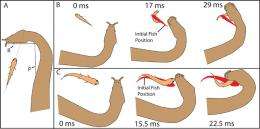
Illustration diagrams how the tentacled snake uses a body fake to trigger fishes' reflexive C-start response causing them to swim directly toward the snake's mouth.

Forget the old folk tales about snakes hypnotizing their prey. The tentacled snake from South East Asia has developed a more effective technique. The small water snake has found a way to startle its prey so that the fish turn toward the snake's head to flee instead of turning away. In addition, the fish's reaction is so predictable that the snake actually aims its strike at the position where the fish's head will be instead of tracking its actual movement.

"I haven't been able to find reports of any other predators that exhibit a similar ability to influence and predict the future behavior of their prey," says Kenneth Catania, associate professor of biological sciences at Vanderbilt University, who has used high-speed video to deconstruct the snake's unusual hunting technique.
A water snake that predicts which way fish will turn when it attacks
Enlarge

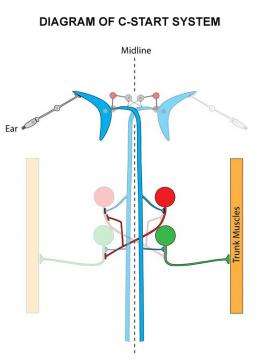
When a fish detects the sound of a disturbance in one of its ears, a special neural circuit is triggered. This is called the C-start because it causes the fish to bend into a "C" shape in the direction opposite to the disturbance. It does this by causing the trunk muscles on the opposite side of the fish to contract and by inhibiting the muscles on side closest to the disturbance.

His observations are published this week in the online early edition of the Proceedings of the National Academy of Sciences.

Catania, who is the recipient of a MacArthur "genius” award, studies the brains and behavior of species with extreme specializations. He was attracted to the tentacled snake because it is the only snake that comes equipped with a pair of short tentacles on its nose and he was curious about their function.

"Before I begin a study on a new species, it is my practice to spend some time simply observing its basic behavior,” Catania explains. The snake forms an unusual "J” shape with its head at the bottom of the "J” when it is fishing. Then it remains completely motionless until a fish swims into the area near the hook of the "J.” That is when the snake strikes.

The snakes' motions take only a few hundredths of a second and are too fast for the human eye to follow. However, its prey reacts even faster, in a few thousandths of a second. In fact, fish are famous for the rapidity of their escape response and it has been extensively studied. These studies have found that many fish have a special circuit in their brains that initiates the escape, which biologists call the "C-start.” Fish ears sense the sound pressure on each side of their body. When the ear on one side detects a disturbance, it sends a message to the fishes' muscles causing its body to bend into a C-shape facing in the opposite direction so it can swim away from danger as quickly as possible

Catania is the first scientist to study this particular predator-prey interaction with the aid of a high-speed video camera. When he began examining the movements of the snake and its prey in slow motion, he saw something peculiar. When the fish that the snake targets turn to flee, most of them turn toward the snake's head and many literally swim into its jaws! In 120 trials with four different snakes, in fact, he discovered that an amazing 78 percent of the fish turned toward the snake's head instead of turning away.

Next, the biologist noticed that the first part of its body that the snake moves is not its head. Instead, it flexes a point midway down its body. Using a sensitive hydrophone that he put in the aquarium, he confirmed that this body fake produces sound waves intense enough to trigger the fish's C-start response. Because these sound waves come from the side opposite the snake's head, this reflex action drives the fish to turn and swim directly toward the snake's mouth.

"Once the C-start begins, the fish can't turn back,” Catania says. "The snake has found a way to use the fish's escape reflex to its advantage.”

As he studied the snake's actions even closer, he made an even more remarkable discovery. When it strikes, the snake doesn't aim for the fish's initial position and then adjust its direction as the fish moves — the way most predators do. Instead it heads directly for the location where it expects the fish's head to be.

"The best evidence for this is the cases when the snake misses,” says Catania. "Not all the targeted fish react with a C-start and the snake almost always misses those that don't react reflexively.”

Catania's next step will be to determine whether this predictive capability is hard-wired or learned. To do so, he hopes to obtain some baby snakes that have just hatched and videotape their first efforts to catch prey.

Click to view the high-speed video

Source: Vanderbilt University (news : web)


print this article email this article download pdf blog this article bookmark this article     Stumble it Digg this share on Facebook retweet share on Reddit add to delicious
Rate this story - 4.8 /5 (6 votes)

Rank Filter

Move the slider to adjust rank threshold, so that you can hide some of the comments.


Display comments: newest first

  • thales - Jun 18, 2009
    • Rank: not rated yet
    Clearly this is evidence for intelligent design! A "J" and a "C"? See, God put his initials right in there.


    (I'm joking, of course. Obviously this is a great example of the evolutionary arms race.)
  • SmartK8 - Jun 19, 2009
    • Rank: not rated yet
    Fascinating. So the fish are better off when not reacting at all. Moreover, the slower the fish is (or dumber) the better chance of its survival. I guess a presence of other predators or other strategies is inhibiting a chance of an evolution to sustain in a local minimum.

June 18, 2009 all stories

Comments: 2

4.8 /5 (6 votes)
  • Stumble this up

  • Digg this

  • share this

  • hide
  • Related Stories

  • Vets at Zoo Atlanta inseminate snake
    created Dec 18, 2005 | popularity not rated yet | comments 0
  • Researchers reveal secrets of snake flight
    created May 12, 2005 | popularity not rated yet | comments 0
  • Washed-up sea snake rescued in New Zealand
    created Apr 24, 2008 | popularity not rated yet | comments 0
  • Snakes Hear in Stereo
    created May 16, 2008 | popularity not rated yet | comments 0
  • Battle over a garter snake in Wisconsin
    created Jul 29, 2006 | popularity not rated yet | comments 0


  • hide
  • Relevant PhysicsForums posts

  • Is it true that
    created 7 hours ago
  • Selenocysteine in pH=7
    created Nov 26, 2009
  • What is the formula for calculating the speed of thought?
    created Nov 26, 2009
  • What does word "absorption" mean in the intestine?
    created Nov 26, 2009
  • What is transpulmonary pressure?
    created Nov 24, 2009
  • Is there a gay gene?
    created Nov 23, 2009
  • More from Physics Forums - Biology

Other News

Hammerhead shark

Wide heads give hammerheads exceptional stereo view

Biology / Plants & Animals

created 23 hours ago | popularity 4.5 / 5 (6) | comments 4

Hammerhead sharks are some of the Ocean's most distinctive residents. 'Everyone wants to understand why they have this strange head shape,' says Michelle McComb from Florida Atlantic University. One possible ...


Golden Oldie: Key Role for Ancient Protein in Algae Photosynthesis

Golden Oldie: Key Role for Ancient Protein in Algae Photosynthesis

Biology / Biotechnology

created 14 hours ago | popularity not rated yet | comments 1

The discovery that an ancient light harvesting protein plays a pivotal role in the photosynthesis of green algae should help the effort to develop algae as a biofuels feedstock. Researchers with the Lawrence ...


Tough yet stiff deer antler is materials scientist's dream

Biology / Plants & Animals

created 23 hours ago | popularity 3 / 5 (2) | comments 2

Prized for their impressive antlers, red deer have been caught in the hunters' sights for generations. But a deer's antlers are much more than decorative. They are lethal weapons that stags crash together when duelling. John ...


Indonesia rejects Bali plan for turtle sacrifices (AP)

Indonesia rejects Bali plan for turtle sacrifices

Biology / Ecology

created 21 hours ago | popularity 5 / 5 (1) | comments 0

(AP) -- Indonesia has rejected a push by the resort island of Bali for rare turtles to be legally slain in Hindu ceremonies, siding with conservationists of the protected reptiles against religious advocates, ...


Ecologists sound out new solution for monitoring cryptic species

Biology / Ecology

created 23 hours ago | popularity not rated yet | comments 0

Ecologists have at last worked out a way of using recordings of birdsong to accurately measure the size of bird populations. This is the first time sound recordings from a microphone array have been translated into accurate ...