Special effects outsourcing grows in India
(AP) -- Outsourcing to India, long dominated by software engineering and back-office work, is expanding in new terrain: special effects for movies.
India's rise comes at a difficult time for U.S. special effects outfits, some of which have buckled as the 2008 L.A. writers strike cut productions and the financial crisis curtailed financing. Executives in India say cost pressures are pushing studios to send more work to India, where special effects projects are up to 40 percent cheaper than in the U.S.
To be sure, Indian shops are, for now, minor players. Hollywood's special effects industry is still dominated by U.S. companies like Industrial Light & Magic. Production standards are generally lower in India, and many moviemakers still won't send creative work thousands of miles (kilometers) away.
But the distance between Hollywood and Bollywood is narrowing, and many say it's only a matter of time before the gap in skills, trust, and quality is closed. The domestic market is also maturing as Indian audiences develop a taste for high-tech Hindi flicks.
"Economic conditions are playing out favorably for us," said S. Nagarajan, the chief operating officer of Visual Computing Labs, based in Mumbai, the visual effects and animation unit of Tata Elxsi, one of India's most prominent studios. "People are more willing to experiment."
His company, one of 18 special effects studios that worked on "Spider-Man 3," has billed as much in the first three months of this year as it did in nine months last year, he said.
"In 2003 and 2004, when I would visit the U.S. and meet with visual effects companies, I'd be told we can't outsource it. It requires creative control and you are too far away," said Pankaj Khandpur, the company's creative director. Now, he said, those naysayers are telling him, "'Hey, let's talk.'"
So far, most work Indian companies have done is midlevel rotoscoping and compositing, which allow filmmakers to blend complex shots.
For "Spiderman 3," Tata Elxsi VCL cut out studio stunt shots of Spiderman and sent them back to California, where they were fit into urban landscapes so the hero appeared to be swooping in death-defying arcs from one tall building to another.
Khandpur said smaller production companies have been more willing to send over complex shots. For "One Night with the King," a 2006 movie about the biblical figure of Esther, the young Jewish woman who became the queen of Persia, VCL used computer software to create and people entire landscapes, filling the land with castles, waterfalls, and hundreds of horsemen, elephants and villagers.
In the last few years a string of acquisitions and new ventures have started to build the relationships and expertise India needs to become a more of a destination for such higher-end work.
Two old Hollywood hands recently opened visual effects companies in Mumbai: Geon, founded by "The Lord of the Rings" producer Barrie Osborne, and EyeQube Studios, headed by Charles Darby, whose credits include "Titanic" and the HBO series "Rome."
Darby set up EyeQube with backing from the U.K.'s Eros International and plans to release his first film "Aladin" - an effects-driven live action film featuring top Bollywood talent - in July.
He hopes it will be his calling card in the West.
"Instead of smiling at India and saying it's not good at special effects, they'll say, 'Hey look at that...Where did that come from? Hell's teeth! It came from India," Darby said.
EyeQube is also in "advanced talks" with a Hollywood studio, which he won't name, to do its first film for U.S. release, he added.
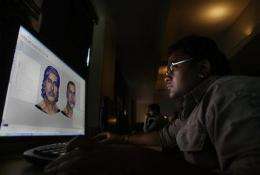
EyeQube's ultramodern studios center on an egg-shaped screening room. The 20,000-square-foot (1,860-square-meter) space is filled with hushed, dusky rooms of computer terminals, where artists experiment with complex computer generated avalanches and digitally transform a man's face into vanishing particles of smoke.
"Of course it's a threat" to U.S. firms, Darby said. But "competition is never a bad thing."
Geon's founders met while working on "The Lord of the Rings" in 2003. They opened an 18,000-square-foot (1,670-square- meter) office in October with funding - how much they won't say - from Sahara India Pariwar, a conglomerate with interests in real estate, finance, media and infrastructure.
Geon ultimately hopes to get out of the effects contracting business, with its razor-thin margins, and start making - and owning - its own films.
For now, Geon is focused on training a pool of Indian artists.
Chief Executive Jon Labrie says he's looking to hire 50 more artists globally and plans to open a Los Angeles office. But he'll be taking on just one Westerner for every 5 to 10 Indians.
There has also been a spate of acquisitions. Sony Pictures Imageworks acquired the Chennai effects studio Frameflow for a reported $5 million in 2007. Last year, Mumbai's Pixion acquired U.K. special effects house Men-from-Mars, whose credits include "Elizabeth."
Since 2006, India's Prime Focus has acquired four special effects companies in the U.K. and two in North America, which have worked on films like "There Will Be Blood."
All this is putting pressure on smaller U.S. special effects companies, like The Orphanage, a San Francisco-based company that shut its doors in February, laying off 100 people.
"The average cost of a shot gets lower and lower every year," said co-founder Scott Stewart. "If they keep driving the prices down, it will keep driving it offshore. Fewer and fewer artists will be working in the U.S."
Even the Orphanage had outsourced work to India to save on costs, he said.
"Everyone's doing it," Stewart said. Indian companies have already established themselves doing low-end work and are now moving up the value chain, he added. "They're starting to get good at everything."
---
AP Business Writer Ryan Nakashima in Los Angeles contributed to this report.
©2009 The Associated Press. All rights reserved. This material may not be published, broadcast, rewritten or redistributed.


