NASA launches LCROSS Lunar Impactor
June 19, 2009 NASA launches LCROSS Lunar Impactor

Enlarge

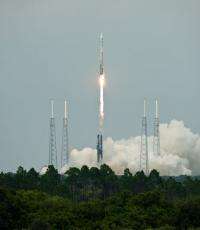
A United Launch Alliance Atlas V rocket roars into space carrying NASA's Lunar Reconnaissance Orbiter and Lunar Crater Observation and Sensing Satellite. Photo credit: NASA/Tom Farrar

NASA launched its first moon shot in a decade Thursday, sending up a pair of unmanned science probes that will help determine where astronauts could land and set up camp in years to come.

NASA successfully launched the Lunar Crater Observation and Sensing Satellite, or LCROSS, Thursday on a mission to search for water ice in a permanently shadowed crater at the moon's south pole. The satellite lifted off on an Atlas V rocket from Cape Canaveral Air Force Station, Fla., at 4:32 p.m. CDT, with a companion mission, the Lunar Reconnaissance Orbiter, or LRO.

LRO safely separated from LCROSS 45 minutes later. LCROSS then was powered-up, and the mission operations team at NASA's Ames Research Center at Moffett Field, Calif., performed system checks that confirmed the spacecraft is fully functional.

LCROSS and its attached Centaur upper stage rocket separately will collide with the moon at approximately 6:30 a.m. on Oct. 9, 2009, creating a pair of debris plumes that will be analyzed for the presence of water ice or water vapor, hydrocarbons and hydrated materials. The spacecraft and Centaur are tentatively targeted to impact the moon's south pole near the Cabeus region. The exact target crater will be identified 30 days before impact, after considering information collected by LRO, other spacecraft orbiting the moon, and observatories on Earth.

"LCROSS has been the little mission that could," said Doug Cooke, associate administrator for NASA's Exploration Systems Mission Directorate at NASA Headquarters in Washington. "We stand poised for an amazing mission and possible answers to some very intriguing questions about the moon."

The 1,290-pound LCROSS and 5,216-pound Centaur upper stage will perform a swing-by maneuver of the moon around 5 a.m. on June 23 to calibrate the satellite's science instruments and enter a long, looping polar orbit around Earth and the moon. Each orbit will be roughly perpendicular to the moon's orbit around Earth and take about 37 days to complete. Before impact, the spacecraft and Centaur will make approximately three orbits.

On the final approach, about 54,000 miles above the surface, LCROSS and the Centaur will separate. LCROSS will spin 180 degrees to turn its science payload toward the moon and fire thrusters to slow down. The spacecraft will observe the flash from the Centaur's impact and fly through the debris plume. Data will be collected and streamed to LCROSS mission operations for analysis. Four minutes later, LCROSS also will impact, creating a second debris plume.

"This mission is the culmination of a dedicated team that had a great idea," said Daniel Andrews, LCROSS project manager at Ames. "And now we'll engage people around the world in looking at the moon and thinking about our next steps there."

The LCROSS science team will lead a coordinated observation campaign that includes LRO, the Hubble Space Telescope, observatories on Hawaii's Mauna Kea and amateur astronomers around the world.

Ames manages LCROSS and also built the instrument payload. Northrop Grumman in Redondo Beach, Calif., built the spacecraft.

Provided by NASA


print this article email this article download pdf blog this article bookmark this article     Stumble it Digg this share on Facebook retweet share on Reddit add to delicious
Rate this story - 4.3 /5 (6 votes)

Rank Filter

Move the slider to adjust rank threshold, so that you can hide some of the comments.


Display comments: newest first

  • deatopmg - Jun 19, 2009
    • Rank: not rated yet
    "The two spacecraft should reach the moon in four to five days - or by early next week."

    4 to 5 days???!!!! C'mon people is this silliness from NASA or Ms. Dunn at the AP? NASA knows to the microsecond exactly where each of these vehicles will be.

  • NickFun - Jun 19, 2009
    • Rank: not rated yet
    Of course they know! They just don't want US to know.
  • lomed - Jun 23, 2009
    • Rank: not rated yet
    From the NASA LCROSS website ( http://www.nasa.g...dex.html )

    LCROSS launched with the Lunar Reconnaissance Orbiter (LRO) aboard an Atlas V rocket from Cape Canaveral, Fla., on June 18, 2009 at 2:32 p.m. PDT. The LCROSS shepherding spacecraft and the Atlas V%u2019s Centaur upper stage rocket will execute a fly-by of the moon on June 23, 2009 at about 5:20 a.m. PDT (LCROSS lunar swingby video stream coverage) and enter into an elongated Earth orbit to position LCROSS for impact on a lunar pole. On final approach, the shepherding spacecraft and Centaur will separate. The Centaur will act as a heavy impactor to create a debris plume that will rise above the lunar surface. Projected impact at the lunar South Pole is currently: Oct 9, 2009 at 4:30 a.m. PDT. Following four minutes behind, the shepherding spacecraft will fly through the debris plume, collecting and relaying data back to Earth before impacting the lunar surface and creating a second debris plume.
    So, from the given launch time to the expected flyby time there are 4 days 14 hours and 48 minutes.

June 19, 2009 all stories

Comments: 3

4.3 /5 (6 votes)
  • Stumble this up

  • Digg this

  • share this

  • hide
  • Related Stories

  • NASA Moon-Impactor Mission Passes Major Review
    created Feb 02, 2007 | popularity not rated yet | comments 0
  • LCROSS Mission To Seek Water Ice on Moon Heads to Florida for Launch
    created Feb 17, 2009 | popularity not rated yet | comments 0
  • NASA's Quest to Find Water on the Moon Moves Closer to Launch
    created Jan 15, 2008 | popularity not rated yet | comments 0
  • Moon-Bound NASA Spacecraft Passes Major Preflight Tests
    created Jun 25, 2008 | popularity not rated yet | comments 0
  • NASA gets ready for moon water search
    created Jan 15, 2008 | popularity not rated yet | comments 0


  • hide
  • Relevant PhysicsForums posts

  • The shape of our solar system's orbits.
    created 5 hours ago
  • Above or Below the Line of Nodes
    created 9 hours ago
  • Supernova vs. Nova?
    created 16 hours ago
  • Supernova's Gamma Rays and Comets
    created Nov 06, 2009
  • More from Physics Forums - General Astronomy

Other News

Seattle team wins $900,000 in Space Elevator Games (AP)

Seattle team wins $900,000 in Space Elevator Games

Space & Earth / Space Exploration

created 19 hours ago | popularity 5 / 5 (8) | comments 4

(AP) -- A Seattle team has collected a $900,000 prize in a NASA-backed competition to develop the concept of an elevator to space - an idea spurred by science fiction novels.


Russian rocket to launch from French Guiana in 2010

Space & Earth / Space Exploration

created 18 hours ago | popularity 5 / 5 (3) | comments 0

A Russian rocket will next year for the first time blast off from a European launch pad in South America, officials said Saturday, as the first rockets headed for the site on board a ship.


Success in 'space elevator' competition (AP)

Success in 'space elevator' competition (Update 3)

Space & Earth / Space Exploration

created Nov 05, 2009 | popularity 4.3 / 5 (33) | comments 50

(AP) -- A robot powered by a ground-based laser beam climbed a long cable dangling from a helicopter on Wednesday to qualify for prize money in a $2 million competition to test the potential reality of the ...


Space hotel taking bookings for 2012 opening

Space hotel taking bookings for 2012 opening

Space & Earth / Space Exploration

created Nov 05, 2009 | popularity 4.3 / 5 (19) | comments 11

(PhysOrg.com) -- The first orbiting space hotel is on track to open for its first customers in 2012, but hurry, as bookings are filling fast.


'Dropouts' pinpoint earliest galaxies

'Dropouts' pinpoint earliest galaxies

Space & Earth / Astronomy

created Nov 06, 2009 | popularity 4.1 / 5 (9) | comments 11

Astronomers, conducting the broadest survey to date of galaxies from about 800 million years after the Big Bang, have found 22 early galaxies and confirmed the age of one by its characteristic hydrogen signature ...