'Ballooning' spiders grounded by infection
June 19, 2009
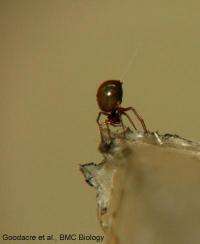
This is a money spider "ballooning." Credit: Goodacre et al., BMC Biology
Money spiders infected with Rickettsia bacteria are less likely to 'balloon' - that is, to use their silk as sails to catch gusts of wind and travel long distances. Researchers writing in the open access journal BMC Biology suggest that it may be in the bacteria's interests to ground the spiders and that this reduction in dispersal could reduce gene flow and impact on reproductive isolation within the meta-population.
While working at the University of East Anglia, Sara Goodacre led an international team of researchers who investigated the microbes' effect on the spiders' ballooning behavior. She said, "Because we found no reduction in fitness associated with Rickettsia infection, the reduced long-distance dispersal seems unlikely to be simply due to decreased body condition caused by illness. Rather, we believe that reducing long-distance dispersal could be an evolved adaptive modification by bacterial infections to promote their own transmission".
The researchers treated the spiders with antibiotics to reduce the bacterial infection and showed that this increased their ballooning frequency. They also observed that Rickettsia-infected spiders reared in the laboratory had reduced long-distance (but not short-distance) dispersal. This parasite-induced change in a non-reproductive trait has never been shown before and, according to Goodacre, "Clearly shows that the dynamics of ecosystem services such as a spider's pest-controlling function may be altered as a consequence of bacterial infection".
-
How parachute spiders invade new territory
Jul 12, 2006 |
not rated yet |
0
-
Untangling the genetic web
Mar 26, 2009 |
not rated yet |
0
-
Black widows invade Romanian shore
Jul 06, 2007 |
not rated yet |
0
-
Giant spiderweb covers Texas park
Sep 01, 2007 |
not rated yet |
0
-
Moving in for the winter toxic brown recluse spiders pose danger
Dec 15, 2008 |
not rated yet |
0
-
Fast photon control brings quantum photonic technologies closer
10 hours ago |
5 / 5 (4) |
0
-
Engineers build first sub-10-nm carbon nanotube transistor
Feb 01, 2012 |
4.9 / 5 (33) |
30
-
Something old, something new: Evolution and the structural divergence of duplicate genes
Jan 31, 2012 |
4.6 / 5 (7) |
1
-
The hidden nanoworld of ice crystals: Revealing the dynamic behavior of quasi-liquid layers
Jan 30, 2012 |
5 / 5 (5) |
1
-
Stock market network reveals investor clustering
Jan 27, 2012 |
3.9 / 5 (23) |
8
-
Factors affecting beet root cell membrane
Feb 12, 2012
-
Stem cell question.
Feb 10, 2012
-
Protease cleavage
Feb 10, 2012
-
Pertubance in a model
Feb 10, 2012
-
Cancer drugs and Alzheimer's, Oh my!
Feb 09, 2012
-
Squishing cells
Feb 09, 2012
- More from Physics Forums - Biology
More news stories
Plants use circadian rhythms to prepare for battle with insects
In a study of the molecular underpinnings of plants' pest resistance, Rice University biologists have shown that plants both anticipate daytime raids by hungry insects and make sophisticated preparations to ...
1 hour ago |
5 / 5 (2) |
0
|
Study finds fish of Antarctica threatened by climate change
A Yale-led study of the evolutionary history of Antarctic fish and their "anti-freeze" proteins illustrates how tens of millions of years ago a lineage of fish adapted to newly formed polar conditions ...
4 hours ago |
5 / 5 (2) |
0
|
Explosive evolution need not follow mass extinctions, says study of ancient zooplankton
Following one of Earth's five greatest mass extinctions, tiny marine organisms called graptoloids did not begin to rapidly develop new physical traits until about 2 million years after competing species became ...
4 hours ago |
5 / 5 (1) |
1
|
Writing a new code for life?
On "Star Trek, the aliens often look so human that crew members fall in love with them. But in real life, scientists in the field known as astrobiology can't be sure alien life would even be carbon-based like us, or use DNA ...
6 hours ago |
5 / 5 (5) |
1
Lens produces hours of scientific work in seconds
A new form of microscope which can produce results in seconds rather than hours dramatically speeding up the process of drug development - is being developed by researchers at the University of Strathclyde ...
8 hours ago |
4.4 / 5 (7) |
1
|
First-of-its-kind stem cell study re-grows healthy heart muscle in heart attack patients
Results from a Cedars-Sinai Heart Institute clinical trial show that treating heart attack patients with an infusion of their own heart-derived cells helps damaged hearts re-grow healthy muscle.
Scientists discover reason for Mt. Hood's non-explosive nature
(PhysOrg.com) -- For a half-million years, Mount Hood has towered over the landscape, but unlike some of its cousins in Oregons Cascade Mountains and many other volcanoes around the Pacific Rim ...
Discovery paves way for salmonella vaccine
(Medical Xpress) -- An international research team led by a University of California, Davis, immunologist has taken an important step toward an effective vaccine against salmonella, a group of increasingly antibiotic-resistant ...
Time of year important in projections of climate change effects on ecosystems
(PhysOrg.com) -- Does it matter whether long periods of hot weather, such as last year's heat wave that gripped the U.S. Midwest, happen in June or July, August or September?
Smoking bans lead to less, not more, smoking at home: study
Smoking bans in public/workplaces don't drive smokers to light up more at home, suggests a study of four European countries with smoke free legislation, published online in Tobacco Control.
Ovarian cancer arises in fallopian tube of knockout mice
(Medical Xpress) -- The most deadly form of "ovarian" cancer arises in the fallopian tubes not the ovaries of knockout mice that lack two genes associated with the disease, said researchers led by Baylor College ...