US woman to pay 1.92 mln dlrs in music piracy case
June 19, 2009
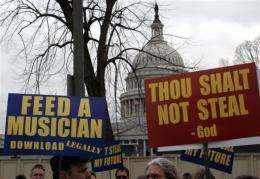
File picture shows demonstrators in front of the US Supreme Court in Washington, DC during a hearing on the legality of file-sharing networks. A US jury Thursday ordered a 32-year-old woman to pay 1.92 million dollars in damages for illegally downloading 24 songs in a high-profile digital piracy case
A US jury has ordered a 32-year-old woman to pay nearly two million dollars in damages for illegally downloading 24 songs over the Internet in a high-profile digital piracy case.
Jammie Thomas-Rasset, a single mother of four from the Minnesota town of Brainerd, was found liable of violating music copyrights for using the Kazaa peer-to-peer file-sharing network to download the songs.
The jury took just under five hours on Thursday to reach its verdict.
It ordered Thomas-Rasset to pay 1.92 million dollars -- or 80,000 dollars per song -- to six record companies: Capitol Records, Sony BMG Music, Arista Records, Interscope Records, Warner Bros. Records and UMG Recordings.
In his closing arguments on Thursday, attorney Timothy Reynolds said Thomas-Rasset had made copyrighted music available to "millions on the Internet" through Kazaa.
"She infringed my clients' copyrights and then she tried to cover it up," Reynolds said.
Thomas-Rasset said that her former husband or her children may have downloaded the music but her arguments apparently did not sway the jury.
Thomas-Rasset had been convicted previously, in October 2007, and ordered to pay 220,000 dollars in damages but the judge who presided over that trial threw out the verdict calling it "wholly disproportionate" and "oppressive."
The case was filed by the Recording Industry Association of America (RIAA), which has brought suit against thousands of people for illegally downloading and sharing music, with most agreeing to settlements of between 3,000 and 5,000 dollars.
Thomas-Rasset was the first among those being sued to refuse a settlement, however, and instead took the case to court. Her case is the only one among the thousands filed to have actually gone to trial.
In December, the RIAA said it will stop suing people who download music illegally and focus instead on getting Internet Service Providers (ISPs) to take action.
The move away from litigation represented a major shift in strategy for the music industry group, which had filed lawsuits against some 35,000 people for online music piracy since 2003.
More than six months later, however, no ISPs have publicly signed on to the program.
(c) 2009 AFP


No problem, I heard that she'll have that money very soon. She found a new "Dollar sharing program" on the internet and she is illegally downloading the money as we speak.
btw why is one song attributed to 6 record companies? Where is the artist? If anything all the proceeds should go to the artist.
http://www.thereg...society/
capitalism at its best
This outrageous, oppressive and ridiculous fine has made me absolutely HATE the RIAA and all recording companies who would destroy the financial lives of a woman and her children. The RIAA needs to get back to reality and realize that technology has made their monopoly on distribution obsolete, and we're not going to destroy the internet to insure their continued profits.
After this poor lady declares bankruptcy, I will start the timer for the bankruptcy of the record companies involved in this suit. Tick. Tock.
I won't be sniffing, but a scratch here and there could be in order.
http://www.byfor.org/
http://www.byfor.org/project_sweet_sacrifice.html
What has happened to the music/art industry is that big money is getting in the way of art. It would be nice, especially for the Christian artistic community, to go to this model.
The Motion Picture Association warned that the VCR would spell doom for their industry as people were "stealing" movies. It would seem that they were wrong as is the RIAA.
There is no crime here unless she attempted to make money from her actions which I have heard no allegation of. There is nothing new here, music has been given away by the industry for decades and people have been copying it for free and they are all still in business. The RIAA needs to look closely at the MPAA and how they have adapted to changes in technology and their market.
Truth is it is not about people copying the music its about the RIAA failing to adapt to the changing technology and marketplace. They are more concerned about being cut out of the loop entirely because now musicians can take their work directly to the people and cut them out entirely.
I might add that 12 of her peers slapped that fine on her. 12 people, chosen from a pool of random, average citizens agreed that she was guilty and chose the amount to fine her. I've been on two juries, one for murder and one for attempted murder, and both ended up as hung juries: no verdict. It is not easy to get 12 people to agree, but they did in this case. She asked for a jury of her peers, and they all found her guilty.
Also, if you read the article, the industry is changing tactics, or at least trying to do so. Hopefully this will be the last big trial of this sort.
I agree that things need to change, but in the end, even independent artists need to support themselves, so what is the new alternative? How can they make a living if people are not willing to pay for entertainment? Everyone wants free stuff. I wish artists would just stop making music altogether, leave us all in an empty void, an entertainment version of Atlas Shrugged. But that isn't going to happen, so here we are.
What's next?
And once we do set a time, can we all agree to abide by it? Can we agree that it is wrong to freely distribute material that is legally copyrighted for a "reasonable" duration?
I must conclude that Frajo has no morals whatsoever and thinks that it is perfectly okay to steal anything he/she wants, anytime, anywhere. Is that right Frajo?
No. But your reasoning is interesting.
And in order to join the discussion I'd like to ask why we should use the verb "steal"
a) to describe an action where a material object is taken away from its owner AND
b) to describe an action where an immaterial object is not taken away from its owner.
I admit that I prefer to use precise language instead of obscuring language.
GIVE the songs away, or use an iTunes like distribution method for cheapz, and make people pay for the concerts. I LOVE paying for concerts! It's totally worth it. You get a massive soundsystem, awesome ambiance, and all sorts of like-minded people all meeting up to appreciate the talent of ONLY the groups of people directly responsible for the music.
I welcome another word for the act of downloading a file against the wishes of the legal copyright owner. And perhaps there is yet another word for the act of distributing said file to others, also against the wishes of the copyright owner, which is what she was accused of doing.
I agree that concerts are cool social events and a good way for the artist to make a living. You say they should give away the songs, and an artist can certainly do that and make a living off the concerts.
But what if he or she decides to record a song. She could certainly do it all herself, but not all musicians are good sound engineers, so maybe she hires one of those. And then maybe she pays someone to design a nice CD jacket. Then she could spend all of her time taking the CD's around to stores to sell them, and listing the tracks with online outfits like iTunes and Amazon, but it would sure be a lot easier to hire someone to do that, too, and let her do what she does best: write and perform her music.
Well, it takes a lot of people to do that, if she chooses to go that route. It allows her to reach a bigger audience. That brings in more money and mostly just pays for the all of the extra staff. Maybe she makes more money personally, maybe not. Many artists only make a profit off the concerts, despite the big business aspect.
So, what does it all accomplish? It gets her a bigger audience and it creates jobs. The audience part is her personal reward, the jobs support all of the people she has networked with, maybe many of her friends. If she goes the corporate route, the same thing applies, just on a more massive scale, she just doesn't personally know most of those people, but they all work, for her, for themselves, and for the corporation of which they are a part.
So we have millions of people making a living by recording and promoting artists and their music.
Give it all away and no one has any jobs, they go into different fields. We end up with small acts in little venues, barely ekeing out an existence, the venerable starving artist. There is nothing wrong with that. It is more personable, more sociable. But every artist has the choice to take whatever route he or she wishes to take.
What right do we the consumers, the people who enjoy the efforts of the artists and those who support the artists, to dictate terms to them. They make the product, in whatever form, and they have the right to set the price. If we don't want to pay, we should just turn away and say, "Sorry, not interested."
What gives us the right to just take what we want from these people. Is it just because it is an intangible? A computer file?
One day we will be able to reproduce anything: files, objects, even thoughts. Do you want people to just come and rape you of all that you have that is unique? Make copies of you to keep and disect for their own use and never compensate you in any way?
We need a way to trade our efforts for the efforts of others. Right now that is money. In the future it might be in some other form, perhaps a reputation market, where if you contribute, you get rewarded with a higher reputation that everyone can see, and thus others are willing to contribute things back that you can use. Whatever you call it, it is still a form of trade, a form of money, currency, whatever.
Money, trade and business is not evil. Only people's actions can be evil.
Who is more evil, the person or group of people that creates something and sells it on the open market, where the consumer has the right to turn down the offer? Or the person or group of people that takes things from others and hands them out against the wishes of the creators and against the recognized law, thus undermining the ability of the creators to make a living?
All I am saying is: don't undermine the market before there is a new way for these people to make a living. We all need to help come up with an alternative, or accept the way things work now. The only other choice is chaos and anarchy.
BTW: Sorry for the long post.
As far as I know, I am the only one here trying to discuss reasonable alternatives to the current system.
As for cassette tapes, there WAS a controversy over illegal dubbing of pre-recorded music and even off the radio. It wasn't as big of an issue as it is now, mostly because the cassette was such a poor medium for recording music.
Also, I don't think the artists/media companies are concerned as much with individuals "dubbing" copies from friends or from streaming sources. I think they are much more concerned with trying to stop the rampant distribution of songs, from one user to thousands or even millions of people, via P2P networks.
All I am saying is: what alternatives are there?
I know I can distribute my songs on iTunes, if I ever get to the point where I think they are worth distributing, that is. If I do that, then I get all of the revenue after iTunes takes their percentage, which I have no problem with.
Despite that freedom to distribute online that we now have, what incentive is there for me to spend my time composing a song, recording it, mastering it, posting it online and promoting myself if no one is going to compensate me for my efforts?
I work full time. I also enjoy making music, as a hobby, and that is all I need, but if I decide to focus more energy into making my music better, and sharing it with a much wider audience, and if those people enjoy my music and value it, shouldn't I be compensated for my time? It is no different than any other job, except that now, my efforts can be copied and passed around carelessly. It makes me not want to share my music at all.
By spying on her computer? So spying on consumer computers is legal, and also asking too much money for music CD is legal, which is stealing from consumers?
She can never pay 2 million dollar, so maybe she has to go to jail. I call this a severe violation of human rights.
Many famous musicians died penniless, and were robbed by the same record companies who charged this poor consumer. It is clear who is the master and who is the slave.
Additionally in the world of copyrighted material, they are copyrighging part of the human genome as they determine what its for so they can charge people to research cures for problems. Sooo if you successfully restrict research on a disease because you copyrighted a fragment of a gene are you legally responsible for everyone who dies of that disease while you restrict research?
Her real peers were on the Net.
Thank all that is rock for independent musicians and their independent labels. \m/
I would go to court and right after the judge sentenced me I would then produce the paperwork for bankruptcy and ask if we can just proceed now with the bankruptcy hearing instead of waiting for a new court date.