Formation of the smallest droplet of acid
June 19, 2009
Tiny droplets of acid.
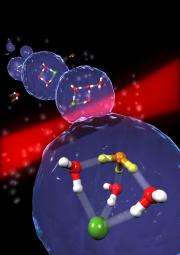
Exactly four water molecules and one hydrogen chloride molecule are necessary to form the smallest droplet of acid. This was the result of work by the groups of Prof. Dr. Martina Havenith (physical chemistry) and Prof. Dr. Dominik Marx (theoretical chemistry) within the research group at the Ruhr-Universitaet-Bochum, Germany.
They have carried out experiments at ultracold temperatures close to absolute zero temperature using infrared laser spectroscopy to monitor the molecules. This has been accompanied by theoretical ab initio simulations. According to their calculations, the reaction at these extremely cold temperatures is only possible if the molecules are aggregating one after the other. Their results will be published in the newest issue of Science.
Chemistry at ultracold temperatures in space
If you put a classical acid, for example hydrogen chloride in water, the acid molecules will preferentially lose a proton (H+). Thereby the pH-value of the solution is decreased and the solution becomes acidic. In particular, so-called hydronium ions (H3O+), are formed by protonated water molecules. This hydronium ion is an important ingredient in many chemical reactions. Despite of the fact that this is one of the most fundamental reactions, it was not clear until now how many water molecules are actually required in order to form a charge separated negative Cl- ion and a positive H3O+ ion. "Whereas we all know acids from our daily life, we have now been able to observe for the first time acid formation on a molecular level."
"We will need this knowledge in order to understant chemical processes on nanoscopic structures, on small particles and on surfaces” explains Prof. Havenith-Newen. This indicates that there is a rich chemistry even at very low temperatures; a fundamental basis for reactions within stratospheric clouds or in interstellar media. Previously, it had been unclear whether reactions with only a few water molecules can take place at theses ultracold temperatures.
Ultracold trap
For their experiments, the researchers have successively embedded hydrogen chloride as well as single water molecules in a special ultracold trap. They used nanodroplets of suprafluid helium which have a temperature of less than -272,8 °C. Molecules will first be cooled down before they have a chance to aggregate. “Suprafluid” is a special property of the helium which implies that the embedded molecules are still free to rotate before they are frozen, thereby allowing monitoring with unsurpassed precision. Captured in such a way, it is possible to obtain the chemical fingerprint of the acid - its infrared spectrum. By combining trapping with high resolution IR laser spectroscopy and theoretical calculations, the chemists demonstrated that exactly four water molecules are required to form the smallest droplet of acid: (H3O)+(H2O)3Cl-.
Important: One molecule after the other
After these results, the researchers were left with the question of how this reaction can take place at ultracold temperatures near absolute zero. “Usually, activation of chemical reactions requires the input of energy, just like for cooking at home you need a cooking plate or a gas flame” explains Prof. Marx. “However, how should this be possible at a few Kelvin (close to absolute zero)?”
The calculations, in combination with experiment, showed that the reaction is only possible by a successive aggregation process. Instead of putting together 4 water molecules and an HCl molecule simultanesously at the beginning and the waiting for a dissociation process to occur, they found in their simulations that when adding the water molecules step by step, a proton is transferred exactly when adding the fourth water molecule. Then, a hydronium ion will immediately form with one of the four added water molecules. This unusual mechanism is called “aggregation induced dissociation”. “We suspect that such aggregation induced reactions, can explain chemical transformations at ultracold conditions, such as can be found at small ice particles in clouds and in interstellar media”, explains Prof. Marx.
-
Hydrogen ions caught in the act of wandering
Oct 05, 2005 |
not rated yet |
0
-
New light cast on key chemical reactions in interstellar space
Jul 11, 2007 |
not rated yet |
0
-
All alone, ammonia and hydrogen chloride use negativity to get attached
Feb 14, 2008 |
not rated yet |
0
-
Dynamic Ice: Surface Physics Technique Reveals Complex Chemical Reactions on Icy Surfaces and Atmospheric Ice Crystals
Aug 30, 2004 |
not rated yet |
0
-
Scattering of hydrogen makes calculation easier
Feb 23, 2006 |
not rated yet |
0
-
Engineers build first sub-10-nm carbon nanotube transistor
Feb 01, 2012 |
4.9 / 5 (31) |
30
-
Something old, something new: Evolution and the structural divergence of duplicate genes
Jan 31, 2012 |
4.6 / 5 (7) |
1
-
The hidden nanoworld of ice crystals: Revealing the dynamic behavior of quasi-liquid layers
Jan 30, 2012 |
5 / 5 (3) |
1
-
Stock market network reveals investor clustering
Jan 27, 2012 |
3.9 / 5 (23) |
8
-
Of microchemistry and molecules: Electronic microfluidic device synthesizes biocompatible probes
Jan 26, 2012 |
5 / 5 (1) |
0
-
How to determine zinc in a plant.
Feb 11, 2012
-
Stoichiometry
Feb 10, 2012
-
Boiling and melting point of impure substances
Feb 10, 2012
-
Safe nitrogen compound to decompose a 500 deg C in a furnace?
Feb 09, 2012
-
[ask]electron inside drinking water
Feb 08, 2012
-
How to avoid formation of Lithium Chromate ???
Feb 08, 2012
- More from Physics Forums - Chemistry
More news stories
Hydrogen from acidic water: Researchers develop potential low cost alternative to platinum for splitting water
A technique for creating a new molecule that structurally and chemically replicates the active part of the widely used industrial catalyst molybdenite has been developed by researchers with the Lawrence Berkeley ...
Feb 09, 2012 |
4.8 / 5 (15) |
21
|
Fool's gold may prove an unlikely alternative to overexploited catalytic materials
Catalytic materials, which lower the energy barriers for chemical reactions, are used in everything from the commercial production of chemicals to catalytic converters in car engines. However, with current catalytic materials ...
Feb 10, 2012 |
4.4 / 5 (8) |
8
|
Research provides octagonal window of opportunity for carbon capture
(PhysOrg.com) -- Filtering carbon dioxide, a greenhouse gas, from factory smokestacks is a necessary, but expensive part of many manufacturing processes. However, a collaborative research team from the National ...
Feb 08, 2012 |
5 / 5 (1) |
5
|
Flexible paper robots
(PhysOrg.com) -- These inexpensive robots can stretch, bend and twist under control, and lift objects up to 120 times their own weight. Being soft, they can apply gentle and even pressure, and adapt to varied ...
Feb 09, 2012 |
5 / 5 (5) |
4
|
New form of hafnium oxide developed
(PhysOrg.com) -- A novel material developed by researchers at the University of Cambridge is opening up new possibilities for next generation electronic and optoelectronic devices, and paving the way for further ...
Feb 07, 2012 |
4.6 / 5 (5) |
4
|
Injured boomers beware: Know when to see doctor
(AP) -- It happened to nurse Jane Byron years after an in-line skating fall, business owner Haralee Weintraub while doing "men's" push-ups, and avid cyclist Gene Wilberg while lifting a heavy box.
Google might launch Drive for cloud storage soon
(PhysOrg.com) -- Google's next big move, according to the Wall Street Journal, is a cloud storage service called Drive. Hardly first to the plate, Google is simply catching up to introducing its cloud reposi ...
Latin America mining boom clashes with conservation
Latin America is experiencing a mining boom as prices rise fuelled by a hike in global demand, but the region is also being hit by a wave of violent protests, strikes and rallies by environmentalists.
Love a click away in Indonesia's Twitter Republic
He was a geeky kid from Yogyakarta, she a glamorous city girl in Jakarta. In a country with one of the world's most vibrant social networking scenes they fell in love on Twitter.
Europeans protest controversial Internet pact
Tens of thousands of people marched in protests in more than a dozen European cities Saturday against a controversial anti-online piracy pact that critics say could curtail Internet freedom.
Walney offshore wind farm is world's biggest (for now)
(PhysOrg.com) -- The Walney wind farm on the Irish Sea--characterized by high tides, waves and windy weather--officially opened this week. The farm is treated in the press as a very big deal as the Walney ...
Jun 20, 2009
Rank: not rated yet
Is this then the most acid solution that exist?
Are those droplets aggressive?