Apollo astronaut Aldrin urges US to land on Mars
June 19, 2009
US astronaut Buzz Aldrin

Enlarge

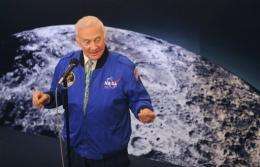
US astronaut Buzz Aldrin speaks during a press conference in Hong Kong. NASA should focus on sending a man to Mars and helping other nations travel in space, Aldrin said.

NASA should focus on sending a man to Mars and helping other nations travel in space, Apollo astronaut Buzz Aldrin said Friday.

Aldrin, who was the second man to set foot on the after Neil Armstrong, said the US agency needed to stop concentrating on simply developing new rockets and turn its attention to visiting the neighbouring planet.

"I think our resources should... be on a pathway that can lead us to Mars," he told reporters during a trip to Hong Kong.

Aldrin added that when the 11 crew returned from their mission and began touring the world, they realised the sense of achievement did not belong only to them.

"We spoke to many people in different countries and they said, 'We did it'," said Aldrin. "These quests to space are capable of unifying people to see the successes of the human race."

"I think the moon needs to be visited by nations with space programmes that have not realised that point yet," he said. "[The US] can help them do that, with our experience."

Aldrin was speaking at the launch of a three-day exhibition at the Hong Kong Space Museum celebrating the moon landing. The 40th anniversary of the landing falls on July 21.

The 79-year-old recently opened an account on the social networking site Twitter to promote the 40th anniversary. He currently has more than 3,000 followers.

When asked what he would have tweeted to the world after walking on the moon, Aldrin smiled and said, "I can't wait to get home."

(c) 2009 AFP

4.5 /5 (11 votes)  

Filter


Move the slider to adjust rank threshold, so that you can hide some of the comments.


Display comments: newest first

deatopmg
Jun 19, 2009

Rank: 1 / 5 (1)
When asked what he would have tweeted to the world after walking on the moon, Aldrin smiled and said, "I can't wait to get home." Aldrin probably left out : ...to take a good long shower"
Velanarris
Jun 19, 2009

Rank: 3 / 5 (2)
He's absolutely right. We need to get to Mars, and eventually, establish colonies.

The value is unimaginable, even as just an off world research facility the possibilities are endless.
gopher65
Jun 19, 2009

Rank: 4 / 5 (4)
Velanarris: He doesn't want a colony. He wants another flag planting mission, which is just stupid. That's what we did on the moon, and it was the wrong decision to make. You don't design shortterm missions like that, you design missions that will have both shortterm and longterm benefits.

That seems to be something that Mr. Aldrin doesn't get:(. He just wants a half-trillion dollar "fire&forget" mission, which is a waste of time and money. I want colonies instead.

Oh, and I wasn't the one who rated you two down:P.
Velanarris
Jun 19, 2009

Rank: 1 / 5 (1)
No it was Noein's non-posting alt again.

On a relevant note, think of the things we found out when we first stuck an animal into orbit. We had no idea there was fatal intrasolar radiation in abundance in belts throughout the solar system, sure we knew about the dangers of solar flares but there was so much more.

Sometimes you need to get there first in order to plan to stay.
zevkirsh
Jun 19, 2009

Rank: 1 / 5 (1)
as we speak there is an american mission to the moon bent on colliding a large object into the polar region and also surverying the moons srface for an appropriate landing area for a base. wierd.
Sean_W
Jun 19, 2009

Rank: not rated yet
While the flag planting missions do achieve some science and provide a lot of opportunities for advancements while meeting the engineering challenges, so do a lot of other projects. Creating a large scale, self-contained and largely self-sustaining colony in a remote desert or Antarctica or on an Arctic island or under the sea would be a start. Using small nuclear plants, geothermal power and other sources of power (some imported, as most nations do to some extent) would be acceptable though the difficulty and expense of such imports would make power saving solutions an important motivation. Mining resources, scientific exploration and tourism would all be possible.

Other projects like creating open-source, free software and content for education and business would be worth the funding. If you are going to spend gobs of money on something, how about commissioning professional quality audio MP3s of the great classical works of literature for the visually impaired or for busy people could enjoy these works while doing other things. Then link the audio to text files in English and other languages so that people who are learning English can improve their ability while understanding the story. I bet that there are lots of voice actors who are too ugly for movies but can do audio books. Do similar things with textbooks from introductory to advanced on many fundamental subjects. Make all of this free so any nation with internet access can have good educational content.
flashgordon
Jun 19, 2009

Rank: not rated yet
Nanotechnologists will get to Mars before our political leaders do;
sender
Jun 20, 2009

Rank: not rated yet
gravity mills and beam power systems/relays between the earth and the sun sounds like a better waste of resource, it would ensure the astronaut has emergency power and resources as well as an interplanetary transport network for shipping ammenities
Keno_Dan
Jun 20, 2009

Rank: 1 / 5 (1)
Buzz is trying to tell us that we should colonize Mars and that it should be an international effort.The CYRUS SPACE SYSTEM is just one way to do it: http://www.cyrus-...stem.com DANIEL STERLING SAMPLE....and SOS SAVE OUR SPACE SHUTTLE!
otto1923
Jun 20, 2009

Rank: not rated yet
The quicker we spread ourselves around the solar system the safer we will all be. We need to plant flags first and return soon after in force and with the will to stay. We need no other reason than to ensure the continued survival of our species. We might just be alone in a very dangerous universe.
Alizee
Jun 20, 2009

Rank: 2.7 / 5 (3)
We need to get to Mars, and eventually, establish colonies.
If we cannot survive in rich and friendly Earth, what we are expected to do in Mars? Why not to terraformize the Earth first?
Edylc
Jun 20, 2009

Rank: not rated yet
Some day some terrible thing will happen and make the earth uninhabitable and when that day comes it would be nice to have somewhere else to go. It might just be that we run out of room. Obviously most likely none of that will happen for a long time, but still. It's better to be safe than sorry.
holoman
Jun 21, 2009

Rank: 1.5 / 5 (2)
Sorry to say. If we keep using chemical propulsion like ORION, Space Shuttle,etc. this is dream that will never happen.

We need near light speed travel if man is to survive space radiation so he can colonize.

But unfortunately, we still have the dunder heads
at our elite space facilites un willing to
advance exotic space propulsion concepts that
have forgot what a box is.
Rank 4.5 /5 (11 votes)
Related Stories
Relevant PhysicsForums posts

More news stories

Russia 'drills into' Antarctic subglacial lake

A Russian team has succeeded in drilling through four kilometres (2.5 miles) of ice to the surface of a mythical subglacial Antarctic lake which could hold as yet unknown life forms, reports said Monday.

Space & Earth / Earth Sciences

created 18 hours ago | popularity 5 / 5 (9) | comments 13

High planetary tilt lowers odds for life?

Highly-tilted worlds would have extreme seasons, subjecting life to alternating periods of scorching and subzero temperatures. This could make the development of all but hardiest, simplest creatures a long ...

Space & Earth / Space Exploration

created 18 hours ago | popularity 4.8 / 5 (10) | comments 9 | with audio podcast

Researchers uncover a mechanism to explain dune field patterns

In a study of the harsh but beautiful White Sands National Monument in New Mexico, University of Pennsylvania researchers have uncovered a unifying mechanism to explain dune patterns. The new work represents a contribution ...

Space & Earth / Earth Sciences

created 10 hours ago | popularity 3.5 / 5 (2) | comments 1 | with audio podcast

UNH ocean scientists shed new light on Mariana Trench

An ocean mapping expedition has shed new light on deepest place on Earth, the 2,500-kilometer long Mariana Trench in the western Pacific Ocean near Guam. Using a multibeam echo sounder, state-of-the-art equipment ...

Space & Earth / Earth Sciences

created 12 hours ago | popularity 4.8 / 5 (5) | comments 0 | with audio podcast

ESO team succeeds in linking telescopes at Paranal Observatory into giant VLT

(PhysOrg.com) -- Researchers working as part of the European Southern Observatory (ESO) at the Cerra Paranal Mountain Observatory in the Atacama Desert in Chile, have succeeded in virtually connecting all ...

Space & Earth / Astronomy

created 17 hours ago | popularity 4.9 / 5 (14) | comments 3 | with audio podcast report


Long-term study shows epilepsy surgery improves seizure control and quality of life

While epilepsy surgery is a safe and effective intervention for seizure control, medical therapy remains the more prominent treatment option for those with epilepsy. However, a new 26-year study reveals that following epilepsy ...

Nicira promises virtual networks will transform networking

(PhysOrg.com) -- For the past four years, founders of the start-up company Nicira have been developing cutting-edge software that they predict will transform the networking technology underlying the Internet. ...

Navy to begin tests on electromagnetic railgun prototype launcher

The Office of Naval Research (ONR)'s Electromagnetic (EM) Railgun program will take an important step forward in the coming weeks when the first industry railgun prototype launcher is tested at a facility ...

Study of diving beetles suggest sperm evolution may be driven by changes in female reproductive organs

Studying female reproductive tracts and sperm in diving beetles (Dytiscidae), researchers from the University of Arizona and Syracuse University have obtained a glimpse into a bizarre and amazing world of spe ...

Fossil cricket: Jurassic love song reconstructed

Some 165 million years ago, the world was host to a diversity of sounds. Primitive bushcrickets and croaking amphibians were among the first animals to produce loud sounds by stridulation (rubbing certain body parts together). ...

New insight from whole-genome sequencing of Europe's 2011 E. coli outbreaks

Using whole-genome sequencing, a team led by researchers from Harvard School of Public Health (HSPH) and the Broad Institute has traced the path of the E. coli outbreak that sickened thousands and killed over 50 people in Ger ...