Researchers explore how cells reconcile mixed messages in decisions about growth
The cells in our body are constantly receiving mixed messages. For instance, an epithelial cell might be exposed to one signal telling it to divide and, simultaneously, another telling it to stop dividing. Understanding the process by which these competing environmental cues are reconciled—as well as understanding the cues themselves—might allow bioengineers to promote tissue growth when and where it's needed, and to discourage it when and where it's not.
The tug-of-war between these two sets of influences, and the effects they have on tissue growth, are explained and explored in a paper authored by scientists from the California Institute of Technology (Caltech) and published online in the early edition of the Proceedings of the National Academy of Sciences (PNAS). The findings in the paper may have implications for our understanding of how cancer develops, as well as for how best to grow tissues in a laboratory.
In normal epithelial tissues, mature cells that are in contact with one another tend not to divide, explains Anand Asthagiri, assistant professor of chemical engineering at Caltech, and the paper's principal investigator. This process, known as contact inhibition, is one of the ways the body keeps cell growth in check. When contact inhibition is disrupted, you get uncontrolled growth and the formation of tumors.
But what Asthagiri and colleagues have found is that contact inhibition is not a "master switch" that overrides all other environmental signals. The human body is, after all, a complex environment. And in that complex environment, contact inhibition doesn't--can't--work by itself. It is instead part of what Asthagiri calls a "tunable system," one that takes into account, and is influenced by, other signals. Among those are growth signals such as epidermal growth factor (EGF).
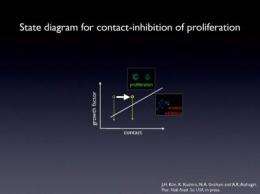
When Asthagiri and his colleagues studied the interplay between contact inhibition and EGF in groups of epithelial cells, they found that the cells have a threshold of sensitivity to EGF. If EGF levels dip below the threshold, contact inhibition takes hold and puts the brakes on cell division. But if EGF levels rise above the threshold, it overrides the effects of cell-cell contact and promotes cell division and tissue growth.
Both factors can potentially be manipulated--either to raise or lower the levels of growth factor or, as Asthagiri and colleagues showed in their paper, to raise or lower the contact-inhibition threshold.
In other words, Asthagiri explains, the team's research showed that it's possible to tune the system—to make cells more or less able to respond to a certain level of EGF by "playing with the extent of the contact the cells have with their neighbors."
One way to do that is to crowd the cells. "For instance," he says, "if you take a large number of cells and force them into the same area in which only a few cells are normally found, the cells become somewhat deaf to the growth factors. In order to get these cells to divide, you really have to crank up the level of growth factors they're exposed to."
You can achieve a similar result, Asthagiri adds, by creating cells that overexpress a protein called E-cadherin, which is a tumor suppressor protein that promotes adhesion of one cell to another. "This makes the cells less willing to divide," he notes, "which means they need a higher level of growth factor before they will divide."
The relationships between these competing influences "are really striking when you let them play out" under the influence of cell geography, says Asthagiri—that is, when the cells grow as a multicellular cluster. The reality is that not all cells in a cluster are exposed to the same amount of inhibition. For instance, the cells in the center of the group—pressed against other cells on all sides—will experience more contact, and will require a larger amount of growth factor if they are to overcome that inhibiting signal. The cells on the periphery of a cluster, on the other hand, get a relative whisper of an inhibitory signal; it doesn't take nearly as much growth factor to prompt those cells to divide.
Thus, it's possible to find a level of growth factor that will override the contact inhibition signal only for the peripheral cells, and then to find a second level that will allow division throughout the cluster. In other words, says Asthagiri, "You can tune the system; you can make the periphery grow more quickly relative to the rest of the area, or you can get the entire cluster to increase in size all at once."
"This is useful," he adds, "in thinking about how to engineer organs and tissues. I believe that this can become an important building block, a part of the tool set, that allows us to grow multicellular structures—and, ultimately, tissues—in specific, spatial ways."
And as for cancer? It's long been assumed that contact inhibition acts as a sort of switch that, when present, prevents tumor formation and, when absent, results in cell overgrowth and cancer. "Our findings support a more graded perspective of contact inhibition," the researchers write in the PNAS paper. Keeping in mind that cancer is often the result of an accumulation of genetic damage, they say, it seems likely that each "hit" to a cell's DNA might subtly lower the threshold at which EGF is capable of overriding contact inhibition to promote unbridled cell division and tumor growth.
"This tunability of the threshold amount of EGF," the researchers write, "would seem to be a fragility in cell cycle regulation that is exploited during cancer development."
Source: California Institute of Technology (news : web)


