Herschel's daring test: A glimpse of things to come
June 19, 2009 Herschel's daring test: A glimpse of things to come

Enlarge

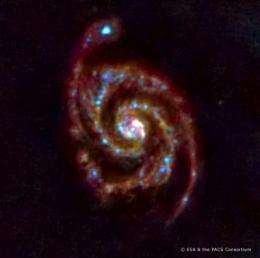
Red, green and blue correspond to the 160-micron, 100-micron and 70-micron wavelength bands of the Herschel’s Photoconductor Array Camera and Spectrometer, PACS. Glowing light from clouds of dust and gas around and between the stars is visible clearly. These clouds are a reservoir of raw material for ongoing star formation in this galaxy. Blue indicates regions of warm dust that is heated by young stars, while the colder dust shows up in red. Credit: ESA and the PACS Consortium

Herschel opened its 'eyes' on 14 June and the Photoconductor Array Camera and Spectrometer obtained images of M51, 'the whirlpool galaxy' for a first test observation. Scientists obtained images in three colours from the observation, which clearly demonstrate the superiority of Herschel, the largest infrared space telescope ever flown.

This image shows the famous 'whirlpool galaxy', first observed by Charles Messier in 1773, who provided the designation Messier 51 (M51). This lies relatively nearby, about 35 million light-years away, in the constellation Canes Venatici. M51 was the first galaxy discovered to harbour a spiral structure.

The image is a composite of three observations taken at 70, 100 and 160 microns, taken by Herschel's Photoconductor Array Camera and (PACS) on 14 and 15 June, immediately after the satellite's cryocover was opened on 14 June.

Herschel, launched only a month ago, is still being commissioned and the first images from its instruments were planned to arrive only in a few weeks. But engineers and scientists were challenged to try to plan and execute daring test observations as part of a 'sneak preview' immediately after the cryocover was opened. The objective was to produce a very early image that gives a glimpse of things to come.

The obvious advantage of the larger size of the telescope is clearly reflected in the much higher resolution of the images: Herschel reveals structures that cannot be discerned in a Spitzer image of M51.

These images clearly demonstrate that the shorter the , the sharper the image — this is a very important message about the quality of Herschel's optics, since PACS observes at Herschel's shortest wavelengths.

Produced from the very first test observation, these images lead scientists to conclude that the optical performance of Herschel and its large telescope is so far meeting their high expectations.

Source: (news : web)


print this article email this article download pdf blog this article bookmark this article     Stumble it Digg this share on Facebook retweet share on Reddit add to delicious
Rate this story - 4.7 /5 (25 votes)

Rank Filter

Move the slider to adjust rank threshold, so that you can hide some of the comments.


Display comments: newest first

  • omatumr - Jun 20, 2009
    • Rank: 2.3 / 5 (3)
    CONGRATULATIONS!

    The color codes suggest a great deal of diversity in the material around and between the stars.

    It may be an over-interpretation to say, "Blue indicates regions of warm dust that is heated by young stars."

    With kind regards,
    Oliver K. Manuel
    http://www.omatumr.com

  • omatumr - Jun 21, 2009
    • Rank: 2.3 / 5 (3)
    HETEROGENEOUS MATERIAL ALSO FORMED SOLAR SYSTEM

    a.) Primordial He is linked with excess Xe-136 in stone meteorites:
    See: "The enigma of helium and anomalous xenon," Icarus 41 (1980) 312-315 http://tinyurl.com/nu82de ; doi:10.1016/0019-1035(80)90014-7

    b.) Nucleogenetic isotopic anomalies in Mo isotopes of iron meteorites: See: http://tinyurl.com/mwsevr

    With kind regards,
    Oliver K. Manuel
    http://www.omatumr.com

June 19, 2009 all stories

Comments: 2

4.7 /5 (25 votes)
  • Stumble this up

  • Digg this

  • share this

  • hide
  • Related Stories

  • Hats Off to Space Day From NASA's Spitzer Space Telescope
    created May 05, 2005 | popularity not rated yet | comments 0
  • Hubble celebrates 15th anniversary
    created Apr 25, 2005 | popularity not rated yet | comments 0
  • Reaching the parts -- with Herschel and SPIRE
    created Apr 03, 2007 | popularity not rated yet | comments 0
  • Herschel, Planck cosmic explorers in flight: stunning images from ground and space
    created May 15, 2009 | popularity not rated yet | comments 0
  • Largest ever galaxy portrait - stunning HD image of Pinwheel Galaxy
    created Feb 28, 2006 | popularity not rated yet | comments 0


  • hide
  • Relevant PhysicsForums posts

  • Question about 2-body gravity
    created 19 hours ago
  • life on Mars
    created 21 hours ago
  • Semi-major axis from cartesian co-ordinates
    created Nov 23, 2009
  • Primary Mirror grinding
    created Nov 23, 2009
  • More from Physics Forums - General Astronomy

Other News

First black holes may have incubated in giant, starlike cocoons, says CU-Boulder study

First black holes may have incubated in giant, starlike cocoons

Space & Earth / Astronomy

created 14 hours ago | popularity 4.4 / 5 (10) | comments 15

(PhysOrg.com) -- The first large black holes in the universe likely formed and grew deep inside gigantic, starlike cocoons that smothered their powerful x-ray radiation and prevented surrounding gases from ...


Cassini Captures Ghostly Dance of Saturn's Northern Lights

Cassini Captures Ghostly Dance of Saturn's Northern Lights (w/ Video)

Space & Earth / Space Exploration

created 11 hours ago | popularity 5 / 5 (4) | comments 0

(PhysOrg.com) -- In the first video showing the auroras above the northern latitudes of Saturn, Cassini has spotted the tallest known "northern lights" in the solar system, flickering in shape and brightness ...


ET: Check your voicemail

ET: Check your voicemail

Space & Earth / Space Exploration

created 11 hours ago | popularity 3.4 / 5 (5) | comments 5

(PhysOrg.com) -- Alien beings on faraway planets may not have noticed, but it’s been 35 years since human beings made the first deliberate effort to send them a message.


Humanity would need five Earths to create the resources needed if everyone lived as like Americans, a report has stated

Mankind using Earth's resources at alarming rate

Space & Earth / Environment

created 20 hours ago | popularity 3.2 / 5 (13) | comments 19

Humanity would need five Earths to produce the resources needed if everyone lived as profligately as Americans, according to a report issued Tuesday.


Infrared Image of Circumstellar Disk Illuminates Massive Star Formation Process

Infrared Image of Circumstellar Disk Illuminates Massive Star Formation Process

Space & Earth / Astronomy

created 10 hours ago | popularity 4.5 / 5 (2) | comments 0

(PhysOrg.com) -- A team of astronomers from Ibaraki University, Japan Aerospace Exploration Agency, Kanagawa University, University of Tokyo, Academica Sinica, and National Astronomical Observatory of Japan ...