'Look Mom No Electricity': Transmitting Information with Chemistry
June 19, 2009 By Lisa Zyga 'Look Mom No Electricity': Transmitting Information with Chemistry

Enlarge

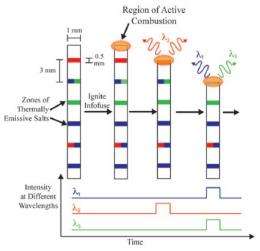
Burning an infofuse transmits a sequence of pulses of light, in which information is encoded using different wavelengths (determined by various metallic salts) and the order of the pattern. Image credit: Samuel W. Thomas III, et al. ©2009 PNAS.

(PhysOrg.com) -- While information technology is generally thought to require electrons or photons for transmitting information, scientists have recently demonstrated a third method of transmission: chemical reactions. Based on a flammable “infofuse,” the new system combines information technology and chemistry into a new area the researchers call "infochemistry."

In the study, led by George Whitesides of Harvard University, with other coauthors from Harvard, Tufts University, and DARPA, the scientists explain that their system transmits in the form of coded pulses of light generated entirely by , without electricity. The system is self-powered, with power being generated by combustion. The power density of the system is higher than that of electrochemical batteries, and has the advantage of not discharging over time.

As Whitesides explained to PhysOrg.com, the significance of the study is that it “demonstrates direct chemical to binary encoding, and transmission of information at a useful bit rate, without batteries.” The researchers hope that their prototype will one day make it possible to make systems that transmit useful information in circumstances in which electronics and batteries do not work, such as harsh environments and under water.

As the scientists explain, the system consists of a strip or fuse of combustible material (nitrocellulose) about 1 mm long. When ignited, a yellow-orange flame moves along the infofuse. To encode information, the scientists patterned the fuse with various metallic salts, which could be done using a desktop inkjet printer or a micropipettor. With their different emission wavelengths, the salts created distinct emission lines in different regions of the , similar to how the colors of fireworks are made: blue (copper), green (barium), yellow (sodium), red (lithium, strontium, calcium), or near-infrared (potassium, rubidium, cesium).

The infofuse, which burns at about 3-4 cm/sec depending on thickness and pattern spacing, is then read by a detector, such as a color CCD camera or fiber optic cable coupled to a spectrometer. The distance between the detector and burning infofuse was typically 2 m, but the detector could still detect a signal up to 30 m away in daylight.

By coding letters of the alphabet using patterns of metallic salts, the scientists transmitted the phrase, “LOOK MOM NO ELECTRICITY” on a single infofuse using the new technique. As the scientists explain, light pulses have several controllable variables that can be used to represent different letters and symbols. In addition to emission wavelength, other variables include pulse duration, time between pulses, and emission intensity. Using combinations of three alkali metals, the researchers demonstrated how to encode 40 different characters by varying some of these parameters.

“It needs a flame, but it does not need additional batteries or power, or auxiliary devices, to convert a chemical signal to a digital one,” Whitesides said. “The power needed to generate the light is produced by chemistry directly, not by drawing power from a battery.”

Although the current infofuses convert energy into light with only 1% of the efficiency of a battery-operated LED, the infofuses generate 10 times more energy per weight than an alkaline battery generates. In general, integrating and chemistry could have certain advantages, possibly leading to systems that operate beyond binary schemes by using a variety of parameters that allow each information unit to carry more information than a bit. Also, since infochemistry is not bound by the principles of electronics (such as fixed circuitry), but rather the principles of chemistry, new systems could lead to novel architectures.

The scientists hope that further improvements to their system could lead to lightweight, portable, self-powered systems that can transmit information and integrate with modern information technologies. Applications could include environmental sensing and transmitting the data optically over a distance. The system could also be used for message transmission in search-and-rescue type applications.

More information: “Infochemistry and infofuses for the chemical storage and transmission of coded information.” Samuel W. Thomas III, et al. Proceedings of the National Academy of Sciences. vol. 106, no. 23, 9147-9150.

Copyright 2009 PhysOrg.com.
All rights reserved. This material may not be published, broadcast, rewritten or redistributed in whole or part without the express written permission of PhysOrg.com.


print this article email this article download pdf blog this article bookmark this article     Stumble it Digg this share on Facebook retweet share on Reddit add to delicious
Rate this story - 4 /5 (13 votes)

Rank Filter

Move the slider to adjust rank threshold, so that you can hide some of the comments.


Display comments: newest first

  • h0dges - Jun 19, 2009
    • Rank: 3.5 / 5 (4)
    I'd have called it chemtronics.
  • Lord_jag - Jun 19, 2009
    • Rank: 3.8 / 5 (4)
    This message will distruct in 3 seconds... well maybe even sooner... As you hear this message, it is destructing.
  • NeilFarbstein - Jun 19, 2009
    • Rank: 2.3 / 5 (4)
    send DNA samples they contain information
  • E_L_Earnhardt - Jun 19, 2009
    • Rank: 1.7 / 5 (3)
    The military is going to LOVE you!
  • Ricochet - Jun 19, 2009
    • Rank: 2 / 5 (1)
    Well, hopefully the biochemical robots we create won't revolt like they did against the other 12 tribes...
  • zevkirsh - Jun 19, 2009
    • Rank: 3 / 5 (1)
    hm. bioluminescence beats this bigtime. sounds like an application for underwater communication. there already is one.......
    whales. the military should just make whales. or train them to do our bidding! neuromorphic brain implants......hey we can already steer beatles to fly the way we want.
  • Azpod - Jun 20, 2009
    • Rank: 3 / 5 (1)
    ? It's using the same concept as throwing various salts in the campfire to make a blue/green flame. How is this all that revolutionary?
  • kasen - Jun 20, 2009
    • Rank: 4.5 / 5 (4)
    "While information technology is generally thought to require electrons or photons for transmitting information, scientists have recently demonstrated a third method of transmission: chemical reactions."

    Right. The actual information is sent via photons, and read by CCD cameras, which, as I recall, need a flow of electrons to work. And how could a system that requires a flame(or oxidation, nevertheless) be more efficient than one that merely needs insulation underwater?
    Let's see a fully working sending, receiving and computing system based exclusively on chemical reactions, then we can talk about infochemistry. It's definitely an interesting research direction, though.
  • Palli - Jun 20, 2009
    • Rank: 3 / 5 (1)
    Kasen, my thoughts exactly!
    And if it doesn't discharge over time, it must be turned on at some point, how do you do that from a remote location? using batteries? :D ..or external lazer of some sort? And the range, 2 meters requiring a line of sight, how will this ever be useful?
  • MNIce - Jun 20, 2009
    • Rank: 4.8 / 5 (4)
    "How will this ever be useful?" Soldiers could use it to code insults into the explosives they fire at their enemies, although I doubt anyone will make the effort to read them anymore than they read the stuff scribbled on bomb casings. More seriously, this general idea could be used to mark solid rocket fuel - put pockets of coloring salts at various points and monitor the exhaust to verify burn patterns. A telescope and fast spectrometer would be needed to extract the data.
  • Haus - Jun 21, 2009
    • Rank: 3 / 5 (1)
    Cool, they used basic chemistry to improve the smoke signal. Ill have to call my native American buddies and let them know. lol

    On a serious note though, MNIce does have some good ideas. It may be useful after all.
  • Merkk - Jun 22, 2009
    • Rank: 4 / 5 (1)
    I am quite sure that there is something useful out of this research. But the only image I see is as follows: Person 1 printing out a secret message on his electricty using computer and printer. Person 1 notifies Person 2 (who is in the same room) that a message is about to be sent. Person 1 lights the paper on fire in full view of Person 2's CCD (using electricity) which is connected to his computer (more electricity). Person 2 decodes the message.

    It still is very novel, and I hope someone can do something with it. I'm just glad I'm not in charge of that cause I got nothing.
  • defunctdiety - Jun 22, 2009
    • Rank: 3 / 5 (1)
    Isn't the information here actually transmitted by light? "Generating Information with Chemistry" is what they should title it, and that's not very novel at all, infact it's the original information source (nerves). Is this info-fuse re-usable, can it be encoded "on the go", where is the practical application exactly?
  • socean - Jun 25, 2009
    • Rank: 3 / 5 (1)
    I think the basic premise of using chemical energy directly is sound. Can efficiencies be improved by reducing the scale? Perhaps oxidation is not the only reaction that could be harnessed. E.g. What would happen if the fuse were inside a nanotube? Perhaps the walls could be designed to detect the photons and "translate" them into electric signals. It seems to me this is a very promising line of basic research that will likely come to fruition when combined with other technologies.
  • Ricochet - Jun 26, 2009
    • Rank: 4 / 5 (1)
    I can see a potential use... you plug the "fuse" in to an optical port, and the "fuse", itself, is the encryption key. It's a one-shot deal. The key either matches or it doesn't.
  • BrianH - Jun 26, 2009
    • Rank: not rated yet
    It's obviously a "use once" option. You can't reset and re-use a burned thread!
  • Nekronomiv - Jun 30, 2009
    • Rank: 5 / 5 (1)
    This is the first attempt to code a chemical message and read it by interpreting light wavelengths - there are vast applications for this, such as reading a chemical reaction of two compounds form a distance. If you devised a measurement catalyst that reacted with different elements in different ways - we could simply launch a rocket into mars or another planet surface and read the results of the impending explosion on a sufficiently advanced recording device - telling you exactly the chemical makeup. No expensive robots to deploy. Just a high resolution camera in orbit.

    This is a very elementary example of a framework that has vast applications.
  • Ricochet - Jul 01, 2009
    • Rank: not rated yet
    Yes, nothing like blowing up the planets we're trying to investigate... hehe
  • medium - Jul 02, 2009
    • Rank: not rated yet
    Fire all the SETI grants and big paid scamming scientists. When pulsars were discovered, they thought the light pulses were extra-terrestial communications. They've wasted our taxpayer dollars on radio signals, when the proof on how to communicate advanced information through outer space is in chemical light pulses.

June 19, 2009 all stories

Comments: 19

4 /5 (13 votes)
  • Stumble this up

  • Digg this

  • share this

  • hide
  • Related Stories

  • New quantum key system combines speed, distance
    created Jun 09, 2007 | popularity not rated yet | comments 0
  • Liquid Battery Offers Promising Solar Energy Storage Technique
    created Mar 06, 2009 | popularity not rated yet | comments 0
  • Molecules of light pulses
    created Oct 12, 2005 | popularity not rated yet | comments 0
  • Information Storage in Three Dimensions
    created Mar 18, 2008 | popularity not rated yet | comments 0
  • Infrared Nanotube Films Offer Advantages for Solar Cells and More
    created Mar 11, 2009 | popularity not rated yet | comments 0


  • hide
  • Relevant PhysicsForums posts

  • Concentrating Household Ammonia
    created 7 hours ago
  • Structure of Dinitroacetylene
    created 7 hours ago
  • How do they melt carbon?
    created Nov 06, 2009
  • Urgent help needed for question on electrolysis & comparing Eo values
    created Nov 05, 2009
  • Ionic vs. Covalent
    created Nov 05, 2009
  • Gas that turn into liquid have a boiling point?
    created Nov 04, 2009
  • More from Physics Forums - Chemistry

Other News

Toward home-brewed electricity with 'personalized solar energy'

Toward home-brewed electricity with 'personalized solar energy'

Chemistry / Materials Science

created Nov 04, 2009 | popularity 3.4 / 5 (9) | comments 4

New scientific discoveries are moving society toward the era of "personalized solar energy," in which the focus of electricity production shifts from huge central generating stations to individuals in their ...


Scientists Reproduce a Building Block of Life in Laboratory

Scientists Reproduce a Building Block of Life in Laboratory

Chemistry / Biochemistry

created Nov 06, 2009 | popularity 4.8 / 5 (21) | comments 0

(PhysOrg.com) -- NASA scientists studying the origin of life have reproduced uracil, a key component of our hereditary material, in the laboratory.


Newly Discovered Fat Molecule: An Undersea Killer with an Upside

Newly Discovered Fat Molecule: An Undersea Killer with an Upside

Chemistry / Biochemistry

created Nov 05, 2009 | popularity 4.9 / 5 (8) | comments 0

(PhysOrg.com) -- A chemical culprit responsible for the rapid, mysterious death of phytoplankton in the North Atlantic Ocean has been found by collaborating scientists at Rutgers University and the Woods Hole ...


CU-Boulder map of human bacterial diversity shows wide interpersonal differences

Map of Human Bacterial Diversity Shows Wide Interpersonal Differences

Chemistry / Biochemistry

created Nov 05, 2009 | popularity 4.7 / 5 (11) | comments 0

(PhysOrg.com) -- A University of Colorado at Boulder team has developed the first atlas of bacterial diversity across the human body, charting wide variations in microbe populations that live in different ...


Mimicking nature, scientists can now extend redox potentials

Mimicking nature, scientists can now extend redox potentials

Chemistry / Biochemistry

created Nov 04, 2009 | popularity 4.8 / 5 (5) | comments 0

(PhysOrg.com) -- New insight into how nature handles some fundamental processes is guiding researchers in the design of tailor-made proteins for applications such as artificial photosynthetic centers, long-range ...