'Milking' microscopic algae could yield massive amounts of oil
June 19, 2009
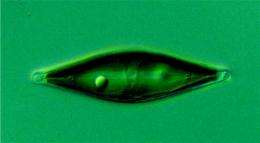
Microscopic diatoms like the one shown above could yield massive amounts of oil, scientists say. Credit: The American Chemical Society
Scientists in Canada and India are proposing a surprising new solution to the global energy crisis —“milking” oil from the tiny, single-cell algae known as diatoms, renowned for their intricate, beautifully sculpted shells that resemble fine lacework. Their report appears online in the current issue of the ACS’ bi-monthly journal Industrial Engineering & Chemical Research.
Richard Gordon, T. V. Ramachandra, Durga Madhab Mahapatra, and Karthick Band note that some geologists believe that much of the world’s crude oil originated in diatoms, which produce an oily substance in their bodies. Barely one-third of a strand of hair in diameter, diatoms flourish in enormous numbers in oceans and other water sources. They die, drift to the seafloor, and deposit their shells and oil into the sediments. Estimates suggest that live diatoms could make 10−200 times as much oil per acre of cultivated area compared to oil seeds, Gordon says.
“We propose ways of harvesting oil from diatoms, using biochemical engineering and also a new solar panel approach that utilizes genetically modifiable aspects of diatom biology, offering the prospect of “milking” diatoms for sustainable energy by altering them to actively secrete oil products,” the scientists say. “Secretion by and milking of diatoms may provide a way around the puzzle of how to make algae that both grow quickly and have a very high oil content.”
More information: Industrial & Engineering Chemistry Research, Journal Article: “Milking Diatoms for Sustainable Energy: Biochemical Engineering Versus Gasoline-Secreting Diatom Solar Panels”
-
NanoWorld: Nature Inspired Micro Circuits
Oct 13, 2005 |
not rated yet |
0
-
Scientists learning to create nanomaterials based on micro-algae patterns
Dec 07, 2006 |
not rated yet |
0
-
Mighty diatoms: Global climate feedback from microscopic algae
Mar 17, 2009 |
not rated yet |
0
-
Nature leads the way for the next generation of paints, cosmetics and holograms
Oct 03, 2007 |
not rated yet |
0
-
New species of diatom discovered
Dec 02, 2005 |
not rated yet |
0
-
Engineers build first sub-10-nm carbon nanotube transistor
Feb 01, 2012 |
4.9 / 5 (31) |
30
-
Something old, something new: Evolution and the structural divergence of duplicate genes
Jan 31, 2012 |
4.6 / 5 (7) |
1
-
The hidden nanoworld of ice crystals: Revealing the dynamic behavior of quasi-liquid layers
Jan 30, 2012 |
5 / 5 (3) |
1
-
Stock market network reveals investor clustering
Jan 27, 2012 |
3.9 / 5 (23) |
8
-
Of microchemistry and molecules: Electronic microfluidic device synthesizes biocompatible probes
Jan 26, 2012 |
5 / 5 (1) |
0
-
Stoichiometry
21 hours ago
-
Boiling and melting point of impure substances
22 hours ago
-
Safe nitrogen compound to decompose a 500 deg C in a furnace?
Feb 09, 2012
-
[ask]electron inside drinking water
Feb 08, 2012
-
How to avoid formation of Lithium Chromate ???
Feb 08, 2012
-
how to choose a reduced or oxidated form in a redox
Feb 08, 2012
- More from Physics Forums - Chemistry
More news stories
Fool's gold may prove an unlikely alternative to overexploited catalytic materials
Catalytic materials, which lower the energy barriers for chemical reactions, are used in everything from the commercial production of chemicals to catalytic converters in car engines. However, with current catalytic materials ...
12 hours ago |
4.3 / 5 (7) |
4
|
Unpicking HIV’s invisibility cloak
Drug researchers hunting for alternative ways to treat human immunodeficiency virus (HIV) infections may soon have a novel targetits camouflage coat. HIV hides inside a cloak unusually rich in a sugar ...
12 hours ago |
5 / 5 (4) |
0
No entry without protein recycling: Researchers discover new coherence in enzyme transport
The group of Prof. Dr. Ralf Erdmann at the Ruhr-Universität Bochum, Germany, discovered a connection of peroxisomal protein import and receptor export. In the Journal of Biological Chemistry, they disclo ...
12 hours ago |
not rated yet |
0
Hydrogen from acidic water: Researchers develop potential low cost alternative to platinum for splitting water
A technique for creating a new molecule that structurally and chemically replicates the active part of the widely used industrial catalyst molybdenite has been developed by researchers with the Lawrence Berkeley ...
Feb 09, 2012 |
5 / 5 (12) |
13
|
Under the microscope #7
In this video Dr Ingrid Graz shows us a thin layer of gold on top of rubber. Cracks in the gold allow it to stretch and we can use this for stretchable electronics.
14 hours ago |
not rated yet |
0
Google users warned of threat to smartphone wallets
Users of Google smartphone wallets were being warned on Friday that there is a way to crack pass codes intended to thwart thieves from going on illicit shopping sprees.
Anonymous knocks CIA website offline (Update)
The website of the Central Intelligence Agency was inaccessible on Friday after the hacker group Anonymous claimed to have knocked it offline.
New error-correcting codes guarantee the fastest possible rate of data transmission
Error-correcting codes are one of the triumphs of the digital age. Theyre a way of encoding information so that it can be transmitted across a communication channel such as an optical fiber o ...
Complex wiring of the nervous system may rely on a just a handful of genes and proteins
Researchers at the Salk Institute have discovered a startling feature of early brain development that helps to explain how complex neuron wiring patterns are programmed using just a handful of critical genes. ...
The power of estrogen -- male snakes attract other males
A new study has shown that boosting the estrogen levels of male garter snakes causes them to secrete the same pheromones that females use to attract suitors, and turned the males into just about the sexiest ...
Humans may have helped the decline of African rainforests 3000 years ago
(PhysOrg.com) -- Large areas of rainforests in Central Africa mysteriously disappeared over three thousand years ago, to be replaced by savannas. The prevailing theory has been that the cause was a change ...
Jun 19, 2009
Rank: 4 / 5 (5)
There is, however, a patented aquatic plant, Ninsei, that continuously produces and exudes (no milking needed) petroleum in commercially attractive quantities while overcoming all of the other drawbacks of growing aquatic organisms for oil.
Jun 19, 2009
Rank: 2.6 / 5 (5)
Jun 19, 2009
Rank: 5 / 5 (4)
I suspect that most algae harvests (single or multi-celled) will be grown and harvested at sea but between water treatment and superior locations, land based operations are not out of the question.
Jun 19, 2009
Rank: 3 / 5 (3)
Jun 19, 2009
Rank: 4.5 / 5 (2)
Jun 19, 2009
Rank: 5 / 5 (3)
Jun 22, 2009
Rank: 1 / 5 (1)
Just joking, this is actually pretty cool research.
Jun 22, 2009
Rank: not rated yet
Jun 22, 2009
Rank: not rated yet
Water coming from an algae pond is much cleaner than it was going in. It can be reused for algae production until it is too clean to provide any more nutrients, then the excess clean water will be sent on down the river. Doing this on the scale that is coming will clean up our rivers and clean up those notorious dead zones at the river mouths.
Jun 22, 2009
Rank: not rated yet