Athletes, spectators faced unprecedented air pollution at 2008 Olympic Games
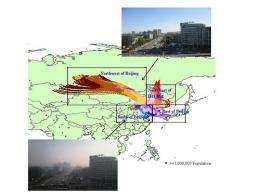
(PhysOrg.com) -- Particulate air pollution during the 2008 Olympic Games in Beijing constantly exceeded levels considered excessive by the World Health Organization, was far worse than other recent Olympic Games, and was about 30 percent higher than has been reported by Chinese environmental experts - even though some favorable weather conditions helped reduce the problem.
The weather, in fact, turned out to be more valuable in addressing this concern than major programs by the Chinese government to heavily restrict automobile use, close factories and slow construction during and before the Olympic games.
These findings are among the final results just published in Environmental Science and Technology, a professional journal, in the first comprehensive study of particulate air pollutants in Beijing and how they compared to past Olympics.
The research was done before, during and after the 2008 Olympics by scientists from Oregon State University and Peking University, in work funded by the National Science Foundation in the United States and the National Science Foundation of China.
"Considering the massive efforts by China to reduce air pollution in and around Beijing during the Olympics, this was the largest scale atmospheric pollution experiment ever conducted," said Staci Simonich, an OSU associate professor of environmental and molecular toxicology. "Despite all that, it was some evening rains and favorable shifts in the winds that provided the most relief from the pollution.
"This demonstrates how difficult it is to solve environmental problems on a short-term, local basis," she added.
And despite some favorable weather and the pollution control efforts, researchers said, the end result was some of the most severe particulate pollution that Olympic athletes have dealt with in recent games. The levels were about two to four times higher than that of Los Angeles on an average day.
In some of the first comparisons of these type ever made, scientists determined that particulate matter air pollution in the Beijing Olympics were about double the levels of recent games in Athens, Greece; triple those of Atlanta, Ga.; and 3.5 times higher than the games in Sydney, Australia. However, the study also noted that, because of its control efforts, Beijing had the most significant decrease in particular air pollution compared to the other Olympic sites around the time of their games.
Despite these efforts, levels of coarse particular matter were higher than considered safe by the World Health Organization 81 percent of the time during the Beijing Olympics. They reached unacceptable levels 100 percent of the time for the most dangerous particulate matter (smaller than 2.5 microns), which is more easily inhaled into the lungs and causes more serious health problems. Levels of the smaller, most harmful particulate matter was also the least affected by government efforts to reduce pollution output, the study concluded.
The finding of levels of pollution higher than those announced previously by Chinese officials reflects a difference in measurement methodology, researchers said, although the approaches used in this study have been widely accepted for many years.
The studies were initially prompted due to traditionally high levels of air pollution in Beijing and the potential risk they posed to athletes and spectators, Simonich said. The city of 17 million people is surrounded by mountains in several directions that trap air pollutants, and has faced significant increases in particulate air pollution in recent years due to increasing industrialization, numbers of automobiles, coal and biomass burning, and other causes.
Atmospheric particulate matter, researchers say, is a concern because various sized particles have potentially toxic chemicals "sorbed" to them. The fine particles have been linked to increased respiratory morbidity and mortality. In China, particulate matter air pollution is believed to be responsible for about one million premature deaths per year, researchers said in their study.
Of some note, the scientists said, is that efforts taken to constrain air pollution may be having a lasting value - particulate matter air pollution in Beijing was as much as 27 percent lower last fall than in the same months a year earlier. Some of this, however, may have been attributable to lower levels of industrial and economic activity.
Simonich said that there is no scientific evidence so far of any health problems that have been linked to the short-term exposure of athletes or spectators to this pollution during the Olympic competition.
"The athletes and visitors were only exposed for a very short time," Simonich said. "Millions of other people there face this air quality problem their entire lives. It was unlike anything I've ever seen - you could look directly at the sun and not have a problem, due to the thickness of the haze."
More information: pubs.acs.org/doi/full/10.1021/es9007504
Source: Oregon State University (news : web)


