Study advises Chinese government to change fuel in millions of households
June 19, 2009 Study advises Chinese government to change fuel in millions of households

Enlarge

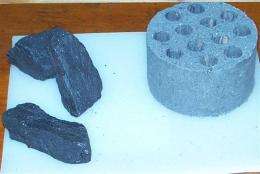
In an effort to reduce China's high air pollution levels, a new study recommends increased use of coal briquettes (right) in Chinese households instead of traditional coal chunks for heating and cooking. Credit: Yingjun Chen, Chinese Academy of Sciences.

Scientists in China are recommending that the Chinese government consider phasing out the direct burning of traditional chunks of coal in millions of households. It suggests that the government substitute coal briquettes and improved stoves for cooking and heating to help reduce the country’s high air pollution levels.

The recommendation stems from one of the first scientific studies showing that this approach is effective in improving , including a 98 percent reduction in air pollution from tiny, inhalable particles of soot. Their study is scheduled for the July 15 issue of ACS’ Environmental Science & Technology.

In the new study, Yingjun Chen and colleagues note that government officials have said for years that coal briquettes and improved stoves with better ventilation may cut emissions, but few scientific studies have tested this claim. Millions of homes in rural China and other parts of the world burn raw coal chunks in small, low-efficiency stoves for cooking and heating. Studies indicate that emissions from incomplete coal combustion in these stoves contribute significantly to China’s serious levels — among the highest in the world.

The scientists compared emissions between traditional and improved stoves using either raw (unprocessed) coal chunks or coal briquettes. The briquettes consist of coal powder and clay and are molded into multihole columns. They found that burning briquettes in well-ventilated stoves dramatically reduced black carbon emissions by 98 percent and other emissions by more than 60 percent. The study concludes that this approach can bring about “explicit benefits in environment and health, together with possible gains in climate stabilization.”

More information: Environmental Science & Technology, Journal Article: “Deployment of Coal Briquettes and Improved Stoves: Possibly an Option for both Environment and Climate”

Provided by American Chemical Society (news : web)


print this article email this article download pdf blog this article bookmark this article     Stumble it Digg this share on Facebook retweet share on Reddit add to delicious
Rate this story - 5 /5 (6 votes)

Rank Filter

Move the slider to adjust rank threshold, so that you can hide some of the comments.


Display comments: newest first

  • omatumr - Jun 20, 2009
    • Rank: 1 / 5 (2)
    NOW ALL WE NEED IS MORE GOVERNMENT CONTROL

    Scientists receiving government funds discovered "that burning briquettes in well-ventilated stoves dramatically reduced black carbon emissions by 98 percent and other emissions by more than 60 percent" and concluded that this can bring about "explicit benefits in environment and health, together with possible gains in climate stabilization."

    How about just using "well-ventilated stoves" to burn whatever fuel one is currently burning?

    Or does the Chinese government also own the factory making coal briquettes?

    Should coal briquettes be produced in "well-ventilated" government factories?

    Apparently members of the Chinese Academy of Sciences have also learned how to sleep with politicians.

    With kind regards,
    Oliver K. Manuel
    http://www.omatumr.com/

  • Nemo - Jun 20, 2009
    • Rank: 5 / 5 (2)
    Government control can be a very good thing if the government is wise. In this case trying to stop the Chinese people from harming themselves seems like an excellent idea.
  • omatumr - Jun 20, 2009
    • Rank: 1 / 5 (1)
    HOW DOES A RABBIT DIG A HOLE WITHOUT
    LEAVING ANY DIRT AROUND THE OPENING?

    Government control can be a very good thing if the government is wise. In this case trying to stop the Chinese people from harming themselves seems like an excellent idea.


    When bureaucrats become wise, . . . . they will

    a.) Understand that "well-ventilated" processes are those that dump pollution directly into air, and

    b.) Ask how clean-burning coal briquettes are made from dirty coal without polluting air.

    THE RABBIT STARTS AT THE BOTTOM AND DIGS UP!

    With kind regards,
    Oliver K. Manuel
    http://www.omatumr.com/
  • SteveS - Jun 21, 2009
    • Rank: not rated yet
    I Agree with Nemo.

    A fine example of "MORE GOVERMENT CONTROL" is the 1956 Clean Air Act in Britain. This was prompted by the London Smog Disaster of 1952 which killed 4000 people in ten days.

    This Act was directed at domestic and industrial sources of smoke pollution, authorising local councils to set up smokeless zones and make grants to householders to convert their homes from traditional coal fires to heaters fuelled by gas, oil, smokeless coal or electricity.

    There was initial resistence to the legislation as some people resented being told what they could or couldn't do in there own homes, but few now doubt that this level of regulation of both private and commercial smoke emissions was necessary.


  • Honor - Jun 22, 2009
    • Rank: not rated yet
    i need to invest in chinese coal briquettes

June 19, 2009 all stories

Comments: 5

5 /5 (6 votes)
  • Stumble this up

  • Digg this

  • share this

  • hide
  • Related Stories


  • hide
  • Relevant PhysicsForums posts

  • cycles
    created 14 hours ago
  • The Origin of the term 'fossil' fuels
    created Nov 05, 2009
  • co2
    created Nov 03, 2009
  • Early Earths Sulfidic Ocean Conditions
    created Oct 30, 2009
  • More from Physics Forums - Earth

Other News

Deep creep means milder, more frequent earthquakes along Southern California's San Jacinto fault

Deep creep means milder, more frequent earthquakes along Southern California's San Jacinto fault

Space & Earth / Earth Sciences

created 13 hours ago | popularity 4.7 / 5 (3) | comments 0

With an average of four mini-earthquakes per day, Southern California's San Jacinto fault constantly adjusts to make it a less likely candidate for a major earthquake than its quiet neighbor to the east, the ...


Success in 'space elevator' competition (AP)

Success in 'space elevator' competition (Update 3)

Space & Earth / Space Exploration

created Nov 05, 2009 | popularity 4.3 / 5 (33) | comments 50

(AP) -- A robot powered by a ground-based laser beam climbed a long cable dangling from a helicopter on Wednesday to qualify for prize money in a $2 million competition to test the potential reality of the ...


In a Galaxy Far, Far Away...

In a Galaxy Far, Far Away...

Space & Earth / Astronomy

created Nov 06, 2009 | popularity 4.8 / 5 (5) | comments 17

(PhysOrg.com) -- Astronomers have published the discovery of the farthest known object in the cosmos: a star that exploded when the universe was only 630 million years old -- only 4.6% of its current age. ...


'Dropouts' pinpoint earliest galaxies

'Dropouts' pinpoint earliest galaxies

Space & Earth / Astronomy

created Nov 06, 2009 | popularity 4.2 / 5 (10) | comments 13

Astronomers, conducting the broadest survey to date of galaxies from about 800 million years after the Big Bang, have found 22 early galaxies and confirmed the age of one by its characteristic hydrogen signature ...


Space hotel taking bookings for 2012 opening

Space hotel taking bookings for 2012 opening

Space & Earth / Space Exploration

created Nov 05, 2009 | popularity 4.4 / 5 (21) | comments 11

(PhysOrg.com) -- The first orbiting space hotel is on track to open for its first customers in 2012, but hurry, as bookings are filling fast.