Google tricycle snaps views from Philly campus
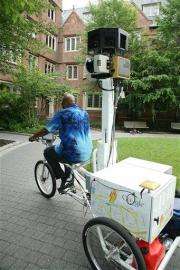
(AP) -- Coming soon to a campus near you - the Google tricycle.
A pedicab-like vehicle mounted with an 8-foot-high camera has been rolling around the pedestrian walkways of the University of Pennsylvania to collect panoramic images of the campus for Google Maps' Street View feature, which gives users detailed, street-level views of map locations over the Internet.
Google Inc. has been using car-mounted cameras to prowl streets in the U.S. and around the world. The human-powered version allows coverage of pedestrian-only areas on campuses, in public parks and at theme parks, as well as along hiking and bicycling trails, as Google seeks to expand coverage of its maps.
The effort comes as Google faces complaints from many individuals and institutions that have been photographed around the world. Since launching in 2007, Street View has expanded to more than 100 cities worldwide.
Danny Sullivan, editor-in-chief of the industry news site Search Engine Land, called the new effort a good public relations move by Google.
"This is a nice way for them to say 'Hey, look, Street View: It's really warm and fuzzy,'" he said. "It's not just about taking pictures of people's houses. We can find these footpaths that people want to go on and walking areas, places people will like."
Officials say the photos of Penn's tree-lined Locust Walk mall and other places will allow prospective students and their parents to get a good feel for the campus, give incoming students a way to map out the best route to their classes - and let alumni fondly remember their school days.
"We see this as an opportunity ... for people to see as much of Penn as possible from their computer," said Marie Witt, University of Pennsylvania vice president for business services. "Students can show their parents where they're living, where the student union is, where their favorite classroom building is."
The 250-pound vehicle, which resembles the pedicabs that carry tourists around Philadelphia and other cities, has the cyclist pumping the pedals up front, with the camera mounted on a tower in the back. On the rear is a red generator along with a large white chest that looks like it might dispense ice cream but actually contains the computer recording the digital images.
On Friday, the tricycle trundled through the Ivy League school quads enclosed by student housing buildings and along campus footpaths, drawing stares from students and employees.
"I think it's fantastic," said Caitlin Hanrahan, 28, a nursing student. "This campus is really confusing ... and when you try and explain to people how to get to the building, people get lost all the time. I think something like that, where you can see a picture of it and what you have to walk through to get there, would actually be really helpful.
Lyndsey Hauck, 25, eating Chinese takeout on a bench in front of a green campus pond, dove for her cell phone to grab a picture as the tricycle apparatus swooped by, ignored by ducks and turtles even after it got stuck on the path and needed a slight push.
"Pretty cool - always kind of interested in how they've done it, so now we know," said her companion, Cody Strohl, 29, also a Penn employee.
The tricycle has also been cruising around other colleges and universities, including Penn State, San Diego State and the University of San Diego, Google spokesman Sean Carlson said.
It has also been seen cruising past Rome's Trevi fountain, at Santa Monica's Third Street promenade and pier and along a Monterey, Calif. bicycle trail. Soon, views will be featured from along walkways of theme parks such as Legoland near Carlsbad, Calif., Carlson said.
In other countries, privacy concerns have been raised about the images.
Mountain View, Calif.-based Google this week acceded to German demands to erase the raw footage of faces, house numbers, license plates and individuals who have told authorities they do not want their information used in the service.
Last month, Greek officials rejected a bid to photograph the nation's streets until more privacy safeguards are provided. In April, residents of one English village formed a human chain to stop a camera van, and in Japan the company agreed to reshoot views taken by a camera high enough to peer over fences.
Witt said university officials escorting the Google teams around campus were working to make sure privacy concerns were addressed. The company says faces and license plates will be blurred, and anyone can quickly flag for removal images they consider inappropriate by clicking a box on the bottom of each page.
One of the tricycle operators, Martin D.F. Angelo, 27, said the camera occasionally gets a leery reaction from older people but seems universally embraced by the young.
"The biggest disappointment that most people seem to voice is that we're actually going to blur out their faces," he said, "so they're not going to be Internet-famous or something like that."
©2009 The Associated Press. All rights reserved. This material may not be published, broadcast, rewritten or redistributed.


