THE INFLUENCE GAME: Excuse me! Lobby wins on burps
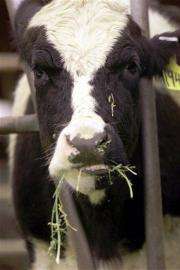
(AP) -- One contributor to global warming - bigger than coal mines, landfills and sewage treatment plants - is being left out of efforts by the Obama administration and House Democrats to limit greenhouse gas emissions.
Cow burps.
Belching from the nation's 170 million cattle, sheep and pigs produces about one-quarter of the methane released in the U.S. each year, according to the Environmental Protection Agency. That makes the hoofed critters the largest source of the heat-trapping gas.
In part because of an adept farm lobby campaign that equates government regulation with a cow tax, the gas that farm animals pass is exempt from legislation being considered by Congress to limit greenhouse gas emissions.
The EPA under President Barack Obama has said it has no plans to regulate the gas, even though the agency recently included methane among six greenhouse gases it believes are endangering human health and welfare.
The message circulating in Internet chat rooms, the halls of Congress and farm co-ops had America's farms facing financial ruin if the EPA required them to purchase air-pollution permits like power plants and factories do. The cost of those permits amounted to a cow tax, farm groups argued.
"It really has taken on a life of its own," said Rick Krause, a lobbyist with the American Farm Bureau Federation, which coined the term cow tax and spread it to farmers across the country. "This is something that people understand. All that we have to say is that (cows) are the next step with these proposed permit fees. And people are still talking about it."
Administration officials and House Democratic leaders have tried to assure farm groups that they have no intention of regulating cows. That effort, however, has done little to ease the concern of farmers and their advocates in Congress about the toll that regulating greenhouse gases will have on agriculture.
Lawmakers and farm groups are now pressing for the climate legislation to guarantee that farmers will be compensated for taking steps to reduce greenhouse gases. That could lead to farmers getting paid if their cows pass less gas.
Research has shown that changing cattle diet and boosting efficiency - such as producing the same amount of milk and beef from a smaller herd - can result in less gas, according Frank M. Mitloehner, an associate professor at the University of California at Davis, who has studied livestock gas for 15 years.
"I don't think livestock should be ignored. Every industry has to play their role," Mitloehner said. But laws designed to reduce emissions from smokestacks and tailpipes won't work with cattle, which can't be fitted with pollution control devices, Mitloehner said.
"The belching is very hard to collect," he said. "You cannot capture these gases."
The climate bill specifically excludes enteric fermentation - the fancy term for the gas created by digestion and expelled largely by burping - from the limit it would place on greenhouse gas emissions. The legislation directs the EPA not to include it among the various sources that could be subject to new performance standards.
EPA administrator Lisa Jackson has called rumors of the cow tax "ridiculous notions" and a "distraction."
On Thursday, Rep. Todd Tihart, R-Kan., successfully added an amendment to the spending bill that covers the EPA to block the agency from including biological processes of livestock - including the release of methane - as part of regulating greenhouse gases.
House aides and EPA officials say that controlling such emissions is unworkable. Cow burps make up about 2 percent of all the climate-altering pollution in the U.S.
But allies of farmers in Congress say the reluctance to step in the cow tax debate has a lot to do with the outcry from the agriculture industry and moderate Democrats from rural states whose votes are needed to pass the bill.
"I think they realized that if you are a Democrat in an agricultural state, a red state, that this is radioactive and I think that is why they have tried scrupulously to reaffirm that they don't have any intention of doing this," said Sen. John Thune, R-S.D. He is sponsoring a bill that would bar the EPA from requiring farmers to get permits for cattle burps.
Thune, whose state is home to a half-million cattle, first heard about the cow tax at a South Dakota Cattlemen Association's conference in early December. Within weeks he introduced his bill and recruited support from New York Democratic Sen. Chuck Schumer, whose state boasts three times more cows.
The origins of the cow tax can be traced to last July, when President George W. Bush's EPA released documents outlining how the Clean Air Act could regulate greenhouse gases.
Even though the Bush administration had no intention of using the law, farm groups seized on a single paragraph deep in the comments from various federal agencies. The Agriculture Department warned that if EPA decided to regulate agricultural sources of greenhouse gases, numerous farms would face costly and time-consuming process to acquire permits for barnyard burping.
The Farm Bureau quickly did the math and figured farms would have to pay about $175 for each dairy cow, $87.50 per head of beef cattle and $20 for each hog to purchase permits for emissions.
The cow tax was born.
---
On the Net:
Environmental Protection Agency: http://www.epa.gov/
Agriculture Department: http://www.usda.gov
American Farm Bureau Federation: http://www.fb.org/
Sen. Thune's release: http://tinyurl.com/n6z52s
©2009 The Associated Press. All rights reserved. This material may not be published, broadcast, rewritten or redistributed.


