Large Hadron Collider restart delayed till October
June 20, 2009
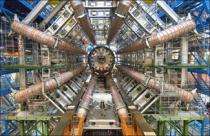
Large Hadron Collider. Photo: CERN
(AP) -- The world's largest atom smasher will likely be fired up again in October after scientists have carried out tests and put in place further safety measures to prevent a repeat of the faults that sidelined the $10 billion machine shortly after startup last year, the operator said Saturday.
The Large Hadron Collider was meant to restart in late September, but that will probably be pushed back two to three weeks, a spokesman for the European Organization for Nuclear Research said.
"We're pretty confident about the dates," James Gillies told The Associated Press, adding that scientists believe they understand the error that happened last year and how to prevent it occurring again.
An electrical fault caused by a faulty splice in the wiring shut down the giant machine on Sept. 19, nine days after it was started up with great fanfare.
The 20-nation operator, known as CERN, expects repairs and additional safety systems to cost about 40 million Swiss francs ($37 million) over the course of several years, Gillies said.
Once it is running, scientists will use the machine to smash together protons from hydrogen atoms inside a 27-kilometer (17-mile) circular tunnel under the Swiss-French border near Geneva. By recording what particles are produced by the collisions they hope to better understand the makeup of the universe and everything in it.
©2009 The Associated Press. All rights reserved. This material may not be published, broadcast, rewritten or redistributed.
-
Particle accelerator to be ready in '07
Dec 16, 2006 |
not rated yet |
0
-
LHC to Restart in 2009
Dec 08, 2008 |
not rated yet |
0
-
Physics world shifts focus to Switzerland
Sep 06, 2007 |
not rated yet |
0
-
Probing Question: Could the Large Hadron Collider swallow the Earth?
Jan 21, 2009 |
not rated yet |
0
-
The story of a 27km long machine and the fundamental building blocks of the Universe
Sep 07, 2006 |
not rated yet |
0
-
Engineers build first sub-10-nm carbon nanotube transistor
Feb 01, 2012 |
4.9 / 5 (29) |
30
-
Something old, something new: Evolution and the structural divergence of duplicate genes
Jan 31, 2012 |
4.6 / 5 (7) |
1
-
The hidden nanoworld of ice crystals: Revealing the dynamic behavior of quasi-liquid layers
Jan 30, 2012 |
5 / 5 (3) |
1
-
Stock market network reveals investor clustering
Jan 27, 2012 |
3.9 / 5 (23) |
8
-
Of microchemistry and molecules: Electronic microfluidic device synthesizes biocompatible probes
Jan 26, 2012 |
5 / 5 (1) |
0
-
How physicists handle the idea of Free Will?
1 hour ago
-
Orbital Decay Question
2 hours ago
-
Pure energy
7 hours ago
-
How to remove the magnetic property for screw driver?
10 hours ago
-
How to magnetize a concrete wall?
14 hours ago
-
Upward speed of an object in water
15 hours ago
- More from Physics Forums - General Physics
More news stories
Borexino Collaboration succeeds in spotting pep neutrinos emitted from the sun
(PhysOrg.com) -- To learn more about how the sun works, scientists study particles that are emitted from it into space due to thermonuclear reactions that occur inside; by applying known physics principles, ...
Physics research suggests new pathways for cancer progression
Observing that certain cancer cells may exhibit greater flexibility than normal cells, some scientists believe that this capability promotes rapid tumor growth. Now computer simulations developed by Boston University Biomedical ...
2 hours ago |
5 / 5 (1) |
0
Explained: Sigma
It's a question that arises with virtually every major new finding in science or medicine: What makes a result reliable enough to be taken seriously? The answer has to do with statistical significance -- but ...
4 hours ago |
5 / 5 (5) |
2
Physicists build highly efficient 'no-waste' laser
A team of University of California, San Diego researchers has built the smallest room-temperature nanolaser to date, as well as an even more startling device: a highly efficient, "thresholdless" laser that ...
23 hours ago |
5 / 5 (17) |
5
|
Transparent iron? For the first time, an experiment shows that atomic nuclei can become transparent
At the high-brilliance synchrotron light source PETRA III, a team of DESY scientists headed by Dr. Ralf Röhlsberger has succeeded in making atomic nuclei transparent with the help of X-ray light. At the ...
23 hours ago |
5 / 5 (9) |
3
|
Model analyzes shape-memory alloys for use in earthquake-resistant structures
Recent earthquake damage has exposed the vulnerability of existing structures to strong ground movement. At the Georgia Institute of Technology, researchers are analyzing shape-memory alloys for their potential ...
New Kindle Touch is an impressive e-reader
When it comes to reading digital books, tablets are all the rage. But there's a lot to like about simple e-readers, which over the past year have become both a lot cheaper and a lot less clunky.
Genetic risks for type 2 diabetes span multiple ethnicities
A recent large and comprehensive analysis of 50,000 genetic variants across 2,000 genes linked to cardiovascular and metabolic function has identified four genes associated with type 2 diabetes (T2D) and six independent disease-associated ...
Digital photos could put kids at risk
A study published in the International Journal of Electronic Security and Digital Forensics this month suggests that parents and carers could be putting children at risk if they upload digital photos that are automatically "geota ...
Ocean warming causes elephant seals to dive deeper
Global warming is having an effect on the dive behaviour and search for food of southern elephant seals. Researchers from the Alfred Wegener Institute for Polar and Marine Research in the Helmholtz Association cooperating ...
New battery could lead to cheaper, more efficient solar energy
A joint research project between the University of Southampton and lithium battery technology company REAPsystems has found that a new type of battery has the potential to improve the efficiency and reduce the cost of solar ...
Jun 20, 2009
Rank: 1 / 5 (3)
Jun 20, 2009
Rank: 1 / 5 (2)
Jun 20, 2009
Rank: 4.4 / 5 (7)
Jun 20, 2009
Rank: 1.3 / 5 (13)
Jun 20, 2009
Rank: 5 / 5 (10)
For a more detailed summary of the technical details containing numerous references, see http://cern.ch/ls...port.pdf
Bottom line: Cosmic-ray proton-proton collisions at _MUCH_ higher energies have been occurring in the Universe and even within the Earth's own atmosphere for many billions of years --- yet the Universe is still here, and the Earth is still here. Therefore, the alleged `risk' is quite literally ASTRONOMICALLY SMALL. Anyone who thinks otherwise has not studied the relevant physics --- they've been reading propaganda from ignorant scaremongers who have no clue what they are talking about because their `knowledge' of `physics' comes from from comic books and bad fiction novels.
Jun 20, 2009
Rank: 3.3 / 5 (6)
Jun 21, 2009
Rank: 4.3 / 5 (3)
Jun 21, 2009
Rank: 2 / 5 (8)
Jun 21, 2009
Rank: 1 / 5 (1)
Bwahahahahaha!
Jun 21, 2009
Rank: 4.2 / 5 (5)
There's a probability for you to turn in to a giant elephant right now, you better kill yourselves before you suffer such a horrible incident, please.
Jun 21, 2009
Rank: 5 / 5 (4)
Read the report. As SpeakerToWolves said, it includes all relevant risks if it is comparing with what is already happening on higher energy scales and flows.
You ask how these things correlate. These are independent collisions, so already included by cosmic ray sources also being independent. This is also already happening with no ill effects.
But if you want to do the effort, that statistical independence should clue us in on how to do the math.
[Hint: The risk when multiplying ASTRONOMICALLY SMALL risks together is on the order of ASTRONOMICALLY SMALL^2, which is ASTRONOMICALLY SMALLer than the already ASTRONOMICALLY SMALL risk from each.]
Jun 21, 2009
Rank: 5 / 5 (1)
[I put these as 'risks', because probabilities that aren't certain to be observable during a universe lifetime seems to me need some analysis to make sure they are meaningful, as the scaremongers and their supporters happily consider. If they exist, do we imply that we live in a multiverse? Or are the distributions existing just on the principle that these frequencies are in principle observable?]
Jun 21, 2009
Rank: 1 / 5 (6)
My only problem is, why LHC was allowed to upgrade at all without such analysis. Now the civilization has only minimal control over further evolution of LHC experiments by now.
Jun 21, 2009
Rank: 4 / 5 (1)
That changes the energy (and momenta), but again are well covered what is already happening at larger energy and momenta.
Jun 21, 2009
Rank: 1 / 5 (6)
OK, I will try to give you an cheap & easy hint, how it could be really working in my broken English: cosmic ray protons are 10E{18} times more energetic, then LHC protons, right?
But the cosmic ray protons are colliding with stratosphere matter, which is 10E{6} thinner, then the underground of LHC. This increases a risk by six oders of magnitude or so.
Furthermore, the protons of cosmic ray are individual particles. But LHC protons are coming in bunches of 10E{6} higher proton density and frequency. This increases a risk by another six oders of magnitude or so.
In addition, the effective crossection is diminished by non-zero rest momentum toward Earth by six orders of magnitude. But at the case of head-to-head proton collisions the resulting momentum and velocity of products of collision may be zero, so they would have a lotta time to interact with their neighborhood. This increases a risk of disaster by another six orders of magnitude or so.
In such way, we have 10E{18} times increased risk of black hole formation for LHC collisions with compare to cosmic rays in stratosphere without any problem.
Now the only remaining question is: are the LHC proponents so giant trolls, they didn%u2019t even realize it - or they ignore this risk analysis purportedly? In both cases such people are simply incompetent to control such sort of experiments.
Jun 21, 2009
Rank: 5 / 5 (3)
The analysis you ask for is already done, you should deal with it.
Jun 21, 2009
Rank: 1 / 5 (6)
Jun 21, 2009
Rank: 5 / 5 (3)
Jun 21, 2009
Rank: 1 / 5 (6)
The muon pairs formation during recent Tevatron experiments in Fermilab well outside of collider pipe may be related to recent pentaquark and tetraneutron evidence and it can demonstrate the stabilization of large matter clusters via supersymmetry and the danger of strangelet formation.
We can understand the dark matter, WIMPS and supersymmetric bosons as a surface tension effects of gravitational field. At the case of large distances / energy densities the energy density of space-time curvature near large particle or galactic clusters can become a dominant force, because it manifests itself as a additional mass density of vacuum with antigravity effects.
In particular, the formation of tiny dense particle clusters can stabilize the exotic forms of matter due the hydrostatic pressure inside of tiny particle droplets like the neutrons inside of neutron stars or atom nuclei by such way, these droplets can escape from collider pipe and they can start the avalanche conversion of normal matter to another strangelets under development of giant explosion, which could vaporize a substantial portion of Earth.
Therefore the latests Fermilab results should serve as a very last warning of people before high energy LHC experiments planned. The confirmation of supersymmetry could become a supersymmetric event for science as well: the best triumph of mainstream science and it%u2019s very last mistake at the same moment.
Jun 21, 2009
Rank: 1 / 5 (5)
I'm just saying: here are aparent safety risks following from these points:
1) head2head collisions, zero momentum of products toward Earth, they%u2019ve a lotta time to interact with it
2) multiparticle collisions: when some piece of heavy matter appears in the accelerator line, the whole content of LHC will feed it by new matter
3) proximity of dense environment with compare to stratospheric collisions of gamma rays
4) the strong possibility of formation of charged and magnetic black hole. As we know, real black holes have always charge and they rotate rapidly. But only gravitational interactions were considered so far, while gravity is way, way weaker, then EMG forces..
5) The surface tension effects of large dense particle clusters, which CAN stabilize the unstable forms of mater and interact with atom nuclei
6) The risk connected with formation of dense clusters of quite common neutral particles, which are stable well outside from LHC energy range, like the neutrons.
None such effect were mentioned in your security report. So I just want to see all of these risk factors reviewed and estimated in relevant probability analysis.
Jun 21, 2009
Rank: 1 / 5 (4)
Jun 21, 2009
Rank: 1 / 5 (5)
Jun 21, 2009
Rank: 2.3 / 5 (3)
You could do the most detailed safety study in the world but it still wont cover everything.....
Especially mystical entities like black holes, dark matter and dark energy...
Jun 21, 2009
Rank: 4.7 / 5 (3)
Here it is again for convenience:
http://public.web...-en.html
Jun 21, 2009
Rank: 4.5 / 5 (4)
However your density worry is unfounded. Cosmic rays hit the moon, too, which takes matches density of the earth.
Furthermore cosmic rays hit white dwarfs, which are roughly six orders of manitude DENSER than the earth.
And white dwarfs survive at least long enough to cool down, and only seem to explode if matter is added to them to reach their limit of 1.4 solar masses.
And neutron stars are far denser even than white dwarfs. So cosmic rays with an energy eight orders of manitude higher than CERN can acheive (or 100 times higher than the entire bunch of protons) regularly smack into neutron stars roughly 14 orders of magnitude denser than the ground around CERN. And any resulting strangeness, even though initially moving near the speed of light, would slow down very quickly (in the first millimeter of the neutron star) and would have plenty of matter to munch on if it were hungry.
Since neutron stars survive cosmic ray bombardment long enough for their spins to slow down, CERN is not going to destroy the world.
Jun 21, 2009
Rank: 5 / 5 (2)
Exactly! Batman, Superman and Peter Pan included! You name it.. ;o)
Now back to topic:
I think that the risk of black holes @ LHC can be safely excluded as those are only stable and/or able to gain mass at 2 very distant scales. One being at sub-atomic level (limited by what some call "neutron" repulsion force). And the other one being somwhere around 3-4 times the mass of our sun, compressed by star implosion below a specific critical radius (overcomming the repulsion). Meaning that at "our scale", even if there was a BH created, it would either last VERY shortly (and "decay") or it would not be able to gain any more mass as of the above mentioned repulsion force "not letting" any more mass to come close enough.
As for the momentum of the collisions being "non-zero" towards Earth - that is plainly impossible as it would require a perfect collision of perfectly identical particles, which is not going to happen. There will allways be rest momentum, and no 2 collided proton pairs will be the same.
So, in my humble opinion, if LHC is gonna destroy the world, it should not be by a BH :)
Jun 21, 2009
Rank: 2 / 5 (2)
Jun 22, 2009
Rank: 1.8 / 5 (4)
I can't wait for your next raving fit!
:-)
Jun 22, 2009
Rank: 4 / 5 (1)
The only fact, is no one knows exactly all the outcomes. Good or bad has nothing to do with it.
Built to prove or disprove theories and assumptions that have yet to be backed by any solid, consistent real world proof about what actually is taking place or will take place inside the LHC at its highest energy level.
Accept all potential outcomes as neutral until real and consistent data/proof takes place from the LHC itself.
Jun 22, 2009
Rank: 1 / 5 (4)
http://www.space....513.html
Before some years scientist believed, something like cold fusion is virtually impossible due the high potential barrier. And what happenned? Watch the video here...
http://www.lenr-c...Navy.htm
Jun 22, 2009
Rank: 1 / 5 (3)
Jun 22, 2009
Rank: 1 / 5 (4)
btw The life on surface of neutron stars is more safe with respect of possible strangelet impact. Magnetosphere of neutron stars behaves like Earth atmosphere with respect of meteorites or solar radiaton. Every faster charged particle would evaporate in contact with magnetosphere immediatelly well before it can reach the surface.
http://imgsrc.hub..._gif.gif
Jun 22, 2009
Rank: 3 / 5 (1)
Jun 23, 2009
Rank: 3 / 5 (1)
As for the people worried so much about charged black holes-how much charged black holes have you seen? How much event horizons has anybody seen? The answer of both things is ZERO. When I see a convincing evidences that this mathematical object called a black hole exist, then I'll worry about the possible creation of such black holes in LHC.
Jun 23, 2009
Rank: 1 / 5 (1)
Jun 24, 2009
Rank: 4 / 5 (1)
But you don't worry about that. You worry about black holes-objects that only popular press "really" know what they are and what they can do. The scientists are much less sure about them and they will continue to be unsure until gravitational wave detectors catch something (anything?!). Yes, there are astrophysical objects that look like black holes, but the key moments in black holes are the event horizon and the singularity in the centre-until we see them (or at least the first), these heavy objects are not black holes, but dark heavy objects. And since the space is full of dark heavy objects, I don't see a reason why we should freak out we could create a miniature versions of them.