Vt. farmers cut cows' emissions by altering diets
June 21, 2009 By LISA RATHKE , Associated Press Writer
Vt. farmers cut cows' emissions by altering diets (AP)

Enlarge

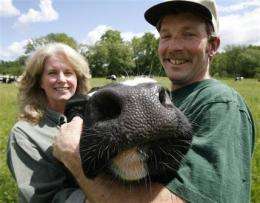
This June 16, 2009 photo shows Tim Maikshilo and his wife, Kristen Dellert, posing with one of their Holsteins in Coventry, Vt. Yogurt maker Stonyfield Farm wants its cows to burp less. It's for a noble cause: cutting down on the gases that contribute to global warming. Working with 15 Vermont farms to change cows' diets so they emit less methane, it has already reduced cow burping by as much as 18 percent. (AP Photo/Toby Talbot)

(AP) -- Vermont dairy farmers Tim Maikshilo and Kristen Dellert, mindful of shrinking their carbon footprint, have changed their cows' diet to reduce the amount of gas the animals burp - dairy cows' contribution to global warming.

Coventry Valley is one of 15 Vermont farms working with Stonyfield Farm Inc., whose yogurt is made with their organic milk, to reduce the cows' intestinal methane by feeding them flaxseed, alfalfa, and grasses high in . The gas cows belch is the dairy industry's biggest contributor, research shows, most of it emitted from the front and not the back end of the .

"I just figured a cow was a cow and they were going to do whatever they were going to do in terms of cow things for gas," said Dellert. "It was pretty shocking to me that just being organic wasn't enough, actually. I really thought that here we're organic, we're doing what we need to do for the planet, we're doing the stuff for the soil and I really thought that was enough."

She learned it wasn't. The dairy industry contributes about 2 percent to the country's total greenhouse gas production, said Rick Naczi, a vice president at Dairy Management Inc., which funds research and promotes dairy products. Most of it comes from the cow, the rest from growing feed crops for the cattle to processing and transporting the milk.

To satisfy consumers' demands for sustainable production, the Innovation Center for U.S. Dairy in Rosemont, Ill., is looking at everything from growing feed crops to trucking milk to reduce the industry's greenhouse gas emissions by 25 percent by 2020. That would be the equivalent of removing about 1.25 million cars from U.S. roads every year, said Naczi, who manages the program.

One way is by feeding cows alfalfa, flax and grasses, all high in Omega 3s, instead of corn or soy, said Nancy Hirschberg, head of Stonyfield's Greener Cow Project. The feed rebalances the cows' rumen, the first stomach of ruminants, and cuts down on gas, she said. Another way is to change the bacteria in a cow's rumen, Naczi said.

When Stonyfield first analyzed its contribution to global warming in the late 1990s, the company thought its factory in Londonderry, N.H., produced the most greenhouse gases.

"And when we got the report and our number one impact on climate change was the milk production, we were completely stunned," she said.

A study showed that the single biggest source was the cow's enteric emissions: gas.

The company funded energy audits on farms and research on small manure digesters so farmers could produce energy from methane gas.

But Hirschberg said she had no idea what to do about enteric emissions. Then she learned what Group Danone of France, majority owner of Stonyfield and best known in the U.S. for its Dannon products, was doing about its methane.

By feeding their cows alfalfa, flax and grasses, they were cutting down on the gas passed.

The milk is tested at a lab at the University of Vermont to determine its fat content, a process patented by French nutrition company Valorex SAS, through which the enteric emissions are calculated.

Since January, Coventry Valley Farm has reduced its cows' belches by 13 percent. At another farm, they've gone down 18 percent.

Maikshilo and Dellert have also noticed a difference in Hester, Rosebud, Pristine and their other cows. The coats of the black and white Holsteins and brown Jerseys are shinier and they've had fewer foot problems and no stomach ailments, they say.

So far, it hasn't cost them any more for their custom-made grain, which the cows only get in the winter. Now they're out grazing on grass in the pasture, getting as many Omega 3s. And the farm's vet bills have gone down.

It's a win-win for farmers, said Naczi.

"It's just the right thing to do," he said.

-----

On the Net:

Stonyfield Farm Inc.'s Greener Cow progam: http://www.stonyfield.com/GreenerCow/

©2009 The Associated Press. All rights reserved. This material may not be published, broadcast, rewritten or redistributed.

3.4 /5 (5 votes)  

Filter


Move the slider to adjust rank threshold, so that you can hide some of the comments.


Display comments: newest first

hooloovoo
Jun 21, 2009

Rank: 3 / 5 (2)
I feel more stupid just for having read this.
jeffsaunders
Jun 21, 2009

Rank: 3.7 / 5 (3)
No wonder the cows were producing gas. We all do if you feed us beans. Give them a decent diet and the gas goes down - what a surprise.
Walid
Jun 22, 2009

Rank: 3 / 5 (2)
@hooloovoo
You feel more stupid because you didn't get the point. Greenhouse gases can be reduced at no cost to farmers which means they can be easily adopted and also have benefits to the cows' health as a side effect.

@jeffsounders
A better diet isn't the only thing that curbs green houses gases. The farm was already organic which is usually considered the better diet. Add to that the diet additives are not regular cow diet components because they don't all grow with meadow grass that the cows feed on.
RAL
Jun 22, 2009

Rank: 3 / 5 (2)
As promising as any anecdote from wholly committed zealots can be. We don't know how many cows are involved here, what other variables might come into play, how accurate the measurements of burpage are, but full speed ahead, it's a miracle and merits full coverage by PhysOrg because it's saving the planet before our very eyes!

(Returns to article index, hoping to find something scientific to read.)
Rank 3.4 /5 (5 votes)
Related Stories
Relevant PhysicsForums posts
  • Do some geologists actually act a lot like Randy Marsh?
    createdFeb 11, 2012
  • Discrepancy between oxygen and carbon-dioxide levels
    createdFeb 09, 2012
  • where gems are found in the world
    createdFeb 09, 2012
  • Wind Waves in Reservoir ~ Wind run-up and Wind set-up
    createdFeb 08, 2012
  • Balance of oxygen in the atmosphere
    createdFeb 01, 2012
  • The case for a methanol-based economy
    createdJan 30, 2012
  • More from Physics Forums - Earth

More news stories

Salvage workers begin pumping fuel from Italian shipwreck

Salvage workers Sunday began pumping fuel from the shipwrecked Italian cruise liner Costa Concordia, a day ahead of schedule, officials said.

Space & Earth / Environment

created 5 hours ago | popularity not rated yet | comments 0

Latin America mining boom clashes with conservation

Latin America is experiencing a mining boom as prices rise fuelled by a hike in global demand, but the region is also being hit by a wave of violent protests, strikes and rallies by environmentalists.

Space & Earth / Environment

created 13 hours ago | popularity 5 / 5 (1) | comments 1

Political leaders play key role in how worried Americans are by climate change: study

More than extreme weather events and the work of scientists, it is national political leaders who influence how much Americans worry about the threat of climate change, new research finds.

Space & Earth / Environment

created Feb 06, 2012 | popularity 5 / 5 (7) | comments 73

NASA budget will axe Mars deal with Europe: scientists

US President Barack Obama's budget proposal to be submitted next week for 2013 will cut NASA's budget by 20 percent and eliminate a major partnership with Europe on Mars exploration, scientists said Thursday.

Space & Earth / Space Exploration

created Feb 10, 2012 | popularity 5 / 5 (3) | comments 58

Humans may have helped the decline of African rainforests 3000 years ago

(PhysOrg.com) -- Large areas of rainforests in Central Africa mysteriously disappeared over three thousand years ago, to be replaced by savannas. The prevailing theory has been that the cause was a change ...

Space & Earth / Environment

created Feb 10, 2012 | popularity 4.1 / 5 (14) | comments 21 | with audio podcast report


Declining health-care productivity in England: Who says so?

Reports that the National Health Service in England has been declining in productivity in the last decade appear to have been accepted as fact. However, a Viewpoint published Online First by The Lancet disputes this. The Vi ...

Scientists discover molecular secrets of 2,000-year-old Chinese herbal remedy

For roughly two thousand years, Chinese herbalists have treated Malaria using a root extract, commonly known as Chang Shan, from a type of hydrangea that grows in Tibet and Nepal. More recent studies suggest that halofuginone, ...

New method to examine batteries -- MRI from the inside

There is an ever-increasing need for advanced batteries for portable electronics, such as phones, cameras, and music players, but also to power electric vehicles and to facilitate the distribution and storage of energy derived ...

Overeating may double risk of memory loss

New research suggests that consuming between 2,100 and 6,000 calories per day may double the risk of memory loss, or mild cognitive impairment (MCI), among people age 70 and older. The study was released today and will be ...

A mitosis mystery solved: How chromosomes align perfectly in a dividing cell

Although the process of mitotic cell division has been studied intensely for more than 50 years, Whitehead Institute researchers have only now solved the mystery of how cells correctly align their chromosomes during symmetric ...

Lab study raises questions over nano-particle impact

Tests involving chickens have raised questions about the impact on health from engineered nano-particles, the ultra-fine grains commonly used in drugs and processed foods, scientists said on Sunday.