Targeting helpers of heat shock proteins could help treat cancer, cardiovascular disease
June 22, 2009
Targeting helpers of heat shock proteins could help treat cancer, cardiovascular disease

Enlarge

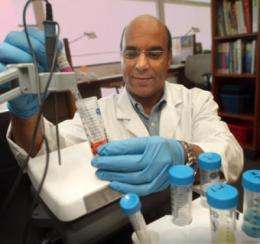
Dr. Ahmed Chadli is a biochemist in the Medical College of Georgia Center for Molecular Chaperones/Radiobiology and Cancer Virology. Credit: Medical College of Georgia

Dissecting how heat shock protein 90 gets steroid receptors into shape to use hormones like estrogen and testosterone could lead to targeted therapies for hormone-driven cancers, such as breast and prostate, that need them as well, Medical College of Georgia researchers say.

"We are trying to understand how Hsp90 folds steroid receptors into the proper conformation so they work," says Dr. Ahmed Chadli, biochemist in the MCG Center for Molecular Chaperones/Radiobiology and Virology. "The goal is to interfere with their function when they are helping cancer."

Hsp90 is vital to steroid receptors whether they are involved with normal hormonal function or cancer. Vital to Hsp90 are helpers such as p23 that help it dock at the receptor, and another Dr. Chadli discovered, GCUNC45, that helps stabilize Hsp90 at the receptor.

In fact, drugs that eventually target the helpers of Hsp90 may one day help physicians target cancer.

"Our hypothesis is that p23 and other co-chaperones helping Hsp90 are driving these hormone-driven cancers," Dr. Chadli says. "We think the Hsp90 machinery is an important piece of cancer development. Whatever we can do to modulate Hsp90 machinery, by targeting it directly or its helpers, is a good thing."

While every cell needs proteins, cancer cells need them even more to maintain their mutated, unstable and extremely busy proteins, he says. "The terminology we use is that the Hsp90 machinery is hijacked by cancer," says Dr. Chadli. Proteins that enable cancer basics such as endless cell reproduction, securing a constant supply of blood and oxygen and ignoring signals to commit suicide, are all dependent on Hsp90. Experience with Hsp90 inhibitors already under study for cancer shows they tend to migrate to the highly active Hsp90 in tumors.

He wants to block Hsp90 in cancer cells by learning more about how it works in normal and . A recent grant from the American Heart Association will enable him to further decipher how GCUNC45 interacts with Hsp90 and how that interaction affects steroid receptor function. "By understanding how these interactions are happening, we could modulate the function of the receptor, Hsp90 or both."

For example, it's known that Hsp90 helps properly assemble steroid receptors in the liquid portion of a cell but receptors have to get to the cell nucleus to be functional. "We know who folds them up, but our big question is: Who takes them over there? It could be that chaperones and helpers both are important for trafficking receptors. If we can inhibit the trafficking, we can inhibit the hormone response."

Hsp90, is one of the most common of the ubiquitous heat shock proteins. These proteins are essential in the body, necessary to even digesting food. In healthy times they fold proteins properly so they'll do the right job, sometimes even delivering them where needed. During stress, heat shock proteins, such as Hsp90, work to help proteins keep proper conformation and function.

It can be bad news when they don't. When proteins start unfolding, amino acids that shouldn't get exposed can interact with other proteins to form unhealthy aggregates, such as the brain plaque that is the hallmark of Alzheimer's, Dr. Chadli says. "The role of molecular chaperones like Hsp90 is to prevent this from happening."

In the cardiovascular system Hsp90 also is a major player. Nitric oxide synthase, which makes the powerful blood vessel dilator, is dependent on it. Steroid receptors also have a role in cardiovascular health, including the protective role estrogen seems to have in women before menopause and the fact that testosterone doesn't seem to do the same for men of any age. "So how do you get both things? Receptors of these hormones need Hsp90 so we need to understand the intricacies of the Hsp90 machinery," Dr. Chadli says.

Source: Medical College of Georgia


Rank not rated yet
Relevant PhysicsForums posts
  • Is Everyday Technology Killing Us?
    createdFeb 08, 2012
  • Exercise and weight loss
    createdFeb 08, 2012
  • Why do we have head aches? Our brains can't feel anything.
    createdFeb 07, 2012
  • "The end of diseases" by David Agus, interview from Daily Show with Jon Stewart
    createdFeb 04, 2012
  • Oncolytic adenovirus
    createdFeb 04, 2012
  • Nutrition label stuffs and diets
    createdFeb 02, 2012
  • More from Physics Forums - Medical Sciences

More news stories

Complex wiring of the nervous system may rely on a just a handful of genes and proteins

Researchers at the Salk Institute have discovered a startling feature of early brain development that helps to explain how complex neuron wiring patterns are programmed using just a handful of critical genes. ...

Medicine & Health / Research

created 4 hours ago | popularity 5 / 5 (7) | comments 0 | with audio podcast

Both maternal and paternal age linked to autism

Older maternal and paternal age are jointly associated with having a child with autism, according to a recently published study led by researchers at The University of Texas Health Science Center at Houston (UTHealth).

Medicine & Health / Psychology & Psychiatry

created 9 hours ago | popularity 5 / 5 (1) | comments 0 | with audio podcast

New understanding of DNA repair could eventually lead to cancer therapy

A research group in the Faculty of Medicine & Dentistry at the University of Alberta is hoping its latest discovery could one day be used to develop new therapies that target certain types of cancers.

Medicine & Health / Cancer

created 8 hours ago | popularity 4.8 / 5 (4) | comments 0 | with audio podcast

Curry spice component may help slow prostate tumor growth

Curcumin, an active component of the Indian curry spice turmeric, may help slow down tumor growth in castration-resistant prostate cancer patients on androgen deprivation therapy (ADT), a study from researchers ...

Medicine & Health / Cancer

created 10 hours ago | popularity 4.5 / 5 (6) | comments 0 | with audio podcast

Human cognitive performance suffers following natural disasters, researchers find

Not surprisingly, victims of a natural disaster can experience stress and anxiety, but a new study indicates that it might also cause them to make more errors - some serious - in their daily lives. In their upcoming Human Fa ...

Medicine & Health / Psychology & Psychiatry

created 6 hours ago | popularity 4 / 5 (1) | comments 0


Google users warned of threat to smartphone wallets

Users of Google smartphone wallets were being warned on Friday that there is a way to crack pass codes intended to thwart thieves from going on illicit shopping sprees.

Anonymous knocks CIA website offline (Update)

The website of the Central Intelligence Agency was inaccessible on Friday after the hacker group Anonymous claimed to have knocked it offline.

New error-correcting codes guarantee the fastest possible rate of data transmission

Error-correcting codes are one of the triumphs of the digital age. They’re a way of encoding information so that it can be transmitted across a communication channel — such as an optical fiber o ...

Putting the squeeze on planets outside our solar system

(PhysOrg.com) -- Using high-powered lasers, scientists at Lawrence Livermore National Laboratory and collaborators discovered that molten magnesium silicate undergoes a phase change in the liquid state, abruptly ...

The power of estrogen -- male snakes attract other males

A new study has shown that boosting the estrogen levels of male garter snakes causes them to secrete the same pheromones that females use to attract suitors, and turned the males into just about the sexiest ...

NASA sees wide-eyed cyclone Jasmine

Cyclone Jasmine's eye has opened wider on NASA satellite imagery, as it moves through the Southern Pacific Ocean.