Brain represents tools as temporary body parts, study confirms
June 22, 2009 Brain

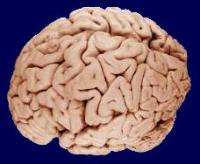
Image source: University of Wisconsin and Michigan State Comparative Mammalian Brain Collections and the National Museum of Health and Medicine.

Researchers have what they say is the first direct proof of a very old idea: that when we use a tool—even for just a few minutes—it changes the way our brain represents the size of our body. In other words, the tool becomes a part of what is known in psychology as our body schema, according to a report published in the June 23rd issue of Current Biology.

"Since the origin of the concept of body schema, the idea of its functional plasticity has always been taken for granted, even if no direct evidence has been provided until now," said Alessandro Farnč of INSERM and the Université Claude Bernard Lyon. "Our series of experiments provides the first, definitive demonstration that this century-old intuition is true."

In the new study, Farnč, Lucilla Cardinali, and their colleagues reasoned that if one incorporates a used tool into the body schema, his or her subsequent bodily movements should differ when compared to those performed before the tool was used.

Indeed, that is exactly what they saw. After using a mechanical grabber that extended their reach, people behaved as though their arm really was longer, they found. What's more, study participants perceived touches delivered on the elbow and middle fingertip of their arm as if they were farther apart after their use of the grabbing tool.

People still went on using their arm successfully following after tool use, but they managed tasks differently. That is, they grasped or pointed to object correctly, but they did not move their hand as quickly and overall took longer to complete the tasks.

It's a phenomenon each of us unconsciously experiences every day, the researchers said. The reason you were able to brush your teeth this morning without necessarily looking at your mouth or arm is because your toothbrush was integrated into your brain's representation of your arm.

The findings help to explain how it is that humans use tools so well.

"We believe this ability of our body representation to functionally adapt to incorporate tools is the fundamental basis of skillful tool use," Cardinali said. "Once the tool is incorporated in the body schema, it can be maneuvered and controlled as if it were a body part itself."


Join PhysOrg.com on Facebook!
Follow PhysOrg.com on Twitter!
Source: Cell Press (news : web)


print this article email this article download pdf blog this article bookmark this article     Stumble it Digg this share on Facebook retweet share on Reddit add to delicious
Rate this story - 4.4 /5 (16 votes)

Rank Filter

Move the slider to adjust rank threshold, so that you can hide some of the comments.


Display comments: newest first

  • NeilFarbstein - Jun 22, 2009
    • Rank: 1 / 5 (2)
    They should investigate effects of computers as tools that affect the body schema and video games and steering wheels.
  • hypnosis - Jun 23, 2009
    • Rank: 5 / 5 (2)
    Yeah,people and machines become one is the feeling.Drive a car,train and a giant dump truck e.t.c seems to incorporate a sense of being the transport as one's self,same if you ask any musician,they get a notion their instrument is part of them.Classic example are ventriloquists,the doll thinks and senses the human is a part of them,quite profoundly.Makes a change that age old intuition turns out to be correct against sciences numerous counter-intuition reports...
  • russcelt - Jun 23, 2009
    • Rank: 5 / 5 (2)
    Exactly! When I climbed into the cab of the eight axle, sixty ton semi-trailer truck toward the end of my driving career I had to think as if I were 13' 6" tall, 10' wide and 60' long to manoeuvre safely on the public roads. To not have done so for twenty five years would have endangered not only myself but the millions of other highway users I shared the roads with. For well over 1.5 million miles I was a safe iron giant.
  • designmemetic - Jun 23, 2009
    • Rank: 5 / 5 (1)
    I would like to hear more about what specific parts of our brain our active during the alteration of our body schema. can they run this test under mri imaging? How does this compare to other animals such as monkeys and dolphins?
  • docknowledge - Jun 23, 2009
    • Rank: 4 / 5 (1)
    Yes, good study. One of those that makes you think: "Come on, I knew that already." Or did I?
  • blubbber - Jun 23, 2009
    • Rank: not rated yet
    Of course you knew it already. And you typed, that proves it.

    Anybody who is really interested in this should check out the work of Vilayanur Ramachandran at Cal. San Diego.
  • farmjunk - Jun 23, 2009
    • Rank: not rated yet
    WOW! After I read this, I noticed that when I try to sort though ideas and concepts in my head I often make my mind into a "computer desktop" (best way of describing it) and will move ideas around, delete and edit them. since the better part of my free time is spent on a computer it seems the action of a mouse has been incorporated into my body.
  • SMMAssociates - Jun 27, 2009
    • Rank: not rated yet
    I won't say that I already knew it, but I did sort of think about it, and seeing this article "fixes" the impression....

    When helping my daughter learn how to drive a few years ago, I had the opportunity to try to figure out how I would do the maneuvering test if I had to do it. That led me back to the whole "be one with the car" thing....

    Then, more recently, I had to do some cleaning in the office here, and I don't move or sit on the floor as well as I used to, so I used one of those "grabber" tools for a couple days. I was tempted to holster it....

    What the brain is actually doing, I'm not sure, but the effect seems similar!


June 22, 2009 all stories

Comments: 8

4.4 /5 (16 votes)
  • Stumble this up

  • Digg this

  • share this

  • hide
  • Related Stories

  • Pain is in the eyes of the beholder
    created Nov 25, 2008 | popularity not rated yet | comments 0
  • How The Octopus Forms An Elbow
    created Apr 21, 2006 | popularity not rated yet | comments 0
  • Monkeys Adapt Robot Arm as Their Own
    created May 11, 2005 | popularity not rated yet | comments 0
  • Left and Right Hands Rely on Different Senses
    created Oct 20, 2006 | popularity not rated yet | comments 0
  • New surgical technique shows promise for improving function of artificial arms
    created Feb 10, 2009 | popularity not rated yet | comments 0


  • hide
  • Relevant PhysicsForums posts

  • Improving the brain through chemistry
    created 4 hours ago
  • Sleep / REM Sleep and homeostasis
    created 21 hours ago
  • The Biceps Reflex
    created Nov 05, 2009
  • Consequenses of striking a Vein and an artery?
    created Nov 05, 2009
  • More from Physics Forums - Medical Sciences

Other News

Decision day for health care in the House (AP)

Decision day for health care in the House

Medicine & Health / Health

created 17 hours ago | popularity not rated yet | comments 0

(AP) -- President Barack Obama is trying to close the deal in the House on his health care overhaul, facing a make-or-break vote that's certain to be seen as a test of his presidency.


Island village hit by suspected swine flu (AP)

Island village hit by suspected swine flu

Medicine & Health / Diseases

created 18 hours ago | popularity 5 / 5 (1) | comments 1

(AP) -- Suspected swine flu is sweeping a traditional Eskimo whaling village on a remote Alaska island - prompting an urgent medical mission to deliver help.


Higher carotid arterial stenting rates associated with poorer clinical outcomes

Medicine & Health / Other

created 18 hours ago | popularity not rated yet | comments 0

Among eligible Medicare beneficiaries, increased use of carotid arterial stenting (CAS) procedures to treat carotid stenosis--the narrowing of the carotid artery--is associated with higher rates of mortality and adverse clinical ...


Turn On, Tune In, Develop?

Turn On, Tune In, Develop? Researchers Examine How Brain Benefits From Musical Training

Medicine & Health / Neuroscience

created Nov 06, 2009 | popularity 5 / 5 (9) | comments 4

For most people music is an enjoyable, although momentary, form of entertainment. But for those who seriously practiced a musical instrument when they were young, perhaps when they played in a school orchestra ...


Chocolate

Chocolate rich in flavanols may protect the skin from UV

Medicine & Health / Health

created Nov 06, 2009 | popularity 5 / 5 (9) | comments 3

(PhysOrg.com) -- A new study has discovered for the first time that dark chocolate rich in flavanols may provide significant protection from the harmful effects of ultraviolet light.