Obsidian 'trail' provides clues to how humans settled, interacted in Kuril Islands
June 22, 2009
Obsidian 'trail' provides clues to how humans settled, interacted in Kuril Islands

Enlarge

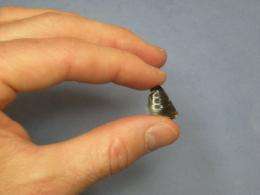
Tiny obsidian flakes such as this found in the Kuril Islands have been traced to their source on Japan's Hokkaido Island and Russia's Kamchatka Peninsula.

(PhysOrg.com) -- Archaeologists have used stone tools to answer many questions about human ancestors in both the distant and near past and now they are analyzing the origin of obsidian flakes to better understand how people settled and interacted in the inhospitable Kuril Islands.

Using X-ray fluorescence spectrometers, archaeologists from the University of Washington and the Smithsonian Institution have found the origin of 131 flakes of obsidian, a volcanic glass. These small flakes were discarded after stone tools were made from obsidian and were found at 18 sites on eight islands in the Kurils. The flakes were found with other artifacts that were dated over a time period spanning about 1,750 years, from 2500 to 750 years before the present.

The Kuril Archipelago stretches for nearly 800 miles between the northern-most Japanese island of Hokkaido and the Kamchatka Peninsula in Russia. Despite the islands' volcanic origin, there are no known local sources of obsidian.

"A key quality of obsidian is you can create very sharp edge. Obsidian flakes easily and fractures in a way that is predictable. When it was available have used it," said Colby Phillips, lead author of the new study and an anthropology doctoral student at the University of Washington. His co-author is Robert Speakman of the Smithsonian's Museum Conservation Institute.

Obsidian is formed when magma is extruded from a volcano and can be geochemically identified Phillips said. That's because the obsidian from each volcano has a unique based on the amount of elements such as rubidium, zirconium and strontium in the glass. Archaeologists gather obsidian samples from volcanoes to create a data base of chemical signatures and compare archaeological samples collected in the field to the data base.

Phillips and Speakman pinpointed the Kuril flakes they analyzed to four locations on Hokkaido and five sources on Kamchatka. The majority of the flakes, slightly more than 60 percent, originated in Kamchatka.

Human occupation of the Kurils began about 4,000 years ago at the southern end of the island chain near Hokkaido and gradually spread northward. And where humans went they carried obsidian with them.

"Obsidian only makes up about 8 percent of the stone tools and the waste left from their manufacture, but it shows up at all sites and over all time periods," said Phillips. "Obsidian may have played a role in maintaining social and trade networks as people migrated across the Kurils. Our work suggests social relationships can be important in local and regional areas. Here we have people living in an isolated area that is covered by fog and clouds and subject to tsunamis, volcanic eruptions and earthquakes. So it would be advantageous to have connections with other people. The fact that we have a material such as obsidian throughout the islands shows people were proactive in maintaining ties in the prehistoric era."

The researchers found a basic pattern of obsidian distribution in the islands. Obsidian from Hokkaido was primarily found in the Southern Kurils with a few samples discovered in the Central Kurils. Kamchatka obsidian was only found in the Central and Northern Kurils.

The Southern Kurils are separated from the other islands in the chain by the 70-mile-wide Bussol Strait. Phillips believes that at some time it became too costly to make the dangerous ocean crossing, and people in the central and northern began trading for Kamchatka obsidian.

Since the research was accepted for publication, Phillips and Speakman have analyzed the sources of an additional 700 obsidian flakes and their results mirror the newly published data.

Source: University of Washington (news : web)


Rank 5 /5 (1 vote)
Relevant PhysicsForums posts
  • Factors affecting beet root cell membrane
    created10 hours ago
  • Stem cell question.
    createdFeb 10, 2012
  • Protease cleavage
    createdFeb 10, 2012
  • Pertubance in a model
    createdFeb 10, 2012
  • Cancer drugs and Alzheimer's, Oh my!
    createdFeb 09, 2012
  • Squishing cells
    createdFeb 09, 2012
  • More from Physics Forums - Biology

More news stories

A frank discussion of the power law and linking correlation to causation

(PhysOrg.com) -- Michael Stumpf a mathematics professor at Imperial College in London, and Mason Porter a lecturer at Oxford have teamed together to write and publish a perspective piece in Science regarding the in ...

Other Sciences / Mathematics

created Feb 10, 2012 | popularity 5 / 5 (5) | comments 11 | with audio podcast report

US workers are 'giving away the store,' costing firms billions

Nearly 70 percent of the nation's service employees give away free goods and services – from hamburgers to cable TV – costing companies billions of dollars a year, according to a groundbreaking study.

Other Sciences / Economics & Business

created Feb 09, 2012 | popularity 3 / 5 (5) | comments 11

Employers feel no love for unscrupulous practice of 'service sweethearting'

A new study led by two Florida State University marketing professors finds that some frontline service employees who are rewarded for hikes in customer loyalty and satisfaction also may engage in "service ...

Other Sciences / Economics & Business

created Feb 10, 2012 | popularity 3.3 / 5 (3) | comments 10

New insights into how to correct false knowledge

The abundance of false information available on the Internet, in movies and on TV has created a big challenge for educators.

Other Sciences / Social Sciences

created Feb 07, 2012 | popularity 4.9 / 5 (7) | comments 9 | with audio podcast

Neanderthal demise due to many influences, including cultural changes: study

As an ice age crept upon them thousands of years ago, Neanderthals and modern human ancestors expanded their territory ranges across Asia and Europe to adapt to the changing environment.

Other Sciences / Archaeology & Fossils

created Feb 07, 2012 | popularity 4.4 / 5 (5) | comments 8 | with audio podcast


Scientists discover molecular secrets of 2,000-year-old Chinese herbal remedy

For roughly two thousand years, Chinese herbalists have treated Malaria using a root extract, commonly known as Chang Shan, from a type of hydrangea that grows in Tibet and Nepal. More recent studies suggest that halofuginone, ...

New method to examine batteries -- MRI from the inside

There is an ever-increasing need for advanced batteries for portable electronics, such as phones, cameras, and music players, but also to power electric vehicles and to facilitate the distribution and storage of energy derived ...

Overeating may double risk of memory loss

New research suggests that consuming between 2,100 and 6,000 calories per day may double the risk of memory loss, or mild cognitive impairment (MCI), among people age 70 and older. The study was released today and will be ...

A mitosis mystery solved: How chromosomes align perfectly in a dividing cell

Although the process of mitotic cell division has been studied intensely for more than 50 years, Whitehead Institute researchers have only now solved the mystery of how cells correctly align their chromosomes during symmetric ...

Lab study raises questions over nano-particle impact

Tests involving chickens have raised questions about the impact on health from engineered nano-particles, the ultra-fine grains commonly used in drugs and processed foods, scientists said on Sunday.

Google might launch Drive for cloud storage soon

(PhysOrg.com) -- Google's next big move, according to the Wall Street Journal, is a cloud storage service called Drive. Hardly first to the plate, Google is simply catching up to introducing its cloud reposi ...