54-million-year-old skull reveals early evolution of primate brains
June 22, 2009
54-million-year-old skull reveals early evolution of primate brains

Enlarge

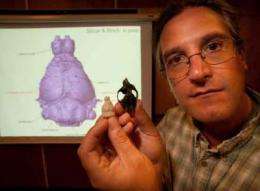
University of Florida vertebrate paleontologist Jonathan Bloch shows the preserved skull of the 54-million-year-old primitive primate, Ignacius graybullianus, and the virtual mold of the brain made from the skull in this June 5, 2009, photo at Florida Museum of Natural History at the University of Florida. The mold, known as an endocast, was made using an ultra-high resolution X-ray CT scanner that took more than 1,200 cross-sectional images of the skull.

(PhysOrg.com) -- Researchers at the University of Florida and the University of Winnipeg have developed the first detailed images of a primitive primate brain, unexpectedly revealing that cousins of our earliest ancestors relied on smell more than sight.

The analysis of a well-preserved skull from 54 million years ago contradicts some common assumptions about brain structure and evolution in the first primates. The study also narrows the possibilities for what caused primates to evolve larger brain sizes. The study is scheduled to appear online the week of June 22 in the .

The skull belongs to a group of primitive primates known as Plesiadapiforms, which evolved in the 10 million years between the extinction of the dinosaurs and the first traceable ancestors of modern primates. The 1.5-inch-long skull was found fully intact, allowing researchers to make the first virtual mold of a primitive brain.

"Most explanations on the evolution of primate brains are based on data from living primates," said lead author Mary Silcox, an anthropologist at the University of Winnipeg and research associate at UF's Florida Museum of Natural History. "There have been all these inferences about what the brains of the earliest primates would look like, and it turns out that most of those inferences are wrong."

Researchers used CT scans to take more than 1,200 cross-sectional X-ray images of the skull, which were combined into a 3-D model of the brain.

"A large and complex brain has long been regarded as one of the major steps that sets primates apart from the rest of mammals," said Florida Museum vertebrate paleontologist and study co-author Jonathan Bloch. "At our very humble beginnings, we weren't so special. That happened over tens of millions of years."

The animal, Ignacius graybullianus, represents a side branch on the primate tree of life, Bloch
said. "You can think of it as a cousin of the main line lineage that would have given rise ultimately to us."

In previous research, Bloch and Silcox established that Plesiadapiforms were transitional species. Ignacius was similar to modern primates in terms of its diet and tree-dwelling but did not leap from tree to tree like modern fast-moving primates.

In many ways, the early primate behaved like living primates but with a brain that was one-half to two-thirds the size of the smallest modern primates. This means that factors such as tree-dwelling and fruit-eating can be eliminated as potential causes for primates evolving larger brain sizes, Silcox said, because "the smaller brained Ignacius was already doing those things."

The mold suggests a "startling combination" of features in the early primate that requires a rethinking of primate brain evolution, said Florida State University anthropologist Dean Falk, who was not involved in the study.

"Hypotheses about early primate brain evolution often link keen smell with nocturnal insect-eating, and a more recently evolved increase in visual processing with fruit-eating in arboreal habitats," Falk said.

The move to larger brain size occurred during an evolutionary burst that happened 10 million years after the of the . At that point, visual features in the brain became much more prominent while the olfactory bulbs became proportionately smaller.

More than likely, Bloch said, this change in brain structure and size was related to primates living in closed canopy forests that brought trees closer together and allowed for more leaping. But answering that will require the discovery and analysis of new fossils.

Changes in brain size and in the early stages of primate evolution have generated enormous debates for decades. But until now, fossil evidence has been lacking.

Many models of the ancestral primate are based on tree shrews, which come from southeast Asia and are distantly related to humans. But with some 70 million years of evolution between them and humans, "it turns out tree shrew brains are not a good model," Silcox said.

Source: University of Florida (news : web)

4.7 /5 (14 votes)  

Filter


Move the slider to adjust rank threshold, so that you can hide some of the comments.


Display comments: newest first

wordofmouth
Jun 22, 2009

Rank: 5 / 5 (1)
A lot more primate brain picking needs done to raise the right questions for us human monkeys before guessing answers.
Rank 4.7 /5 (14 votes)
Relevant PhysicsForums posts
  • Factors affecting beet root cell membrane
    created7 hours ago
  • Stem cell question.
    createdFeb 10, 2012
  • Protease cleavage
    createdFeb 10, 2012
  • Pertubance in a model
    createdFeb 10, 2012
  • Cancer drugs and Alzheimer's, Oh my!
    createdFeb 09, 2012
  • Squishing cells
    createdFeb 09, 2012
  • More from Physics Forums - Biology

More news stories

A frank discussion of the power law and linking correlation to causation

(PhysOrg.com) -- Michael Stumpf a mathematics professor at Imperial College in London, and Mason Porter a lecturer at Oxford have teamed together to write and publish a perspective piece in Science regarding the in ...

Other Sciences / Mathematics

created Feb 10, 2012 | popularity 5 / 5 (5) | comments 10 | with audio podcast report

Employers feel no love for unscrupulous practice of 'service sweethearting'

A new study led by two Florida State University marketing professors finds that some frontline service employees who are rewarded for hikes in customer loyalty and satisfaction also may engage in "service ...

Other Sciences / Economics & Business

created Feb 10, 2012 | popularity 3.3 / 5 (3) | comments 10

US workers are 'giving away the store,' costing firms billions

Nearly 70 percent of the nation's service employees give away free goods and services – from hamburgers to cable TV – costing companies billions of dollars a year, according to a groundbreaking study.

Other Sciences / Economics & Business

created Feb 09, 2012 | popularity 3.5 / 5 (4) | comments 10

New insights into how to correct false knowledge

The abundance of false information available on the Internet, in movies and on TV has created a big challenge for educators.

Other Sciences / Social Sciences

created Feb 07, 2012 | popularity 4.9 / 5 (7) | comments 9 | with audio podcast

Neanderthal demise due to many influences, including cultural changes: study

As an ice age crept upon them thousands of years ago, Neanderthals and modern human ancestors expanded their territory ranges across Asia and Europe to adapt to the changing environment.

Other Sciences / Archaeology & Fossils

created Feb 07, 2012 | popularity 4.4 / 5 (5) | comments 8 | with audio podcast


Scientists discover molecular secrets of 2,000-year-old Chinese herbal remedy

For roughly two thousand years, Chinese herbalists have treated Malaria using a root extract, commonly known as Chang Shan, from a type of hydrangea that grows in Tibet and Nepal. More recent studies suggest that halofuginone, ...

New method to examine batteries -- MRI from the inside

There is an ever-increasing need for advanced batteries for portable electronics, such as phones, cameras, and music players, but also to power electric vehicles and to facilitate the distribution and storage of energy derived ...

Google might launch Drive for cloud storage soon

(PhysOrg.com) -- Google's next big move, according to the Wall Street Journal, is a cloud storage service called Drive. Hardly first to the plate, Google is simply catching up to introducing its cloud reposi ...

Lab study raises questions over nano-particle impact

Tests involving chickens have raised questions about the impact on health from engineered nano-particles, the ultra-fine grains commonly used in drugs and processed foods, scientists said on Sunday.

A mitosis mystery solved: How chromosomes align perfectly in a dividing cell

Although the process of mitotic cell division has been studied intensely for more than 50 years, Whitehead Institute researchers have only now solved the mystery of how cells correctly align their chromosomes during symmetric ...

Starve a virus, feed a cure? Findings show how some cells protect themselves against HIV

A protein that protects some of our immune cells from the most common and virulent form of HIV works by starving the virus of the molecular building blocks that it needs to replicate, according to research published online ...