Energy-saving method checks refrigerant level in air conditioners
June 22, 2009 by Emil Venere Energy-saving method checks refrigerant level in air conditioners

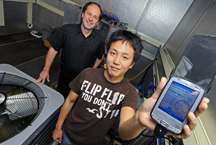
Purdue mechanical engineering graduate student Woohyun Kim, at right, and James Braun, a professor of mechanical engineering, use a new technique designed to save energy and servicing costs by indicating when air conditioners are low on refrigerant, preventing the units from working overtime. Technicians servicing home air conditioners might simply plug a personal digital assistant into the unit to read the refrigerant-charge information. The conventional method for accurately learning how much charge is in a system involves removing all of the refrigerant and weighing it, a time-consuming procedure that requires a vacuum pump. (Purdue University photo/Andrew Hancock)

(PhysOrg.com) -- Engineers have developed a technique that saves energy and servicing costs by indicating when air conditioners are low on refrigerant, preventing the units from working overtime.

The new "virtual refrigerant charge sensor" is particularly practical for automotive air conditioners, which tend to leak refrigerant more than other types of units, and also for household central air conditioning units, said James Braun, a professor of mechanical engineering at Purdue University.

Maintaining the proper "charge," or amount of refrigerant in a system, saves energy because air conditioners low on refrigerant must operate longer to achieve the same degree of cooling as properly charged units.

"Not only does the go down, but you also reduce the lifetime of the unit because it has to work harder, causing parts to wear out faster," Braun said. "It's also very time consuming and costly to have a technician check the refrigerant and charge it up to specification. To accurately learn how much charge is in the system, you have to remove all of the refrigerant and weigh it, a procedure that requires a vacuum pump and is quite time consuming."

The new alternative works by using to monitor the temperature of refrigerant at various points along the tubing in an air-conditioning unit. The technique is easy to use because the sensors are simply attached to the outside of the tubing, Braun said.

Researchers tested the system on various types of air conditioners running on conventional refrigerants, including R-22 and the more environmentally friendly R-410A, which is replacing R-22 in the latest units. The research has been funded by the California Energy Commission through its Public Interest Energy Research, or PIER, program.

Findings are detailed in a research paper presented June 22 during a meeting of the American Society of Heating, Refrigerating and Air Conditioning Engineers in Louisville, Ky. The technique also was described in a paper published in the journal HVAC&R Research. The paper was written by Braun and former mechanical engineering doctoral student Haorong Li, who is now an assistant professor of architectural engineering at the University of Nebraska.

Another research project at Purdue is nearing completion and has involved a more extensive evaluation of the virtual charge sensor. The project, also funded through California's PIER program, has been led by graduate student Woohyun Kim.

Purdue has applied for a patent on the technique, developed in research based at the university's Ray W. Herrick Laboratories.

Li and Braun created a software algorithm that interprets temperature-sensor data to estimate the amount of refrigerant in the system. The four sensors are attached to tubing running into and out of components called heat exchangers.

In air conditioning and refrigeration systems, liquid refrigerant evaporates in a heat exchanger called an evaporator, cooling the air. The refrigerant vapor turns back into a liquid in another heat exchanger called a condenser. During these evaporation and condensing steps, the refrigerant undergoes dramatic temperature changes.

Automotive air conditioning units equipped with the new refrigerant-charge system could activate a warning light on a car's dashboard. Technicians servicing home air conditioners might simply plug a personal digital assistant into the unit to read the refrigerant-charge information, Braun said.

Researchers began developing the technique four years ago.

"The method could be commercialized if a company invested some time in the implementation side," Braun said.

Provided by Purdue University (news : web)


print this article email this article download pdf blog this article bookmark this article     Stumble it Digg this share on Facebook retweet share on Reddit add to delicious
Rate this story - 2.5 /5 (2 votes)

Rank Filter

Move the slider to adjust rank threshold, so that you can hide some of the comments.


Display comments: newest first

  • deatopmg - Jun 23, 2009
    • Rank: not rated yet
    even more money can be saved and less environmental damage done by replacing the fluorinated hydrocarbons with about 1 tenth the amount of simple hydrocarbons like propane and/or iso-butane. Works great in my rejuvenated R-12 car AC.
  • Popawsandy3 - Jun 23, 2009
    • Rank: not rated yet
    This is the dumbest bit of science I have seen in a while . Technitions have used suction superheat to charge A/C and refrigeration systems with refrigerant for the last 75 years [at least ] . This is not a new science ! I retired after 50 years in the business and am quite familiar with the science . There is nothing new here .
  • Shaoping - Jun 24, 2009
    • Rank: not rated yet
    I read it ,but I want to know more about it. I am at Hefei,Anhui,China.Please email your paper to me. My email: dsp88@126.com

June 22, 2009 all stories

Comments: 3

2.5 /5 (2 votes)
  • Stumble this up

  • Digg this

  • share this

  • hide
  • Related Stories

  • NIST helps heat pumps 'go with the flow' to boost output
    created Jan 23, 2008 | popularity not rated yet | comments 0
  • Scientists discuss carbon dioxide uses
    created Mar 13, 2006 | popularity not rated yet | comments 0
  • Staying Cool Shouldn't Burn a Hole in Your Wallet
    created Jul 07, 2006 | popularity not rated yet | comments 0
  • Purdue studies office building power
    created Jan 18, 2006 | popularity not rated yet | comments 0
  • Tiny refrigerator taking shape to cool future computers
    created Jun 19, 2008 | popularity not rated yet | comments 0


  • hide
  • Relevant PhysicsForums posts

  • Achromat lens - magnifying LCD
    created 13 hours ago
  • Control System
    created Nov 24, 2009
  • Base Isolation Systems in Skyscrapers?
    created Nov 23, 2009
  • Need to interview a Computer Hardware Engineer for school project
    created Nov 23, 2009
  • More from Physics Forums - General Engineering

Other News

Sony optimistic on 3-D TVs, in-house display (AP)

Sony optimistic on 3-D TVs, in-house display

Technology / Hi Tech

created 1hour ago | popularity not rated yet | comments 0

(AP) -- A third to a half of the Sony Corp. TV sets sold annually will be packed with 3-D features by the year ending March 2013, a senior executive said Thursday.


Post Office card error leaves Italians in the red: report

Technology / Other

created 1hour ago | popularity not rated yet | comments 0

A computer glitch left Italian Post Office customers in the red by processing card transactions at 100 times their value, Italian press reported Thursday.


Should I buy a PC or Mac?

Technology / Software

created 12 hours ago | popularity 4 / 5 (4) | comments 8

Q. Our 6-year-old PC computer is dying a slow death and we are considering moving to a new iMac but have a few concerns. First, of all, we have several Word documents on our disk drive now that we want to keep and add to ...


Time Inc., Conde Nast and Hearst are preparing to launch an online newsstand described as an "iTunes for magazines"

Magazine publishers creating 'iTunes for magazines': reports

Technology / Internet

created 14 hours ago | popularity 5 / 5 (1) | comments 1

US magazine publishers Time Inc., Conde Nast and Hearst are preparing to launch an online newsstand described as an "iTunes for magazines," according to published reports.


New guidelines for broadcasters on user-generated content

Technology / Other

created 2 hours ago | popularity not rated yet | comments 0

For the first time guidelines are to be published on how broadcasters around the world can encourage audiences to produce better quality user-generated content and to improve media and information literacy.