Cold case techniques bring mummy's face to life
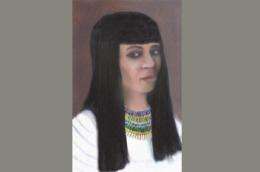
(PhysOrg.com) -- Thanks to the skills of artists who work on cold case investigations, people have a chance to see what the Oriental Institute’s mummy Meresamun may have looked like in real life.
A Chicago forensic artist and a police artist in Maryland prepared the images, which depict an engaging woman in her late 20s as she would have looked in 800 B.C. Both artists, though working independently, produced strikingly similar images. The drawings are on display at the Oriental Institute Museum, and have been placed on the institute’s Web site (oi.uchicago.edu/museum/special/meresamun/), on Meresamun’s Facebook page, her Wikipedia listing and on YouTube.
Dr. Michael Vannier, Professor of Radiology, began the process of restoring the mummy’s facial features with two exhaustive CT examinations of Meresamun in 2008 at the University of Chicago Medical Center.
“A huge number of CT scans of the skull were used to create a 3-D digital model of Meresamun’s skull,” said Emily Teeter, Research Associate at the Oriental Institute an curator of a museum exhibition about the mummy. “Those files were given to forensic artists who use methods employed in cold case investigations where skeletal remains need to be identified.”
The Oriental Institute wanted to compare multiple reconstructions, in order to obtain a trustworthy image of Meresamun’s face. Both a digital version of the traditional forensic reconstruction and a missing person-type sketch were submitted.
In the traditional forensic method, layers of fat, muscle and flesh are built up upon the skull. Starting with a three-dimensional image of the skull created from multiple CT scans, Chicago artist Joshua Harker used a technique known as the Gatliff-Snow American Tissue Depth Marker Method to calculate the contours of the face to digitally recreate Meresamun’s appearance.
“The skull is the driving architecture of the face—all the proportions and placements are there, if know how to read it,” Harker explained. “Even the shapes of the lips, nose and eyebrows can be determined if you know what to look for,”
The American Tissue Depth Marker method has been shown to be effective in accurately reconstructing a face, both in identifying victims and as admissible evidence in court.
“I try not to make any assumptions without expert direction, whether that be from an anthropologist regarding the race, gender or age, or from and expert like Emily Teeter who can give me an accurate description about details based on historical evidence,” Harker said. “I am ecstatic that my reconstruction of Meresamun has been so well received by the community who knows the most about her.”
Michael Brassell, who works with the Department of Justice/Maryland State Police Missing Persons Unit, used his skills as a trained sketch artist to produce a second, more traditional reconstruction.
“The project was no different then any of the postmortems drawings I have worked on for cold case homicides. The CT scans were very clear, making my job easy,” he said. “If this was a homicide case, I would almost go as far to guarantee a hit on the profile drawing.”
Meresamun lived in Thebes (ancient Luxor) about 800 B.C. and died of undetermined causes about age 29-30. An exhibit, “The Life of Meresamun: A Temple Singer in Ancient Egypt,” features her mummy and coffin and will be featured through Dec. 6 at the Oriental Institute Museum. A video display allows visitors to view features of Meresamun’s physical state and perform a “virtual unwrapping” of the mummy, enabling them to see how it was prepared. Advanced digital techniques have made it possible to recreate Meresamun’s appearance.
She was tall by ancient standards—5-and-a-half feet—her features were regular with wide-spaced eyes and she had an overbite. “Meresamun was, until the time of her death at about 30, a very healthy woman,” Vannier said. “The lack of arrest lines on her bones indicates good nutrition through her lifetime and her well-mineralized bones suggest that she lived an active lifestyle.”
Provided by University of Chicago (news : web)


