Indonesian elephant fossil opens window to past
June 23, 2009 By NINIEK KARMINI , Associated Press Writer Indonesian elephant fossil opens window to past (AP)

Enlarge

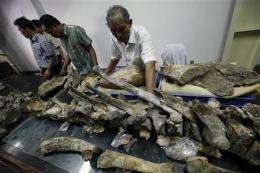
Scientists arrange the bones of an estimated 200,000 year-old giant elephant at Geology Museum in Bandung, West Java, Indonesia, Thursday, June 18, 2009. Indonesian scientists are reconstructing the largest, most complete skeleton of an ancient elephant ever found in the tropics, a finding that may offer new clues into the largely mysterious origins of its modern Asian cousin. Based on the fossil, the ancient elephant stood four meters (13-feet) tall, was five meters (16-feet) long and weighed more than 10 tons, considerably larger than the great Asian mammals now on Earth. (AP Photo/Dita Alangkara)

(AP) -- Indonesian scientists are reconstructing the largest, most complete skeleton of a prehistoric giant elephant ever found in the tropics, a finding that may offer new clues into the largely mysterious origins of its modern Asian cousin.

The prehistoric elephant is believed to have been submerged in quicksand shortly after dying on a riverbed in Java around 200,000 years ago. Its bones - almost perfectly preserved - were discovered by chance in March when an old sand quarry collapsed during monsoon rains.

The animal stood four meters (13-feet) tall, five meters (16-feet) long and weighed more than 10 tons - closer in size to the woolly mammoth of the same period than to the great Asian mammals now on Earth.

Animal fossils are rare in the humid, hot climate of the equator because decomposition occurs extremely quickly.

Following a monthlong excavation, a team of seven paleontologists from the Museum in Bandung, West Java, set the bones in plaster for the trip back to their office where they will be laboriously pieced back together.

"We believe from the shape of its teeth that it was a very primitive elephant," but little else has been verified, said paleontologist Fachroel Aziz, who is heading a 12-strong skeletal reconstruction team.

Scientists agree it is the first time an entire prehistoric elephant has been unearthed since vertebrate findings began to be recorded in Indonesia in 1863.

"It is very uncommon to discover a fossil like this in a tropical region like Indonesia," said Edi Sunardi, an independent expert at Indonesia's Pajajaran University in Bandung, West Java. "It apparently was covered by volcanic sediment that protected it from high temperatures, erosion and decay."

The next challenge will be removing the delicate bones from their molds and joining them into a stable, upright structure, a process that experts said is already being hampered by a lack of funding, inadequate tools and poor expertise.

Indonesia, an emerging and impoverished democracy of 235 million people, cannot afford to allocate more than a token sum to its aging museums, even for projects that have the potential to advance knowledge about the origin of key native species.

Gert van den Berg, a researcher at Australia's Wollongong University who helped dig up the skeleton, said tests are under way to determine its precise age and species, and that they will help provide details "about when the modern evolved into what they are now."

About 2,000 old elephant remains have been found across the island nation over the past 150 years, but never in such good condition, Aziz said.

"We want to exhibit it publicly because this is a spectacular discovery," he said.

©2009 The Associated Press. All rights reserved. This material may not be published, broadcast, rewritten or redistributed.


print this article email this article download pdf blog this article bookmark this article     Stumble it Digg this share on Facebook retweet share on Reddit add to delicious
Rate this story - 4.4 /5 (5 votes)

Rank Filter

Move the slider to adjust rank threshold, so that you can hide some of the comments.


Display comments: newest first

  • Birger - Jun 23, 2009
    • Rank: not rated yet
    With the ongoing efforts (Google "Svante Pääbo" for details) to extract DNA from fossils, it will be exciting to see how this giant animal is related to the mammoth and the surviving elephant species.

June 23, 2009 all stories

Comments: 1

4.4 /5 (5 votes)
  • Stumble this up

  • Digg this

  • share this

  • hide
  • Related Stories

  • Ancient elephant bones found in Calif.
    created Oct 22, 2007 | popularity not rated yet | comments 0
  • Study: Elephants thought extinct may have survived
    created Apr 17, 2008 | popularity not rated yet | comments 0
  • New dinosaur species found in Montana
    created Sep 24, 2007 | popularity not rated yet | comments 0
  • Researchers says Hobbit was human
    created Sep 24, 2005 | popularity not rated yet | comments 0
  • Second ancient whale found in Italy
    created Apr 02, 2007 | popularity not rated yet | comments 0


  • hide
  • Relevant PhysicsForums posts

  • Questions about diffusion
    created 1hour ago
  • Human Leukocyte Antigen (HLA) typing
    created 8 hours ago
  • Breeding program
    created Nov 20, 2009
  • How does a concentration gradient provide energy?
    created Nov 20, 2009
  • More from Physics Forums - Biology

Other News

Museum: Galileo's fingers, tooth are found (AP)

Museum: Galileo's fingers, tooth are found

Other Sciences / Archaeology & Fossils

created 19 hours ago | popularity 4 / 5 (1) | comments 5

(AP) -- Two fingers and a tooth removed from Galileo Galilei's corpse in a Florentine basilica in the 18th century and given up for lost have been found again and will soon be put on display, an Italian museum ...


Measure to change U. of Neb. stem-cell rule fails (AP)

Measure to change U. of Neb. stem-cell rule fails (Update 2)

Other Sciences / Other

created 19 hours ago | popularity 5 / 5 (1) | comments 0

(AP) -- The University of Nebraska's governing board on Friday voted not to place tighter restrictions on embryonic stem cell research than those outlined under federal guidelines, which were expanded after ...


Researcher: Faint writing seen on Shroud of Turin (AP)

Researcher: Faint writing seen on Shroud of Turin (Update)

Other Sciences / Archaeology & Fossils

created Nov 20, 2009 | popularity 1.9 / 5 (23) | comments 23

(AP) -- A Vatican researcher has rekindled the age-old debate over the Shroud of Turin, saying that faint writing on the linen proves it was the burial cloth of Jesus. Experts say the historian may be reading ...


Three of a kind

Three of a kind: Revealing language’s universal essence

Other Sciences / Social Sciences

created Nov 20, 2009 | popularity 3.9 / 5 (11) | comments 6

(PhysOrg.com) -- On the surface, English, Japanese, and Kinande, a member of the Bantu family of languages spoken in the Democratic Republic of Congo, have little in common. It is not just that the vocabularies ...


Maya

New insights into the life of the Maya

Other Sciences / Archaeology & Fossils

created Nov 16, 2009 | popularity 4.6 / 5 (15) | comments 7

(PhysOrg.com) -- Ancient artifacts are almost always concerned with rich and powerful religious and political leaders, but new excavations of an ancient Maya site have unearthed a pyramid decorated with murals ...