A urine test for appendicitis?
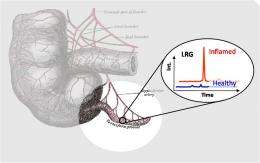
Appendicitis is the most common childhood surgical emergency, but the diagnosis can be challenging, especially in children, often leading to either unnecessary surgery in children without appendicitis, or a ruptured appendix and serious complications when the condition is missed. Now, emergency medicine physicians and scientists at the Proteomics Center at Children's Hospital Boston demonstrate that a protein detectable in urine might serve as a "biomarker" for appendicitis. Their report was published online June 23 by the Annals of Emergency Medicine.
Despite improvement in imaging technologies, recent figures indicate that 3 to 30 percent of children have unnecessary appendectomies, while 30 to 45 percent of those diagnosed with appendicitis already have a ruptured appendix. Laboratory biomarkers have been identified, but none have proved reliable enough to be clinically useful. Researchers led by Richard Bachur, MD, acting chief of emergency medicine at Children's Hospital Boston, Hanno Steen, PhD, director of the Proteomics Center, and clinical fellow Alex Kentsis, MD, PhD, decided to take a systematic approach, performing a proteomics study using state-of-the are mass spectrometry (a technique that detects and quantifies proteins in a sample). Their two-part study has identified the most accurate biomarker for acute appendicitis known to date.
In the first phase, they examined 12 urine specimens - 6 from patients with appendicitis, taken before and after appendectomy, and 6 from patients without appendicitis -and identified 32 candidate biomarkers, including many proteins associated with immune response and inflammation. To these 32 they added other candidates found through gene expression studies and other means, yielding a total of 57 potential biomarkers. They then sought to validate these markers in 67 children seen at the hospital for suspected appendicitis over an 18-month period, 25 of whom ultimately had proven appendicitis. The laboratory investigators testing for the markers were not told the patients' clinical status, to ensure unbiased assessment of the test performance.
Seven promising urine biomarkers were identified. The best of them was leucine-rich alpha-2-glycoprotein (LRG), which appears to be a specific marker of local inflammation. It had an "area under the curve" value of 0.97, indicating near-perfect sensitivity (with almost no false-negatives) and near-perfect specificity (almost no false-positives). LRG was strongly elevated in diseased appendices, even when those appendices appeared normal on imaging, and the amount of LRG correlated with the severity of the appendicitis as judged by histologic review of the appendix specimens.
Although mass spectrometry isn't widely available clinically, urine LRG elevations were detected by immunoblotting, suggesting that a rapid clinical test, such as a urine dipstick, could be developed through further research.
Bachur, Steen and Kentsis now seek to develop quantitative LRG urine assays and further validate their findings. "Recent diagnostic advances have focused on advanced radiologic procedures, such as computed tomography and ultrasound, but these resources are not universally available and can delay diagnosis," says Bachur. "Although these advances have improved the diagnosis and decreased complications from appendicitis, CT scans also expose children to radiation that may increase the lifetime risk of cancer."
The researchers note that since their study was limited to children, and that patterns of biomarkers likely vary in older patients, LRG testing would need to be studied in other clinical settings.
Steen, director of the Proteomics Center at Children's, predicts that proteomics will play a major role in discovering diagnostic markers for a variety of pediatric diseases in the future. The hospital made a significant financial investment five years ago to launch the Center.
Source: Children's Hospital Boston (news : web)


