A Glimpse of the Future MEMS-based Storage: Totally Green & Thumbnail Size
June 23, 2009 by Mary Anne Simpson weblog
Khatib MEMS

Enlarge

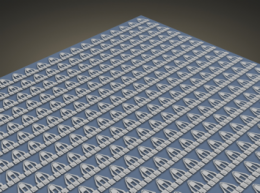
Micro-Electro-Mechanical System. Credit: Zurich IBM Lab

The University of Twente--Enschede, The Netherlands published newly conferred PhD Mohammed Ghiath Khatib's thesis, "MEMS-based Storage Devices: Integration in Energy-Constrained Mobile System". The new MEMS, (Micro-Electro-Mechanical Systems) discovery will allow video camera batteries to increase their charging life approximately 2-1/2 times, consume 1/5th of the energy of disc storage and store 1-Tb on a postage stamp size device. Dr. Khatib expects this new technology to be available to the public within the next five-years.

MEMS technology is currently used in iPhone and devices. Dr. Khatib's MEMS technology differs insofar as it optimizes the technology for use as a data storage device. The high-end discovery is less expensive to produce. The cost to operate will be cheaper than any other known memory device available for mobile devices. Dr. Khatib's discovery is as effective as flash memory, but more cost-effective in all respects.

According to the University of Twente spokesperson, "this new green with extremely high data densities has shown experimentally a storage density of 4Tb/in2 in a demonstration. In effect this means that when this technology is fully developed, it will be possible for a storage device to be reduced to the size of a fingernail, with a capacity of 1 Tb, (200 DVDs) and consumption remains extremely low. Thereby, MEMS combines the advantages of a disc (inexpensive) and a memory card (energy efficient)."

Nearly everyone is familiar with digital still or video cameras. Video cameras often use storage on a disc such as a DVD (disk storage). Cameras often store their data on a memory card, such as a flash card (flash memory). Both methods have their own disadvantage. The cost of disk storage requires a lot of energy and the battery must be recharged often. Storage on a memory card is costly. Dr. Khatib's method combines the best of both worlds and delivers a product which has low energy consumption with the advantages of high-density data storage on a low cost disc.

Dr. Khatib received his PhD on June 11, 2009 from the TU Faculty of Electrical Engineering, Mathematics, and Computer Science and the Centre for Telematic and Information Technology under the supervision of Professor Pieter Hartel and Dr. Leon Abelmann. The research was funded by the technology Foundation, STW.

4.2 /5 (14 votes)  

Rank 4.2 /5 (14 votes)
Related Stories
Relevant PhysicsForums posts
  • Calling function with no input argument
    created3 hours ago
  • Force free body diagram problem on gym equipment
    created4 hours ago
  • Empirical data regarding shower heads and water
    created12 hours ago
  • feed hold button on CNC lathe
    createdFeb 09, 2012
  • RFAC in Fortran
    createdFeb 09, 2012
  • dynamics 2/32
    createdFeb 08, 2012
  • More from Physics Forums - General Engineering

More news stories

Review: Netflix and Hulu's new scripted originals

Within just over a week, Netflix and Hulu are both debuting their first stabs at original scripted programming.

Technology / Business

created 1 hour ago | popularity not rated yet | comments 0

India probes Google over 'forex transactions'

Indian authorities are probing whether online giant Google broke domestic foreign-exchange transactions rules while shifting funds abroad, the Press Trust of India reported on Friday.

Technology / Internet

created 46 minutes ago | popularity not rated yet | comments 0

Germany freezes signing of disputed Internet pact

Germany on Friday halted the signing of a controversial international accord billed as a way to beat online piracy that has sparked angry protests, saying it needed more time to consider it.

Technology / Internet

created 57 minutes ago | popularity not rated yet | comments 0

Expat French get Internet vote for first time

French citizens will for the first time this year be able to vote in a parliamentary election over the Internet, an experiment that could be extended to other elections if successful.

Technology / Internet

created 7 minutes ago | popularity not rated yet | comments 0

New error-correcting codes guarantee the fastest possible rate of data transmission

Error-correcting codes are one of the triumphs of the digital age. They’re a way of encoding information so that it can be transmitted across a communication channel — such as an optical fiber o ...

Technology / Computer Sciences

created 6 hours ago | popularity 5 / 5 (3) | comments 2 | with audio podcast


Hovering not hard if you're top-heavy, researchers find

Top-heavy structures are more likely to maintain their balance while hovering in the air than are those that bear a lower center of gravity, researchers at New York University's Courant Institute of Mathematical Sciences ...

Grass to gas: Researchers' genome map speeds biofuel development

Researchers at the University of Georgia have taken a major step in the ongoing effort to find sources of cleaner, renewable energy by mapping the genomes of two originator cells of Miscanthus x giganteus, a large perenn ...

Putting the squeeze on planets outside our solar system

(PhysOrg.com) -- Using high-powered lasers, scientists at Lawrence Livermore National Laboratory and collaborators discovered that molten magnesium silicate undergoes a phase change in the liquid state, abruptly ...

Researchers develop new method for creating tissue engineering scaffolds

Researchers at Northwestern University have developed a new method for creating scaffolds for tissue engineering applications, providing an alternative that is more flexible and less time-intensive than current technology.

Molecular profiling reveals differences between primary and recurrent ovarian cancers

There is a need to analyze tumor specimens at the time of ovarian cancer recurrence, according to a new study published in Molecular Cancer Therapeutics. Researchers used a diagnostic technology called molecular profiling to examine ...

C-sections linked to breathing problems in preterm infants

Research conducted at Yale School of Medicine shows that a cesarean (C-section) delivery, which was thought to be harmless, is associated with breathing problems in preterm babies who are small for gestational age.