Scientists discover new source for harvesting stem cells
June 23, 2009 Human term placenta a new abundant source of hematopoietic cells

Enlarge

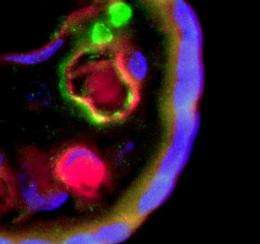
This is a microphotograph of chorionic villus of human term placenta immunostained for CD34 (Marker of endothelial and hematopietic stem cells, red), CD31 (marker of endothelial cell, green) and nuclei (DAPI, blue). Non-endothelial CD34-positive cell is clearly observed in tissue of placenta. Credit: Society for Experimental Biology and Medicine

A groundbreaking study conducted by Children's Hospital & Research Center Oakland is the first to reveal a new avenue for harvesting stem cells from a woman's placenta, or more specifically the discarded placentas of healthy newborns. The study also finds there are far more stem cells in placentas than in umbilical cord blood, and they can be safely extracted for transplantation. Furthermore, it is highly likely that placental stem cells, like umbilical cord blood and bone marrow stem cells, can be used to cure chronic blood-related disorders such as sickle cell disease, thalassemia, and leukemia.

The study, led by Children's Hospital & Research Center Oakland scientists Frans Kuypers, PhD, and Vladimir Serikov, PhD, will be the feature story in the July 2009 issue of Experimental Biology and Medicine. The doctors and their team made the discoveries by harvesting term placentas from healthy women undergoing elective Cesarean sections. "Yes, the stem cells are there; yes, they are viable; and yes, we can get them out," declared Dr. Kuypers.

Stem cells are essentially blank cells that can be transformed into any type of cell such as a muscle cell, a brain cell, or a red blood cell. Using stem cells from umbilical cord blood, Children's Hospital Oakland physicians have cured more than 100 kids with chronic blood-related diseases through their sibling donor cord blood transplantation program, which began in 1997. However, according to the American Cancer Society, each year at least 16,000 people with serious blood- related disorders are not able to receive the bone marrow or cord blood transplant they need because they can't find a match.

Dr. Kuypers explained that even when a patient receives a cord blood transplant, there may not be enough stem cells in the umbilical cord to successfully treat their disorder. Placentas, however, contain several times more stem cells than umbilical cord blood. "The greater supply of stem cells in placentas will likely increase the chance that an HLA (human leukocyte antigen) matched unit of stem cells engrafts, making stem cell transplants available to more people. The more stem cells, the bigger the chance of success," said Dr. Kuypers.

Drs. Kuypers and Serikov have also developed a patent-pending method that will allow placental stem cells to be safely harvested and made accessible for transplantation. The process involves freezing placentas in a way that allows them to later be defrosted and suffused with a compound that enables the extraction of viable stem cells. The method will make it possible for companies to gather, ship and store placentas in a central location. "We're looking for a partnership with industry to get placenta-derived in large quantities to the clinic," said Dr. Kuypers. He adds that much more research and grant funding are needed to explore the maximum potential of this latest discovery. He remains encouraged. "Someday, we will be able to save a lot more kids and adults from these horrific blood disorders."

Source: Children's Hospital & Research Center at Oakland (news : web)


print this article email this article download pdf blog this article bookmark this article     Stumble it Digg this share on Facebook retweet share on Reddit add to delicious
Rate this story - 4 /5 (4 votes)


June 23, 2009 all stories

Comments: 0

4 /5 (4 votes)
  • Stumble this up

  • Digg this

  • share this

  • hide
  • Related Stories

  • New technology enhances therapeutic potential of cord blood stem cells
    created Jun 06, 2008 | popularity not rated yet | comments 0
  • Clinical trial demonstrates safety of pre-transplant expansion of umbilical cord blood stem cells
    created Dec 08, 2008 | popularity not rated yet | comments 0
  • Molecule dictates how stem cells travel
    created Jan 14, 2006 | popularity not rated yet | comments 0
  • New research sheds light on how stem cells turn into blood cells
    created Mar 05, 2009 | popularity not rated yet | comments 0
  • Menstruation proves more than a curse
    created Nov 15, 2007 | popularity not rated yet | comments 0


  • hide
  • Relevant PhysicsForums posts

  • Improving the brain through chemistry
    created Nov 07, 2009
  • Sleep / REM Sleep and homeostasis
    created Nov 07, 2009
  • The Biceps Reflex
    created Nov 05, 2009
  • Consequenses of striking a Vein and an artery?
    created Nov 05, 2009
  • More from Physics Forums - Medical Sciences

Other News

Developmental delay could stem from nicotinic receptor deletion

Medicine & Health / Genetics

created 11 hours ago | popularity 4.5 / 5 (2) | comments 0

The loss of a gene through deletion of genetic material on chromosome 15 is associated with significant abnormalities in learning and behavior, said a consortium of researchers led by Baylor College of Medicine in a report ...


House passes health care bill on close vote (AP)

Landmark health bill passes House on close vote

Medicine & Health / Health

created 19 hours ago | popularity 3.7 / 5 (9) | comments 2

(AP) -- The Democratic-controlled House narrowly passed far-reaching health care legislation, handing President Barack Obama a hard-won victory on his chief domestic priority though the road ahead in the ...


Expanding drug treatment: Is US ready to step up? (AP)

Expanding drug treatment: Is US ready to step up?

Medicine & Health / Other

created 6 hours ago | popularity not rated yet | comments 0

(AP) -- Based on the rhetoric, America's war on drugs seems poised to shift into a more enlightened phase where treatment of addicts gains favor over imprisonment of low-level offenders. Questions abound, ...


Children who often drink full-fat milk weigh less

Medicine & Health / Health

created Nov 03, 2009 | popularity 5 / 5 (4) | comments 5

Eight-year-old children who drink full-fat milk every day have a lower BMI than those who seldom drink milk. This is not the case for children who often drink medium-fat or low-fat milk. This is one conclusion of a thesis ...


Turn On, Tune In, Develop?

Turn On, Tune In, Develop? Researchers Examine How Brain Benefits From Musical Training

Medicine & Health / Neuroscience

created Nov 06, 2009 | popularity 5 / 5 (11) | comments 4

For most people music is an enjoyable, although momentary, form of entertainment. But for those who seriously practiced a musical instrument when they were young, perhaps when they played in a school orchestra ...