Magnetic field on bright star Vega
June 23, 2009 Magnetic field on bright star Vega

Enlarge

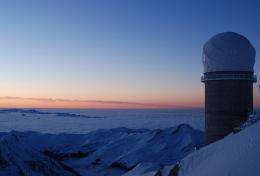
Bernard-Lyot Telescope, on top of the Pic du Midi de Bigorre (France). © Pascal Petit

Astronomy & Astrophysics journal publishes the first detection of a magnetic field on the bright star Vega. Using the NARVAL spectropolarimeter of the Bernard-Lyot telescope on top of the Pic du Midi (France), astronomers clearly observe the magnetically-induced effect in the spectrum of Vega, thereby showing that the star possesses a magnetic field, something unknown so far.

Astronomy & Astrophysics is publishing the first detection of a magnetic field on the star Vega, one of the brightest stars in the sky. Using the high-sensitivity NARVAL spectropolarimeter installed at the Bernard-Lyot telescope (Pic du Midi Observatory, France), a team of astronomers detected the effect of a magnetic field (known as the Zeeman effect) in the light emitted by Vega.

Vega is a famous star among amateur and professional astronomers. Located at only 25 light years from Earth in the Lyra constellation, it is the fifth brightest star in the sky. It has been used as a reference star for brightness comparisons. Vega is twice as massive as the Sun and has only one tenth its age. Because it is both bright and nearby, Vega has been often studied but it is still revealing new aspects when it is observed with more powerful instruments. Vega rotates in less than a day, while the Sun's rotation period is 27 days. The intense centrifugal force induced by this rapid rotation flattens its poles and generates temperature variations of more than 1000 degrees Celsius between the polar (warmer) and the equatorial regions of its surface. Vega is also surrounded by a disk of dust, in which the inhomogeneities suggest the presence of planets.

This time, astronomers analyzed the polarization of light emitted by Vega and detected a weak magnetic field at its surface. This is really not a big surprise because one knows that the charged particle motions inside stars can generate magnetic fields, and this is how solar and terrestrial magnetic fields are produced. However, for more massive stars than the Sun, such as Vega, theoretical models cannot predict the intensity and the structure of the magnetic field, so that astronomers had no clue to the strength of the signal they were looking for. After many unsuccessful attempts in past decades, both the high sensitivity of NARVAL and the full dedication of an observing campaign to Vega have made this first detection possible.

The strength of Vega magnetic field is about 50 micro-tesla, which is close to that of the mean field on Earth and on the Sun. This first observational constraint opens the way to in-depth theoretical studies about the origin of magnetic fields in massive stars. This detection also suggests that magnetic fields exist but have not been detected yet on many stars like Vega, but farther and more difficult to observe. Astronomers believe that this discovery will be a key step in understanding stellar magnetic fields and their influence on stellar evolution. As for Vega, it is now the prototype of a new class of magnetic stars and will definitely continue fascinating astronomers for years.

More information: “First evidence of a on Vega. Towards a new class of magnetic A-type ”, by F. Ligničres, P. Petit, T. Böhm, and M. Auričre, Published in Astronomy & Astrophysics, 2009, vol. 500-3; http://www.aanda.org/10.1051/0004-6361/200911996/pdf

Source: Astronomy & Astrophysics


print this article email this article download pdf blog this article bookmark this article     Stumble it Digg this share on Facebook retweet share on Reddit add to delicious
Rate this story - 4.5 /5 (6 votes)

Rank Filter

Move the slider to adjust rank threshold, so that you can hide some of the comments.


Display comments: newest first

  • omatumr - Jun 23, 2009
    • Rank: 1 / 5 (1)
    WHO KNOWS?

    ". . . one knows that the charged particle motions inside stars can generate magnetic fields, and this is how solar and terrestrial magnetic fields are produced."

    Several recent research articles and news reports here and elsewhere acknowledge that we do NOT, in fact, KNOW that charged particle motions inside the Sun generate magnetic fields, "and this is how solar and terrestrial magnetic fields are produced."

    See: "Superfluidity in the Solar Interior:
    Implications for Solar Eruptions and Climate,"
    Journal of Fusion Energy 21 (2002) 193-198.
    http://arxiv.org/...501441v1

    With kind regards,
    Oliver K. Manuel

June 23, 2009 all stories

Comments: 1

4.5 /5 (6 votes)
  • Stumble this up

  • Digg this

  • share this

  • hide
  • Related Stories

  • Vega: the star with comets?
    created Apr 12, 2006 | popularity not rated yet | comments 0
  • NARVAL -- The first observatory dedicated to stellar magnetism
    created Feb 08, 2007 | popularity not rated yet | comments 0
  • First Glimpse of Star Flip
    created Feb 26, 2008 | popularity not rated yet | comments 0
  • Watching how planets form
    created Sep 28, 2006 | popularity not rated yet | comments 0
  • The first detection of magnetic fields in the central stars of four planetary nebulae
    created Jan 04, 2005 | popularity not rated yet | comments 0


  • hide
  • Relevant PhysicsForums posts

  • Q?
    created Nov 02, 2009
  • Mercury not travelling in a straight line?
    created Nov 02, 2009
  • Where do the 'bars' in a barred spiral come from?
    created Nov 01, 2009
  • southwest sky
    created Oct 31, 2009
  • More from Physics Forums - General Astronomy

Other News

This undated file picture shows part of the Pastoruri snowcapped mountain in the central Peruvian Andes

'Whitewash' could slow global warming: Peruvian scientist

Space & Earth / Earth Sciences

created 17 minutes ago | popularity not rated yet | comments 0

A Peruvian scientist has called on his country to help slow the melting of Andean glaciers by daubing white paint on the rock and earth left behind by receding ice so they will absorb less heat.


Calm before the spawn: Climate change and coral spawning

Space & Earth / Environment

created 43 minutes ago | popularity not rated yet | comments 0

What's the point of setting up marine reserves to protect coral reefs from pollution, ship groundings and overfishing if climate change could cause far more damage? A study published this week in London in Proceedings of ...


Camels carry salt in the Ethiopia's Afar Region

Volcanic eruptions may split Africa: scientists

Space & Earth / Earth Sciences

created 11 hours ago | popularity 4.7 / 5 (6) | comments 1

Volcanic activity may split the African continent in two owing to a recent geological crack in northeastern Ethiopia, researchers said on Tuesday.


SMOS forms three-pointed star in the sky (w/ Video)

Space & Earth / Space Exploration

created 12 hours ago | popularity 3 / 5 (1) | comments 0

(PhysOrg.com) -- Following the launch of ESA's SMOS satellite on 2 November, the French space agency CNES, which is responsible for operating the satellite, has confirmed that the instrument's three antenna arms have ...


Shedding light on the cosmic skeleton

Shedding Light on the Cosmic Skeleton

Space & Earth / Astronomy

created 21 hours ago | popularity 4.9 / 5 (15) | comments 4

(PhysOrg.com) -- Astronomers have tracked down a gigantic, previously unknown assembly of galaxies located almost seven billion light-years away from us. The discovery, made possible by combining two of the ...