New electron microscopy images reveal the assembly of HIV
June 23, 2009 New electron microscopy images reveal the assembly of HIV

Enlarge

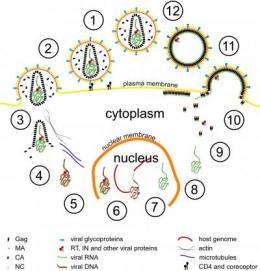
The HIV lifecycle begins with the interaction of a virus particle with a receptor on the surface of a cell (step 1), which leads to fusion of the viral and cellular membranes (step 2) and deposition of the viral contents into the cell (step 3). The viral RNA genome is reverse transcribed resulting in DNA copy, which is imported into the nucleus (step 5). Within the nucleus, the viral DNA is integrated into the host cell genome (step 6). The virus may now enter a period of latency. The late stages of the viral life cycle begin when the viral genome is transcribed from within the host genome (step 7), exported from the nucleus (step 8) and translation of the viral proteins by host cell machinery begins (step 9). The major structural protein, Gag, is transported to the plasma membrane where it directs assembly of the viral coat, and incorporates other viral proteins and the viral genome (step 10). The virus buds through the cell membrane (step 11), and Gag is cleaved by the viral protease in five places. This leads to a structural change of the virion into its mature infectious form (step 12), which is capable of fusing with a new susceptible cell. Credit: John Briggs

Scientists at the European Molecular Biology Laboratory (EMBL) and the University Clinic Heidelberg, Germany, have produced a three-dimensional reconstruction of HIV (Human Immunodeficiency Virus), which shows the structure of the immature form of the virus at unprecedented detail.

Immature HIV is a precursor of the infectious virus, which can cause AIDS. The study, published in the 22-26 June online edition of PNAS, describes how the protein coat that packages the virus' genetic material assembles in . Drugs that block this assembly process and prevent the virus from maturing into its infectious form are considered a promising therapeutic approach.

HIV consists of an RNA molecule that carries the genetic information of the virus and is surrounded by protective protein and membrane layers. During infection the virus deposits its genetic material into a human cell where it reprogrammes the host cell machinery to generate many copies of the viral genome and initiates the production of a viral protein called Gag. In the immature virus, many copies of Gag interact to form a roughly spherical lattice that encloses the virus' . The then leaves the cell with the help of proteins of the host and infects new cells.
New electron microscopy images reveal the assembly of HIV
Enlarge

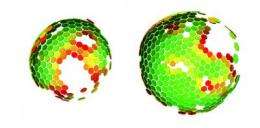
Lattice maps for immature HIV particles. The 3-D computer reconstruction shows the immature Gag lattice of HIV that matures to form the protein shell of the infectious virus. Maps are shown in perspective such that hexamers on the rear surface of the particle appear smaller. The side of the particle toward the viewer lacks ordered Gag. Credit: John Briggs/EMBL

Using a method called cryoelectron tomography researchers in the groups of John Briggs at EMBL and Hans-Georg Kräusslich at the University Clinic Heidelberg generated the as yet highest resolution 3D computer reconstruction images of the immature Gag lattice. The results suggest a simple model of formation in human cells: multiple Gag proteins interact to form a hexameric lattice that grows with an inherent curvature and that incorporates new proteins stochastically. Several further steps in which Gag is cleaved by an enzyme are necessary to transform this immature lattice into its mature, infectious form.

Briggs and his team are now working on producing an even higher resolution structure of the protein lattice to gain a more detailed understanding of the virus' assembly and maturation processes, which may eventually help to find weak points that could be targeted by drugs.

Cryoelectron tomography is a technique with which a sample is instantly frozen in its natural state and then examined with an electron microscope. Images are taken from different directions and assembled into an accurate 3D reconstruction by a computer.

Source: European Molecular Biology Laboratory (news : web)


print this article email this article download pdf blog this article bookmark this article     Stumble it Digg this share on Facebook retweet share on Reddit add to delicious
Rate this story - 4.7 /5 (3 votes)


June 23, 2009 all stories

Comments: 0

4.7 /5 (3 votes)
  • Stumble this up

  • Digg this

  • share this

  • hide
  • Related Stories

  • Heidelberg Virologists Make HIV Luminate
    created Feb 28, 2005 | popularity not rated yet | comments 0
  • Getting wise to the influenza virus' tricks
    created May 04, 2008 | popularity not rated yet | comments 0
  • 3D structure of HIV is discovered
    created Jan 24, 2006 | popularity not rated yet | comments 0
  • Scientists create first crystal structure of an intermediate particle in virus assembly
    created Feb 08, 2009 | popularity not rated yet | comments 0
  • Scientists image a single HIV particle being born
    created May 25, 2008 | popularity not rated yet | comments 0


  • hide
  • Relevant PhysicsForums posts

Other News

Developmental delay could stem from nicotinic receptor deletion

Medicine & Health / Genetics

created 33 minutes ago | popularity not rated yet | comments 0

The loss of a gene through deletion of genetic material on chromosome 15 is associated with significant abnormalities in learning and behavior, said a consortium of researchers led by Baylor College of Medicine in a report ...


House passes health care bill on close vote (AP)

Landmark health bill passes House on close vote

Medicine & Health / Health

created 8 hours ago | popularity 3.3 / 5 (7) | comments 1

(AP) -- The Democratic-controlled House narrowly passed far-reaching health care legislation, handing President Barack Obama a hard-won victory on his chief domestic priority though the road ahead in the ...


Children who often drink full-fat milk weigh less

Medicine & Health / Health

created Nov 03, 2009 | popularity 5 / 5 (4) | comments 5

Eight-year-old children who drink full-fat milk every day have a lower BMI than those who seldom drink milk. This is not the case for children who often drink medium-fat or low-fat milk. This is one conclusion of a thesis ...


Turn On, Tune In, Develop?

Turn On, Tune In, Develop? Researchers Examine How Brain Benefits From Musical Training

Medicine & Health / Neuroscience

created Nov 06, 2009 | popularity 5 / 5 (11) | comments 4

For most people music is an enjoyable, although momentary, form of entertainment. But for those who seriously practiced a musical instrument when they were young, perhaps when they played in a school orchestra ...


Chocolate

Chocolate rich in flavanols may protect the skin from UV

Medicine & Health / Health

created Nov 06, 2009 | popularity 5 / 5 (9) | comments 3

(PhysOrg.com) -- A new study has discovered for the first time that dark chocolate rich in flavanols may provide significant protection from the harmful effects of ultraviolet light.