Galactic Colonization Limited By The Inability To Expand Exponentially
June 23, 2009 by Miranda Marquit
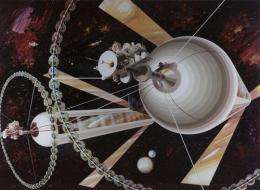
Galactic colonization is likely to be limited by the Fermi Paradox. Image credit: NASA
(PhysOrg.com) -- For more than 50 years, many have taken the so-called Fermi Paradox to indicate that the existence of intelligent alien civilizations is an impossibility. However, a recent re-examination of the paradox points out that, rather than discounting the spread of an intelligent civilization, the Fermi Paradox merely points out that advanced civilizations with exponential growth are unlikely to exist.
Enrico Fermi speculated (during a lunch break) that the age of the universe, as well as its size, meant that there should be a number of advanced societies keeping Earth company, in a galactic sense. Growth of these civilizations would be exponential, Fermi implied, and therefore if they existed, we would have encountered them already. Ergo, advanced alien societies must not exist, since their expansion hasn't brought them into the range of our detection.
A new take on the Fermi Paradox, though, changes the equation a bit. At Pennsylvania State University, two scientists suggest that the key to the paradox is the assumption that civilizations would colonize the universe at an exponential rate. Jacob Haqq-Misra and Seth Baum point out that finite resources preclude exponential expansion. Technology Review offers a look at the problem of exponential growth:
"The problem is that this kind of growth may not be possible, and they look at Earth as an example. For any expansion to be sustainable, the growth in resource consumption cannot exceed the growth in resource production. And since Earth's resources are finite, and it has a finite mass and receives solar radiation at a constant rate, human civilization cannot sustain an indefinite, exponential growth."
This means that, if we decide to colonize our galaxy, Earth's civilization will be unable to do so at an exponential rate. If you apply the realities of Earth to possible alien civilizations, then it becomes much more likely that there are other advanced societies out there. Like Earth, though, they are limited in their expansionary capabilities. Perhaps there are thousands of alien societies out there, just trying to effectively colonize their moons or settle on planets in their solar systems. It is possible that, if that is the case, the question of existence of intelligent alien life may not be answered in our life times.
• Join PhysOrg.com on Facebook!
• Follow PhysOrg.com on Twitter!
© 2009 PhysOrg.com


In short, speculation is useless. We need to get out there and find out ourselves rather than staring at our navels.
2. Theyve only made contact with a select few
3. They see no reason to expand outward
-Theres no reason to expect that a mature species would be spewing excess radiation beyond waste heat. Theres no reason to think they would value unlimited expansion beyond that needed to ensure survival, over a static existance of continued refinement. Only overpopulaters like ourselves automatically think of room to expand. This quality would probably present a threat they would want to either manage or eliminate. The fact that we still exist could mean we are being managed, husbanded; or that the urge to expand naturally fades.
4. Theres no reason to think that this system is not already occupied by beings who have migrated to the outer reaches where it is quiet and safe, and who value nothing more about us than our company.
I also think us not knowing of them is a pretty insignificant way of saying they're not there.
I can think of endless reasons why we wouldn't know about them that don't require any kinds of studying and are just as plausible.
otto said what I was thinking in a much smarter way.
'cept why is finite Solar Constant a limit for them but not for greenie economy?
Humans do not "overpopulate" - Modern developed cultures are all trending towards 0 population growth. There is a natural equilibrium that will arrive on this world, and the pressure to find new lands will be increased.
Those who use simple models of human population are misled to think that our populaiton will grow without change until we run out of resources. The protection against this is economics - As the staples of life become more and more expensive, the birth rates will decline. There will be no catastrophic precipice - This is why birth rates in the developed world are already low and declining. As the cost of living increases for third world countries, they too will zero out their birth rates and the world will stabilize.
These arguments don't hold much value. You are assuming that every single alien civilization would choose exactly the same principles and make the same decisions. This is not very likely to happen. Even if a majority of them choose a specific course of action or there is some interspecies government, there will always be dissenters that go a different route. This would happen even in our own species, if the human race expanded out and found an alien civilization, you will have people who want to follow the prime directive and don't interfere, want to manipulate them without them knowing, want to announce our selfs to them and try and help them, want to conquer them, want to blow them up in case they become a threat, want to sell them Pepsi, want to spread various religions or that word of god or whatever.
We would only need 1 person of the 6.6billion (much more by then) to violate the rule in an obvious way. The only way would be if there was some kind of way to implement a complete and total control over every species and individual to stop them interfering.
Maybe a giant impenetrable 'cage' around the solar system to keep out the nasties and fake the energy from the rest of the universe (to stop radio signals being sent or some nutter from blowing up suns in a specific order and announcing to everyone at one or something). Of course the cage would have to be completely impervious to all the other races technology and such.
I think the real reason we haven't found anything is the age of the universe, the age of the human race and the time required for space travel. Limits on exponential growth might explain why the galaxy isn't crawling with aliens but it doesn't stop deliberately sending out self replicating probes to visit each star system, reproduce, and carve your initials on a planet to announce your exinstance (or something more hightech).
I don't think anyone has ever claimed that the amount of solar energy that could be harnessed is infinite. But the potential there (if it was presently economical) is more than we could consume, at present.
I doubt they would be interested in us at all, and would be exploring other dimensions, if there are any, or creating new universes tailored to their needs, if that is possible.
If we meet them at all, we'll meet them somewhere "on the other side" of things. (You know, like in the Apple iPhone store.)
The only exception would be an extremely unlikely chance encounter between two species at the same developemental stage. An extreme long shot, but you never know.
So we might explore some star systems and have small colonies, but there just wouldn't be the population increase for exponential growth.
Such a system of probes could visit and catalog every star system in a galaxy in a few million years. The technology is, for now, beyond ours. But that THAT much beyond. I'll bet we could do this by 2100 if not 2050. And it requires very little resources from each star system visited.
So no, limited resources aren't a good solution to Fermi's Paradox. Yes, it's likely why some expansionist version of the Borg doesn't occupy the entire galaxy. But you don't need to colonize a star system to go there, learn about it and use its resources to move to the next system.
If humanity is on the crux of building such a system of galaxy-roaming probes, there's no reason to assume that every other advanced civilization hasn't already done this or something more advanced. Chances are extremely good that our star system has been visited by advanced probes again and again and again.
The only reasonable conclusion one can infer from the Fermi Paradox is that the aliens who know we exist don't want to talk to us for some reason. Maybe they're waiting for us to become advanced enough to find them. Chances are, that won't take all that long either! If the Kepler mission finds a world with water vapor, oxygen and ozone in the atmosphere of a small world as far out from the habitable zone as is Neptune... it'd be hard to explain that through natural means!
My thoughts exactly. When we visited the moon we left a flag and a plaque.The two Voyager probes carry welcome messages, and they may very well be the first things that an alien race encounters...in a million years or so. IMHO the only reason we have never met or spoken with aliens is that we just haven't been around long enough. Our race may or may not exist by the time they receive our messages however...too bad.
If individuals live practically forever, then procreation directly adds to total headcount, as there is virtually no compensatory shrinkage due to deaths. Each individual might procreate at least once, just to have that experience -- meaning that over time, the population grows without bounds up until it bumps against energy/resource constraints... or until it completely loses all interest in procreation.
This would be a relatively slower process, when compared to the human population explosion in the last few thousand years, but we're talking about billions of years (the universe is some 13.5 billion years old...) It's all but guaranteed that unless life on earth is some nearly-impossible accident, then there should've been life in our galaxy long before our solar system formed ~4.6 billion years ago.
There's got to be some REALLY OLD geezers out there by now; problem is they've seen it all and they know it all -- so to them we aren't the least bit interesting in the slightest. On the other hand, they'd be so advanced that to us they'd be all but undetectable. After all, the more advanced you are, the more efficient you are: so you wouldn't be leaking massive amounts of energy into space, that Earthlings could detect with their telescopes... (which is why I think the whole SETI idea is boneheaded.)
And all of that is even assuming that the "universe" we know and love is all there is. We might well be suffering from some good ol' geo-centrism: for all we know, more advanced aliens tend to depart our quaint little spacetime cradle in favor of some more enticing hyperspace environs where the grown-ups come to play...
It just so happens the "overpopulation" and "industrial pollution" coincides with the most rapid advancement of living standards and technology mankind has ever known.
I get to live twice as long as my great, great grand parents. I get far more spare time and far less back-breaking labour.
The greatest irony is that the malthusians/club of rome types tend to be the biggest opponents of nuclear energy, especially breeder reactors of any kind. That inherently makes them supporters of coal power.
I think Amory Lovins expressed the reasoning behind this view most clearly when he said: "Complex technology of any sort is an assault on human dignity. It would be little short of disastrous for us to discover a source of clean, cheap, abundant energy, because of what we might do with it."
In another 1000 years, will we be interested in doing so? I'd rather be an immortal, concious, exploring and learning lightbeam... Mingling intimately in unimaginable ways. ;)
The problem here is the assumption of exponential growth. The limit is not resources as those would also grow exponentially or at least could as long as one solar system was capable of producing more than one colony. The real limit is the speed of light.
To grow exponentially without limit would eventually require a civilization to expand faster than the speed of light. This limit is the main reasons I suspect that there is no way to beat the speed of light. If there was Fermi might be right.
Then again someone has to be first. Maybe we are it.
Ethelred
QubitTroll will be released from my sig at the end of June.
Ethelred
QubitTroll will be released from my sig at the end of June.
Our current `behaviour` seems more likely to cause mass extinction than building conditions to colonise a galaxy neither linearly nor exponentially. If even our food supply remains so utterly dependent on fossil fuels than today it is easy what the world will look like if oil prices hit again levels of 140 and beyond (having partially desabilized housing markets followed by the financial sector) and states won't be able to spent billions again.
Have a look on Richard Heinbergs Videos on "The peak of everything" on youtube - this will make a little clearer that it is not likely to keep Kurzweils vision of double exponential growth rates (and devolepement of biotechnology and nanotechnology as well as robotics an anti-aging and galactical colonisation) alive if we continue like we do. Bold acts are an absolute requirement before dreams like galactical colonisation are considered any further.
Interesting that you used the classic L-5 Colony design to illustrate this article. That was O'Neill's answer to the question: Where is the proper place for a growing technological civilization? Space.
Between accelerating technology, solar power, asteroids, comets, and moons, there is plenty of energy and material resources for an exponentially growing civilization.
Absolutely. We know almost nothing. In fact, one of the things we DO know is that a host of Black Swans will be discovered, as we proceed further into the cosmos.
More or less true (though, if an advanced civilization builds spaceships capable of traveling at 3/4 c, then two of those traveling in opposite directions will increase the distance between them, as measured by a stationary observer, at a rate of 1.5 c...)
More to the point, our galaxy is "only" about 100,000 light years in diameter. Even if you started on the very outskirts, and even if you 'crept' across it at average of a mere 0.0001 c (about 30 km/s, the speed of a slow-moving meteor), you will have still completely canvassed it within a mere 1 billion years. If you started close to the galactic center, then you can do the same in about half the time (since rather than traversing the diameter of the galaxy, you will only have to cover the radius.)
Hypothetical "science" fiction like proposal would be to digitize humanity (we already are going in that direction) upload our conciousness and physical bodies into cyberspace, hence Second Life, social networks, digital broadcasts, genome project.
Then afterward, expand outward and only instantiate a physical presence when necessary, mostly using robot remotes, shielding for our digital environs and expand outward to the stars. Populate a planet only when it has advantages for survival and move onward, eventually maybe mastering instantaneous travel through high energy wormhole physics, if possible. Unless this takes us to alternate realities.
Somewhat simple really, once we acquire the technology, whole races could travel on viral expanding "microstarships" to the stars, time dilation could be used to slow down the cpu cycles on the starship so that the perceived journey for consciousness would be short.
Most of the ideas are here (I shamelessly plug myself) webmac.com
Where the heck are you going to find a point of lower energy than the vacuum energy? No differential then there will be no energy flow.
Ethelred
QubitTroll will be released from my sig at the end of June.
Secondly, I think many are discounting the extreme difficulty, danger, financial cost and political difficulty of any long-term space faring venture. Look at we humans. Here, in our glory, at the peak of two colassal centuries of great though painful advancement, we can't confidently mount a timely effort to our own moon, a pea-shooter spit away.
Thirdly, one must take into account the possibility that anywhere near lightspeed flight may be impossible. The density of the interstellar medium itself becomes an obstacle well below these speeds.
Taken together, I believe it is highly possible that there are other intelligent societies out there in every direction, but they simple haven't yet had the time or (like us) the political will to come anywhere near our nieghborhood.
I'm sure they're all lovely creatures. But the likelihood of our ever meeting is remote, extremely, extremely remote.
BTW, any radio signal(radiation) arguement holds no water. The technology creating the signals and the technology to detect them are too short lived(a couple hundred years on the outside) to likely ever overlap.
Well then, let me reassure you on that that point. Tesla did not die in vain... he died in New York City.
Which is my point. You can't move energy from the lowest possible state to an area of higher energy. Not without spending more energy than you get out. You can pump heat out of ice but it cost energy. More energy than the heat that is moved.
Uhnnmmm, they never existed? Yeah I think that might be it.
He created the system used today for the US power grid. The way people talk about him you would think he was the combined incarnation of Nemo, Merlin, and Harry Potter. Giant Tesla coils just aren't a practical way to move energy from the generator to the user.
Ethelred
QubitTroll will be released from my sig at the end of June.
2. Tesla was murdered.
3. Nazi bell-technology saucers never existed ... Prove It!
:-P
Which has nothing to do with the concept of Zero Point Energy. Its mass conversion. Any mass in the black hole is converted to energy on the outside of the hole.
Zero point energy is based on the Casimir effect. The problem is readily apparent. The Casimir effect pushes two plates together a barely measureable amount. To cycle it you push the plates apart, ooops that used up all the energy the Casimir effect released. And a little more.
Yeah right. Its so hard to believe he had a heart attack because he was so young. A mere 83 years old. A spring chicken. A child really. Hardly anything at all in comparison to any number of mythological people.
The FBI is hiding the information I need. Probably in Area 51. They want people to believe in Nazi saucers so they will forget about the Little Green Men.
Sorry if your original post was joke. Its so hard to tell here. Even the real scientists seem to be enamored with becoming a Mad Scientist after they retire. Some others clearly aren't waiting for retirement.
Otto are you practicing to write short stories? You might try making a little longer. Perhaps studying Fred Brown would be a good idea. He was the master of the very short story AND he wrote about Little Green Men from Mars.
Ethelred
QubitTroll will be released from my sig at the end of June.
They will certainly modify the body and brain, and eventually, in a mere hundred thousand years or so, abandon the concept of biological bodies altogether. They may even prefer interstellar space (and the occasional "brown dwarf" system), since the ambient temperature makes their component parts superconducting. We could be well inside an expansion front for such a civilisation and never notice it.
That said, the most likely case is that we are *among the first* technological civilizations in the local galaxy group, with a million light years to the next neighbour. The reasons for my pessimism can be found in the book "Rare Earth: Why Complex Life Is Uncommon in the Universe" by Ward & Brownlee.
Another thing to consider is that interstellar travel is a quick way to suicide for a warlike species. Anything that can propel a starship can also deliver WMDs, and at much lower cost. We'd better learn to live with each other before we try spreading too far, or somebody is going to start throwing rocks - big ones!
-quantum flux plus many zeros = impressive macroscopy: freeze earthquakes, negate gravity, flatten White House
-Ethelred = metaphysical infidel
http://picasaweb....Nvl-KVlQ
Glaubst du jetst? Nein?
They might have ascended to highest levels of consciousness where the universe of unity and its infinite variegatedness is one and the same.
If humanity wants to evolve faster along with machine consciousness they require radical expansion of consciousness. In order to give birth to self-identifying machine consciousness, we ourselves need to evolve consciously first.
You can find some new human consciousness expansion tools and techniques here at www.innergate.org
Our own experience shows us that there is a natural progression from simple to complex in all life forms we have encountered.
This would appear to be a natural process
If it is natural here it should be natural everywhere.
Within the limits our our own planet we find life forms thriving in environments hostile to us (deep ocean vents)
We therefore know from our own planet that life can develop in environments hostile to us.
Due to that it is my view that life will be a common occurrence throughout all of space.
BUT it does not have to be like us.
The next problem is distance and speed.
Even at the speed of light we will take 4 years to our nearest neighbours and they may not have a planet suitable for us.
Let us assume that we find a suitable world relatively close to us, say 50 light years (astronomically that is virtually our front doorstep).
If we gain light speed the people who start out will die before they reach their destination.
Those who do make it will have lived all their life in space and will have to adjust to gravity upon arrival. Whether they can do this and survive is something we still have to learn.
Presently we measure our propulsion speeds in tens of thousands of kilometers per hour
We have to achieve speeds of over one billion kilometers per hour.
Unless some of the science fiction concepts come to our rescue it will be a long, long, long time before we make any appreciative journeys.
At this point in time we are hog-tied to our planet.
Distance and speed are our enemies.
If other civilisations are similar to ours in that we make technological advances whilst socially and emotionally we remain barbarians, then they are likely to have brought about their own demise.
Whilst we here are pondering our ability or otherwise to travel out among the stars we live on a world that has finite resources and we continue to breed like rabbits and we will eventually outbreed the planets ability to support us.
We may be the first earth species to bring about its own extinction.
If we do that then we really do not need to worry about interstellar travel.
If there are intelligent beings who have conquered the problems of distance and speed and if they in their evolution have become civilised they would surely look upon us as a very backward and primitive species, for that is what we are.
The best we could hope from them is that they would observe us as we do animals in zoos or that they might do as we do and take one or two for research purposesWe delude ourselves that technological advancement equates to civilised.
Sadly it doesn't.
Technology requires resources, mathematics, and science. Assuming they are intelligent enough to develop mathematics, they would need a very strong curiosity about the natural world to initiate the scientific method.
However, being scientists, they would probably want to avoid influencing what they are studying until we see them. At least, that's my opinion on this aspect of the Fermi paradox.
i think the possibilities are not even immaginable.
as well as Humans more developed and powerful (just imagine our Race evolved for 500.000 years in another galaxy)
we understood only today that IF we could step back and leave the Indians of America alone (instead than invade them and destroy them) they would have developed their own way
(simply think, when we arrived with Columbus in America or in the Pacific Islands, with a simple flu we caused thousand of deaths, our imported animals - rabbits or unwanted rats which caused local fauna problems)
we want the contact, but they might avoid it
or who is at our same level doesnt have the knowledge to try it (like us)
we as humans are causing a bit too many of extintions (from primitive tribes, to animal species to natural environments)
You can say that again. But as the old saying goes why put off tomorrow what you can do today. :)
It's hard to imagine a civilization able to travel and expand thru the stars not containing at least a few misfits or social scientists who'd find us interesting enough to want to study. They may not choose to do so openly or they might have done so in the past and had impacts that we don't see. And it's possible they'd 'leave a light on' for us, sending out primitive radio waves so that less advanced species could detect it even if they'd moved past the need for that tech eons before.
In my opinion, there are a few possibilities. Outsiders are not allowed or are kept away by some means. We are unappealing for some reason, maybe too primitive at this point, as in an adult trying to have a meaningful conversation with a three-year-old. They're here now and they're either covert by choice or through government cooperation. They were here and they got bored and left. They're so different from us that we have nothing to interest them. Our solar system may have some feature that makes it hard for them to travel here. I think it's a sure thing there has been other intelligent life and that they've colonized other star systems. But we may only find their fossils when we begin to colonize for ourselves since so many things could wipe out even a space-borne civilization.
Here's what I thing of. Come to think of it, the universe has been there for billions of years and ALIENS may have lived a few thousands of years after and therefore, they might have the knowledge to have a technology that can't be detected by ours.
If you consider a factor of the distance away from any contacts, maybe, each civilization living in such planet or system has different speed of gaining knowledge. For instance, like our Earth, Europe in the past or maybe today has very fast technology, In the Americas they only have the use of nature as feats of engineering, 100% religious beliefs,(well you know that)etc. In Asia, there is the "native style" of tech and there's the spiritual use in its society.
So, if we apply the same thing to the universe, then, it's still the same.
This article has THE most poorly constructed "argument" against the paradox I've EVER read...
The problem with this argument is that it does take more and more resources to continue to "do" whatever it is advanced civilizations do. Even if it's just pure scientific research.
They will have to expand. This has been addressed before. There MIGHT be a civilizatoin that doesn't but it would not resemble us much (not that it has to), but since we're the only example we know of to think otherwise would be going against the only data point we have.
Again this argument is pretty flawed. For a species to gain intelligence they're probably going to be curious almost to a fault (look at us). Staying home and being intelligent is like being a couch potato and being healthy...the two are pretty mutually exclusive.
The problem here is the immense problem of hiding evidence of your existance from an exponetntially advancing culture. Very soon we'll have telescopes that can resolve details on planets in other solar systems.
Even if we didn't have contact with Indians, how do you hide a jumbo jet contrail passing over a village?
Very true, but this is merely a speed limit...or a time limit. It says nothing about HOW the expansion would take place.
There has been math done that suggests that even at sublight speeds humanity could colonize the entire galaxy in about ten million years or so...blink of an eye stuff...
If you are a colonist on a near-light speed ship which travels to a distant star, then in your own reference frame, only a few days pass for the entire trip, whereas "everywhere else" in the universe years or even millenia can pass.
I explored the pros and cons of this about a year ago in my "interstellar sputnik" deep space probe scheme that I came up with, as well as another post on interstellar population growth for near light speed colonists.
In other words, in the reference frame of a colonist who was on a ship at 0.99c, they only observe a few hundred days pass to cross the entire galaxy. This mostly positive and negative acceleration time. Now 0.99c is an extrem example, but similar huge effects become very significant starting around 0.86c, and speeds of 0.1-0.5c are currently unattainable, but are not at all unrealistic considering the possibility of fusion or anti-matter. Anyway, to the colonist on the 0.99c ship, they see a few days pass, but earth and everyone else has had eons worth of time to expand. Quite literally, a ship can leave earth at 0.9c and arrive at a planet ages AFTER a 0.99c or 0.999c colony ship has been invented, lifted off, and landed on a still more distant planet...(I proved this previously.)
In other words, by the time the first colony ship reaches its destination, there may already be billions of humans living on that planet who are descendants of colonists who got there by travelling in a much faster ship which was created years or even decades(in earth's reference frame) after the first ship lifted off.
So, if near-light speed (0.5c or greater) is possible (and it is theoretically possible given enough anti-matter or enough fissile matter,) then "somewhat exponential" growth of a galactic or even inter-galactic civilization actually IS possible.
I say "somewhat exponential" because it isn't perfect, as nothing is, but conceptually, you could have tens or hundreds of colony ships leaving earth and reaching their destinations tens, hundreds, thousands, millions of years in the future as observed by earth, (but merely a few hundred days or less as observed by the colonists.)
What is the return on the investment, from Earth's point of view? not materials or resources, but rather knowledge, especially astronomy and physics, but also all forms of knowledge and technology. A population of 100 billion has ten times as many minds as that of 10 billion, a population of 1 trillion or more is 100 times, etc. So more brains, more technology. More observatories and probes throughout the galaxy, more knowledge and more accurate astronomy, especially for long distance measurements.
Anyway, if you think about it, the time doesn't really have anything to do with exponential growth or non exponential, especially since time is relative.
If we simply look at the issue in terms of habitable planets and moons, then arbitrarily exponential growth is very easy to obtain.
Earth sends out "N" colony ships to "N" habitable bodies.
Each colony started by those ships eventually sends out "N" ships, and so on.
This is exponential growth, but it is respect to bodies inhabited, not time.
Since time is relative, exponential growth with respect to time would itself be relative, which means that growth which appears exponential with respect to time in one reference frame (earth's) may not appear exponential with repsect to time in another (the 0.9c colony ship which was "passed up" by the 0.99c ship)..
http://www.physor...003.html
Also- space is full of crap, might render relativistic travel un-possible. See everything from here with solar system-wide scope arrays, gravity wave sensors etc. instead.
Just like this debate we don't need to be in the same physical space to communicate with aliens and combine knowledge of the universe.
Humans may not even be able to handle the degradation that will occur with intergalactic travel. We are much more likely to build robots that connect directly to our cyber reality and send them out than our take the risk of doing harm to our fragile bodies.
If we spend so much money to extend our lives for the purpose of living longer it makes sense that we will be even more risk averse to putting ourselves in harms way by travelling through space.
We haven't detected any other civilizations because if they exist, they do just what we do, listen but don't talk.
To send and receive, requires exceeding the background and internal noise levels at the receiver. This is why your cell phone can only go so far.
Transmitting omnidirectionally would require thousands of times more power than transmitting directionally, and to transmit directionally would require knowing where the aliens are.
Of course the usable distance also is dependent on bandwidth, the more information in the signal we send, the less distance it can be received, unless even more power is used.
To send to an alien civilization, even directionally say 50 light years away, would require more power and continuity of effort than our civilization is capable of.
Transmitting continuously over thousands or millions of years at these power levels is unlikely.
The chance of us and any other civilization transmitting these power levels, in the correct direction, and looking to receive messages from the other in the correct direction, happening simultaneously with these kind of distances is slim to none.
What's worse is if the next habitable planet is 1000 light years away.
The only reason to travel to other systems would be to meet other aliens in person.
There are more than enough resources, both in energy and materials, in our solar system to last us for millions of years.
Just look at Saturn and its moons, Jupiter and its moons, Mars and its moons, the asteroid belt, and the Kuiper belt for materials.
The sun produces essentially unlimited energy if harvested in space, which of course is where all the dirty manufacturing would occur.
None of this is impossible, and it wouldn't have to be that expensive, but would a future generation be interested in listening?
This will depend on bandwidth.
Maybe someone who has the time could do this.
See this link for the math.
www.geoset.info/a...obes.ppt
To be taken exactly as seriously since I can't even gleen what time interval "exponential" is on.
AND regardless of brick walls like light-speed, or whether it's a distance at all or a sort of exponentially increasing population on the surface of an expanding balloon blown up by exploration.
I DON'T GET IT!
Anyway.. just thought I'd do a drive-by with a better idea.
Why should traversal be such and arduous decider if simultaneity occurs at all?
Nassim Haramein - Crossing the Event Horizon
http://video.goog...43918266
Let's say consciousness is a universal singularity. And these "advanced aliens" understand that and physics limitations perfectly like we understand the difference between binary and analog.
Why would they ever traverse anything when they could instantaniously BE (so to speak) a person of earth or anywhere else?
The only reason to traverse is to satisfy growth for the sake of survival, if theyre advanced at all, and never growth for the sake of growth, so automatic "exploration" would also be moot.
They would simply undrestand this place as well as we.
"Then according to the man who showed his outstretched arm to space;
He turned around and pointed, revealing all the human race. I shook my head and smiled a whisper, knowing all about the place."