Dry autumns and winters may lead to fewer tornadoes in the spring
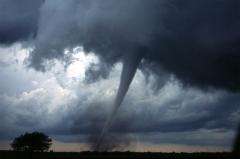
Global warming will likely mean more unpredictable weather, scientists say, and a new study by researchers at the University of Georgia pins down, possibly for the first time, how drought conditions in an area's fall and winter may effect tornado activity the following spring.
The study, published today in the journal Environmental Research Letters, is specific to Georgia and the Southeast, but further study could reveal patterns that might make this more general—including the already tornado-prone Great Plains.
"Our results suggest that there is a statistically significant reduction in tornado activity during a tornado season following drought the preceding fall and winter," said Marshall Shepherd, a meteorologist and lead author of the study. On the other hand, wet autumns and winters examined in the study had nearly twice as many spring tornado days as drought years did.
The research gives hope that one day meteorologists and climatologists may be able to predict the severity of a spring tornado season the way they now do for hurricanes. Other authors of the paper were Thomas Mote, also of the University of Georgia, and Dev Niyogi of Purdue University. Shepherd and Mote are in department of geography in UGA's Franklin College of Arts and Sciences.
The genesis for the research was the severe Atlanta tornado in March 2008, and Shepherd's interest in how tornadoes form during severe drought years.
While such tools as Doppler radar have increased our ability to "see" tornadoes as they form, predicting a tornado season's potential severity has remained elusive. The Intergovernmental Panel on Climate Change projected in 2007 that the frequency and severity of droughts may increase over time, but very little is known about drought conditions affect the frequency or intensity of severe weather hazards such as tornadoes.
To help understand how fall and winter weather might affect spring tornado seasons, the research team acquired the historical database of severe thunderstorms and tornado occurrences from 1951-2006 from the Storm Prediction Center of the National Oceanic and Atmospheric Administration. They also analyzed storm data reports from the National Climactic Data Center and meteorological drought conditions using historical rain gauge and Tropical Rainfall Measuring Mission (TRMM) satellite data from the National Aeronautics and Space Administration (NASA).
Using a number of tools of scientific analysis, the team primarily focused on tornado activity from March-June in Georgia and the Southeast. What they found was shocking, Shepherd said, yet plausible.
On average, wet autumns and winters presaged nearly twice as many spring tornado days in the study area as prior drought seasons. Springs following wet winters and falls were also five to six times more likely to have multiple tornado days than antecedent drought years.
"We do not suggest that soil moisture or precipitation the previous fall and winter exert a direct control on which individual storms will spawn tornadoes," said Shepherd. "But these long-term seasonal relationships in the study area are striking."
Correlating historical records and tornado activity has been difficult at best for scientists over the years. For one thing, the National Weather Service did not implement its watch and warning system until the mid-1950s, and only with advent of advanced radar techniques and ground examination of storm sites have researchers been able to say categorically that a certain storm even was a tornado. Also, studies linking tornadic activity with the El Niño cycle have been contradictory.
While it clearly seems that wet falls and winters lead to more severe spring tornado seasons, antecedent seasonal drought scenarios in north Georgia were almost never associated with above-normal tornadic activity the following spring over the 50-years period of the study.
The results for north Georgia were essentially replicated for the larger region encompassing Tennessee, Georgia, Alabama and Mississippi. For this entire region, a stunning 75 percent of years characterized by meteorological drought in falls and winters had below-normal tornado seasons in the spring.
While the new study, which was supported by grants from NASA, offers strong clues about how spring tornado seasons form, the authors urge caution in interpreting the findings until the analysis is repeated for other locations.
Just how the connection works between fall-winter rainfall and spring tornado seasons remains unclear. One possibility is that the atmosphere uses soil moisture "memory" from the fall and winter to modify conditions suitable for severe weather. A related hypothesis is related to "soil moisture" pockets and storm initiation.
Source: University of Georgia (news : web)


