First acoustic metamaterial 'superlens' created
June 24, 2009 First acoustic metamaterial 'superlens' created by U. of I. researchers

Enlarge

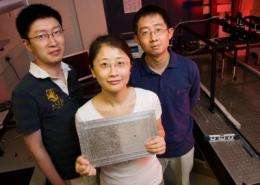
A team of Illinois researchers led by Nicholas X. Fang, left, a professor of mechanical science and engineering, have created the world's first acoustic "superlens." Doctoral student Shu Zhang holding the lens and Leilei Yin, a microscopist at Beckman Institute, were co-authors. Credit: L. Brian Stauffer

A team of researchers at the University of Illinois has created the world's first acoustic "superlens," an innovation that could have practical implications for high-resolution ultrasound imaging, non-destructive structural testing of buildings and bridges, and novel underwater stealth technology.

The team, led by Nicholas X. Fang, a professor of mechanical science and engineering at Illinois, successfully focused ultrasound waves through a flat metamaterial lens on a spot roughly half the width of a wavelength at 60.5 kHz using a network of fluid-filled Helmholtz resonators.

According to the results, published in the May 15 issue of the journal Physical Review Letters, the acoustic system is analogous to an inductor-capacitor circuit. The transmission channels act as a series of inductors, and the Helmholtz resonators, which Fang describes as cavities that house resonating waves and oscillate at certain sonic frequencies almost as a musical instrument would, act as capacitors.

Fang said acoustic imaging is somewhat analogous to optical imaging in that bending sound is similar to bending light. But compared with optical and X-ray imaging, creating an image from sound is "a lot safer, which is why we use sonography on pregnant women," said Shu Zhang, a U. of I. graduate student who along with Leilei Yin, a microscopist at the Beckman Institute, are co-authors of the paper.

Although safer, the resultant image resolution of acoustic imaging is still not as sharp or accurate as conventional optical imaging.

"With acoustic imaging, you can't see anything that's smaller than a few millimeters," said Fang, who also is a researcher at the institute. "The image resolution is getting better and better, but it's still not as convenient or accurate as optical imaging."

The best tool for tumor detection is still the optical imaging, but exposure to certain types of such as X-rays also has its health risks, Fang noted.

"If we wish to detect or screen early stage tumors in the human body using acoustic imaging, then better resolution and higher contrast are equally important," he said. "In the body, tumors are often surrounded by hard tissues with high contrast, so you can't see them clearly, and acoustic imaging may provide more details than optical imaging methods."

Fang said that the application of acoustic imaging technology goes beyond medicine. Eventually, the technology could lead to "a completely new suite of data that previously wasn't available to us using just natural materials," he said.

In the field of non-destructive testing, the structural soundness of a building or a bridge could be checked for hairline cracks with acoustic imaging, as could other deeply embedded flaws invisible to the eye or unable to be detected by optical imaging.

"Acoustic imaging is a different means of detecting and probing things, beyond optical imaging," Fang said.

Fang said acoustic imaging could also lead to better underwater stealth technology, possibly even an "acoustic cloak" that would act as camouflage for submarines. "Right now, the goal is to bring this 'lab science' out of the lab and create a practical device or system that will allow us to use acoustic imaging in a variety of situations," Fang said.

Source: University of Illinois at Urbana-Champaign (news : web)


Rate this story - 4.4 /5 (13 votes)

Rank Filter

Move the slider to adjust rank threshold, so that you can hide some of the comments.


Display comments: newest first

  • otto1923 - Jun 24, 2009
    • Rank: 5 / 5 (1)
    Better acoustic weapons?
  • bearly - Jun 24, 2009
    • Rank: 1 / 5 (1)
    Since it has military applications, the public won't see (pun intended) much of this tecnology.
  • bredmond - Jun 24, 2009
    • Rank: 1 / 5 (1)
    maybe i could use this for a Brain-Computer Interface device.
  • Birger - Jun 25, 2009
    • Rank: 3 / 5 (2)
    I see two very concrete applications:
    ultrasound imaging of fetuses (even severe cases where the fetus lacks three-quarters of the brain can sometimes escape detection until very late in pregnancy, due to the imperfections of current ultrasound technology) and
    quality control of ceramic tiles for the aerospace industry (remember the brittle tiles of the space shuttle - today it is impossible to detect small defects, which makes ceramics prone to catastophic failure).
  • KBK - Jul 01, 2009
    • Rank: not rated yet
    "We were working secretly...for the military..our experiments in sound were nearly ready to begin..

    They told us, that they wanted...a sound..that ....could kill someone from a distance..."

    Lyrics for the Kate Bush song, -'Experiment #IV'
  • cmn - Jul 01, 2009
    • Rank: not rated yet
    Fang's like: "yeah, I'd tap Shu Zhang." :}

June 24, 2009 all stories

Comments: 6

4.4 /5 (13 votes)

  • hide
  • Related Stories


  • hide
  • Relevant PhysicsForums posts

  • Interception angle
    created 2 hours ago
  • Pressure created by clamping base and cover
    created 2 hours ago
  • How to find static friction
    created 8 hours ago
  • Calculating decible increases
    created 16 hours ago
  • More from Physics Forums - General Physics

Other News

Extra large carbon

Extra large carbon

Physics / General Physics

created 16 hours ago | popularity 4.7 / 5 (12) | comments 7 | with audio podcast

An exotic form of carbon has been found to have an extra large nucleus, dwarfing even the nuclei of much heavier elements like copper and zinc, in experiments performed in a particle accelerator in Japan. ...


Scientist explore future of high-energy physics

Scientist explore future of high-energy physics

Physics / General Physics

created 22 hours ago | popularity 4.9 / 5 (12) | comments 8 | with audio podcast

In a 1954 speech to the American Physical Society, the University of Chicago's Enrico Fermi fancifully envisioned a particle accelerator that encircled the globe. Such would be the ultimate theoretical outcome, ...


Leaf veins inspire a new model for distribution networks (w/ Video)

Physics / General Physics

created 19 hours ago | popularity 5 / 5 (3) | comments 0 | with audio podcast

(PhysOrg.com) -- Following the straight and narrow may be good moral advice, but it’s not a great design principle for a distribution network. In new research, a team of biophysicists describe a complex netting of interconnected ...


New magnetic tuning method enhances data storage

New magnetic tuning method enhances data storage

Physics / General Physics

created 22 hours ago | popularity 4.2 / 5 (5) | comments 0 | with audio podcast

Researchers in Chicago and London have developed a method for controlling the properties of magnets that could be used to improve the storage capacity of next-generation computer hard drives.


High-performance microring resonator developed by INRS researchers

Physics / Optics & Photonics

created 14 hours ago | popularity 1.5 / 5 (2) | comments 0

A new, more efficient low-cost microring resonator for high speed telecommunications systems has been developed and tested by Professor Roberto Morandotti's INRS team in collaboration with Canadian, American, and Australian ...