A breath mint made from... coffee?
June 24, 2009 A breath mint made from... coffee?

Enlarge

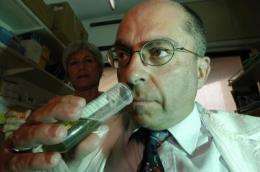
This is Prof. Mel Rosenberg, Tel Aviv University, in his laboratory. Credit: AFTAU

We all know why Starbucks puts boxes of breath mints close to the cash register. Your morning latte can create a startling aroma in your mouth, strong enough to startle your co-workers too.

But intriguing new research from Tel Aviv University by renowned breath specialist Prof. Mel Rosenberg of TAU's Sackler Faculty of Medicine finds that a coffee extract can inhibit the bacteria that lead to bad breath. New laboratory tests have shown that the extract prevents malodorous bacteria from making their presence felt -- or smelt.

"Everybody thinks that coffee causes bad breath," says Prof. Rosenberg, "and it's often true, because coffee, which has a dehydrating effect in the mouth, becomes potent when mixed with milk, and can into smelly substances."

But not always. "Contrary to our expectations, we found some components in coffee that actually inhibit bad breath," explains Prof. Rosenberg. The findings were presented last month to members of the International Society for Breath Odor Research in Germany by Yael Gov, a researcher in Prof. Rosenberg's laboratory.

A "taster's choice" for stopping bad bacteria

In the laboratory, the team monitored the bacterial odor production of coffee in saliva. In the study, three different brands of coffee were tested: the Israeli brand Elite coffee, Landwer Turkish coffee, and Taster's Choice. Prof. Rosenberg expected to demonstrate the malodor-causing effect of coffee in an in vitro assay developed by Dr. Sarit Levitan in his laboratory. To his surprise, the extracts had the opposite effect.

"The lesson we learned here is one of humility," says Prof. Rosenberg. "We expected coffee would cause bad breath, but there is something inside this magic brew that has the opposite effect."

Prof. Rosenberg would love to isolate the bacterial-inhibiting molecule in order to reap the biggest anti-bacterial benefits from coffee. "It's not the raw extract we will use," he says, "but an active material within it." His latest discovery could be the foundation for an entirely new class of mouthwash, breath mints and gum. Purified extract can be added to a breath mint to stop bacteria from forming, stopping at its source, instead of masking the smell with a mint flavor.

Prof. Rosenberg is a successful scientist and inventor who has already developed a popular mouthwash sold widely in Europe, a pocket-based breath test, and an anti-odor chewing gum.

Source: Tel Aviv University (news : web)


print this article email this article download pdf blog this article bookmark this article     Stumble it Digg this share on Facebook retweet share on Reddit add to delicious
Rate this story - 4.3 /5 (3 votes)


June 24, 2009 all stories

Comments: 0

4.3 /5 (3 votes)
  • Stumble this up

  • Digg this

  • share this

  • hide
  • Related Stories

  • Sweet magnolia: Tree bark extract fights bad breath and tooth decay
    created Nov 19, 2007 | popularity not rated yet | comments 0
  • Are you okay to kiss?
    created May 18, 2009 | popularity not rated yet | comments 0
  • Stomach ulcer bug causes bad breath
    created Nov 24, 2008 | popularity not rated yet | comments 0
  • Fingerprinting fake coffee
    created Sep 03, 2007 | popularity not rated yet | comments 0
  • Bad breath? Mouthrinses work, but some cause temporary staining
    created Oct 08, 2008 | popularity not rated yet | comments 0


  • hide
  • Relevant PhysicsForums posts

  • nesfatin
    created 20 hours ago
  • Obsessive Compulsive Disorder
    created Nov 20, 2009
  • West's zone 2 starling resistor respiratory physiology
    created Nov 18, 2009
  • 50-0-50 rule
    created Nov 18, 2009
  • More from Physics Forums - Medical Sciences

Other News

popcorn

Popcorn at the movies still an unhealthy treat

Medicine & Health / Health

created 29 minutes ago | popularity not rated yet | comments 0

(PhysOrg.com) -- A study carried out in 1994 by advocacy group CSPI (Center for Science in the Public Interest) found that popcorn being sold by cinema chains in the US was high in saturated fat and calories, ...


New research shows versatility of amniotic fluid stem cells

Medicine & Health / Research

created 5 hours ago | popularity 5 / 5 (2) | comments 0

For the first time, scientists have demonstrated that stem cells found in amniotic fluid meet an important test of potential to become specialized cell types, which suggests they may be useful for treating a wider array of ...


Study: kids watching hours of TV at home daycare

Medicine & Health / Health

created 4 hours ago | popularity not rated yet | comments 0

In a new study, the amount of television viewed by many young children in child care settings doubles the previous estimates of early childhood screen time, with those in home-based settings watching significantly more on ...


Researchers track down protein responsible for chronic rhinosinusitis with polyps

Medicine & Health / Diseases

created 5 hours ago | popularity not rated yet | comments 0

A protein known to stimulate blood vessel growth has now been found to be responsible for the cell overgrowth in the development of polyps that characterize one of the most severe forms of sinusitis, a study by Johns Hopkins ...


Exposure to lead, tobacco smoke raises risk of ADHD

Medicine & Health / Health

created 5 hours ago | popularity not rated yet | comments 0

Children exposed prenatally to tobacco smoke and during childhood to lead face a particularly high risk for ADHD, according to research done at Cincinnati Children's Hospital Medical Center.