Prehistoric flute in Germany is oldest known
June 24, 2009 Prehistoric flute in Germany is oldest known

Enlarge

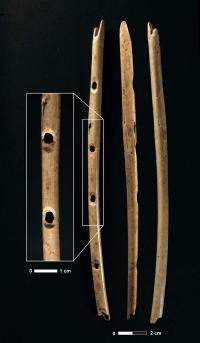
The flute. Foto: H. Jensen. Copyright: Universität Tübingen.

Excavations in the summer of 2008 at the sites of Hohle Fels and Vogelherd produced new evidence for Paleolithic music in the form of the remains of one nearly complete bone flute and isolated small fragments of three ivory flutes.

The most significant of these finds, a nearly complete bone flute, was recovered in the basal Aurignacian deposits at Hohle Fels Cave in the Ach Valley, 20 km west of Ulm. The flute was found in 12 pieces. The fragments were distributed over a vertical distance of 3 cm over a horizontal area of about 10 x 20 cm. This flute is by far the most complete of all of the musical instruments thus far recovered from the caves of Swabia.

The preserved portion of the bone flute from Hohle Fels has a length of 21.8 cm and a diameter of about 8 mm. The flute preserves five finger holes. The surfaces of the flute and the structure of the bone are in excellent condition and reveal many details about the manufacture of the flute. The maker carved two deep, V-shaped notches into one end of the instrument, presumably to form the proximal end of the flute into which the musician blew. The find density in this stratum is moderately high with much flint knapping debris, worked bone and ivory, bones of horse, reindeer, mammoth, cave bear, ibex, as well as burnt bone. No diagnostic human bones have been found in deposits of the Swabian Aurignacian, but we assume that modern humans produced the artifacts from the basal Aurignacian deposits shortly after their arrival in the region following a migration up the Danube Corridor.

The maker of the flute carved the instrument from the radius of a griffon vulture (Gyps fulvus). This species has a wingspan between 230 and 265 cm and provides bones ideal for large flutes. Griffon vultures and other vultures are documented in the Upper Paleolithic sediments of the Swabian caves.

The 2008 excavations at Hohle Fels also recovered two small fragments of what are almost certainly two ivory flutes from the basal Aurignacian. The different dimensions of the fragments indicate that the two finds are not from the same instrument. Excavators at Vogelherd in the Lone Valley 25 km northwest of Ulm recovered another isolated fragment of another ivory flute.

The technology for making an ivory flute is much more complicated than making a flute from a bird bone. This process requires forming the rough shape along the long axis of a naturally curved piece of ivory, splitting it open along one of the bedding plains in the ivory, carefully hollowing out the halves, carving the holes, and then rejoining the halves of the flute with an air-tight seal. Given the tendency of delicate ivory artifacts to break into many pieces, it is not unusual to find isolated pieces of such artifacts.

The 10 radiocarbon dates from the basal Aurignacian fall between 31 and 40 ka BP. Available calibrations and independent controls using other methods indicate that the flutes from Hohle Fels predate 35,000 calendar years ago. Apart from the caves of the Swabian Jura there is no convincing evidence for musical instruments predating 30 ka BP.

These finds demonstrate that music played an important role in Aurignacian life in the Ach and Lone valleys of southwestern Germany. Most of these flutes are from archaeological contexts containing an abundance of organic and lithic artifacts, hunted fauna, and burnt bone. This evidence suggests that the inhabitants of the sites played musical instruments in diverse social and cultural contexts and that flutes were discarded with many other forms of occupational debris. In the case of Hohle Fels, the location of the bone flute in a thin archaeological horizon only 70 cm away from a female figurine of similar age suggests that a possible contextual link exists between these two finds.

The flutes from Hohle Fels, Vogelherd and previous finds from nearby Geißenklösterle Cave demonstrate that a musical tradition existed in the cultural repertoire of the Aurignacian around the time modern humans settled in the Upper Danube region. The development of a musical tradition in the Aurignacian accompanied the development of the early figurative art and numerous innovations, including a wide array of new forms of personal ornaments, as well as new lithic and organic technologies. The presence of music in the lives of Upper Paleolithic peoples did not directly produce a more effective subsistence economy and greater reproductive success, but music seems to have contributed to improved social cohesion and new forms of communication, which indirectly contributed to demographic expansion of modern humans relative to the culturally more conservative Neanderthal populations.

The flutes from the caves of the Swabian Jura constitute a key part a major exhibit in Stuttgart entitled Ice Age Art and Culture, which will run from September 18, 2009 - January 10, 2010.

More information: The authors of the paper “New flutes document the earliest musical tradition in southwestern Germany” are Nicholas J. Conard Maria Malina and Susanne C. Münzel. The paper will be published as Advance online publication in Nature, June 25, 2009.

Provided by Universitaet Tuebingen


print this article email this article download pdf blog this article bookmark this article     Stumble it Digg this share on Facebook retweet share on Reddit add to delicious
Rate this story - 4.4 /5 (9 votes)

Rank Filter

Move the slider to adjust rank threshold, so that you can hide some of the comments.


Display comments: newest first

  • mattytheory - Jun 25, 2009
    • Rank: not rated yet
    This is the first I have heard about any of these double-digit thousand year old flutes!
  • denijane - Jun 25, 2009
    • Rank: not rated yet
    "Neanderthals also lived in Europe around the time the flute and sculpture were made, and frequented the Hohle Fels cave. Both Conard and Roebroeks believe, however, that layered deposits left by both species over thousands of years suggest the artifacts were crafted by early modern humans."

    Yes, it's so fun base a theory only on prejudices and a gut feeling. Maybe because evolution works only for Homo Sapiens. Neanderthals are a product of different natural law and they are bound to stay the same throughout the history.

    Ok, irony aside, if we consider our human history if we compare our culture today, with that a mere 2000 of years ago, the difference is obvious. If that can happens to us, then it might happen to Neanderthals too. And we're talking about a simple flute, not about spaceships!
  • ThomasS - Jun 25, 2009
    • Rank: 5 / 5 (1)
    No mention of the flute's musical scale? I know from 8000-year old chinese flutes (which were found in one piece) that they match the normal diatonic scale used today. Would be interesting information.
  • THEY - Jun 25, 2009
    • Rank: 5 / 5 (2)
    Thomas - it is diatonic. There is a player you can listen to in this article:
    http://news.bbc.c...7915.stm

    So cool!
  • cyberflute - Jun 29, 2009
    • Rank: not rated yet
    Despite the primitive nature of the culture, expression through music still existed. We should keep that in mind when school districts want to cut music and art programs.

    http://www.cyberflute.com

June 24, 2009 all stories

Comments: 5

4.4 /5 (9 votes)
  • Stumble this up

  • Digg this

  • share this

  • hide
  • Related Stories

  • Ivory sculpture in Germany could be world's oldest
    created May 13, 2009 | popularity not rated yet | comments 0
  • Scientists redate Neanderthal fossils
    created Jan 05, 2006 | popularity not rated yet | comments 0
  • How modern were European Neandertals?
    created Aug 25, 2006 | popularity not rated yet | comments 0
  • China's earliest modern human
    created Apr 02, 2007 | popularity not rated yet | comments 0
  • Neanderthal/human relationship questioned
    created Sep 12, 2005 | popularity not rated yet | comments 0


  • hide
  • Relevant PhysicsForums posts

  • Super quick question about Starling forces?
    created Nov 22, 2009
  • Questions about diffusion
    created Nov 22, 2009
  • Human Leukocyte Antigen (HLA) typing
    created Nov 21, 2009
  • Breeding program
    created Nov 20, 2009
  • How does a concentration gradient provide energy?
    created Nov 20, 2009
  • Eyesight and Neural Damage from Electronics
    created Nov 19, 2009
  • More from Physics Forums - Biology

Other News

Grand Canyon to change 'unfair' permit system

Other Sciences / Other

created 3 hours ago | popularity not rated yet | comments 0

(AP) -- Getting one of the roughly 11,500 permits granted each year to backpack overnight in the Grand Canyon has become so competitive and "unfair" that managers at the national park have decided to change the system.


Researcher: Faint writing seen on Shroud of Turin (AP)

Researcher: Faint writing seen on Shroud of Turin (Update)

Other Sciences / Archaeology & Fossils

created Nov 20, 2009 | popularity 2.3 / 5 (28) | comments 30

(AP) -- A Vatican researcher has rekindled the age-old debate over the Shroud of Turin, saying that faint writing on the linen proves it was the burial cloth of Jesus. Experts say the historian may be reading ...


Museum: Galileo's fingers, tooth are found (AP)

Museum: Galileo's fingers, tooth are found

Other Sciences / Archaeology & Fossils

created Nov 21, 2009 | popularity 4.3 / 5 (3) | comments 7

(AP) -- Two fingers and a tooth removed from Galileo Galilei's corpse in a Florentine basilica in the 18th century and given up for lost have been found again and will soon be put on display, an Italian museum ...


Maya

New insights into the life of the Maya

Other Sciences / Archaeology & Fossils

created Nov 16, 2009 | popularity 4.6 / 5 (15) | comments 7

(PhysOrg.com) -- Ancient artifacts are almost always concerned with rich and powerful religious and political leaders, but new excavations of an ancient Maya site have unearthed a pyramid decorated with murals ...


Three of a kind

Three of a kind: Revealing language’s universal essence

Other Sciences / Social Sciences

created Nov 20, 2009 | popularity 4.1 / 5 (13) | comments 6

(PhysOrg.com) -- On the surface, English, Japanese, and Kinande, a member of the Bantu family of languages spoken in the Democratic Republic of Congo, have little in common. It is not just that the vocabularies ...