Ancient well, and body, found in Cyprus
June 24, 2009 By MENELAOS HADJICOSTIS , Associated Press Writer Ancient well, and body, found in Cyprus (AP)

Enlarge

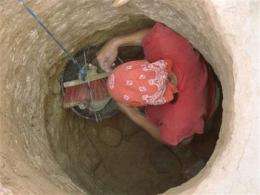
In this undated image provided by Cyprus' Antiquities Department, Wednesday, June 24, 2009, a researcher descends into a prehistoric well in Kirsonerga village in the Paphos district of Cyprus. Archaeologists have discovered a water well in Cyprus that was built as long as 10,500 years ago, and the skeleton of a young woman at the bottom of it, an official said Wednesday. (AP Photo/Cyprus Antiquities Department, HO)

(AP) -- Archaeologists have discovered a water well in Cyprus that was built as long as 10,500 years ago, and the skeleton of a young woman at the bottom of it, an official said Wednesday.

Pavlos Flourentzos, the nation's top antiquities official, said the 16-foot (5-meter) deep cylindrical shaft was found last month at a construction site in Kissonerga, a village near the Mediterranean island nation's southwestern coast.

After the well dried up it apparently was used to dispose trash, and the items found in it included the poorly preserved skeleton of the young woman, animal , worked flints, stone beads and pendants from the island's early Neolithic period, Flourentzos said.

The skeleton could be as old as the well itself, but don't know how the girl died or when and why the was left there, he said. Radiocarbon dating found the well is between 9,000 to 10,500 years old, he said.

That was around the time migrating humans started to build permanent settlements on the island. Before then, temporary settlements were inhabited by sea-borne migrants using Cyprus as a way station to other destinations.

Thomas Davis, director of the Nicosia-based Cyprus American Archaeological Research Institute, said the well - which he called "among the earliest in the world" - offers proof of the "high level of sophistication" of the island's early Neolithic farmers.

"The fact that they were using wells and that they tapped into the island's water table shows heightened appreciation for the environment here," said Davis, who was not involved in the discovery. "This was a major investment."

Cypriot archaeologists studied the well in collaboration with Edinburgh University. The university has excavated in the area over the last three decades, unearthing several settlements dating from the Chalcolithic Period (3800-2500 B.C.).

©2009 The Associated Press. All rights reserved. This material may not be published, broadcast, rewritten or redistributed.


print this article email this article download pdf blog this article bookmark this article     Stumble it Digg this share on Facebook retweet share on Reddit add to delicious
Rate this story - 4.8 /5 (8 votes)


June 24, 2009 all stories

Comments: 0

4.8 /5 (8 votes)
  • Stumble this up

  • Digg this

  • share this

  • hide
  • Related Stories

  • Dig uncovers ancient beach camp site
    created Nov 23, 2005 | popularity not rated yet | comments 0
  • 3,000-year-old skeleton found in Rome
    created May 31, 2006 | popularity not rated yet | comments 0
  • Prehistoric human skeleton found in Texas
    created Aug 28, 2006 | popularity not rated yet | comments 0
  • Ancient handle with Hebrew text found in Jerusalem
    created May 20, 2009 | popularity not rated yet | comments 0
  • Briefs: Rare ancient coffin found in Cyprus
    created Mar 20, 2006 | popularity not rated yet | comments 0


  • hide
  • Relevant PhysicsForums posts

  • Breeding program
    created 23 hours ago
  • How does a concentration gradient provide energy?
    created Nov 20, 2009
  • Eyesight and Neural Damage from Electronics
    created Nov 19, 2009
  • Quick question about the Golgi Apparatus?
    created Nov 19, 2009
  • More from Physics Forums - Biology

Other News

Museum: Galileo's fingers, tooth are found (AP)

Museum: Galileo's fingers, tooth are found

Other Sciences / Archaeology & Fossils

created 8 hours ago | popularity not rated yet | comments 4

(AP) -- Two fingers and a tooth removed from Galileo Galilei's corpse in a Florentine basilica in the 18th century and given up for lost have been found again and will soon be put on display, an Italian museum ...


Researcher: Faint writing seen on Shroud of Turin (AP)

Researcher: Faint writing seen on Shroud of Turin (Update)

Other Sciences / Archaeology & Fossils

created 23 hours ago | popularity 1.8 / 5 (20) | comments 21

(AP) -- A Vatican researcher has rekindled the age-old debate over the Shroud of Turin, saying that faint writing on the linen proves it was the burial cloth of Jesus. Experts say the historian may be reading ...


Measure to change U. of Neb. stem-cell rule fails (AP)

Measure to change U. of Neb. stem-cell rule fails (Update 2)

Other Sciences / Other

created 8 hours ago | popularity 5 / 5 (1) | comments 0

(AP) -- The University of Nebraska's governing board on Friday voted not to place tighter restrictions on embryonic stem cell research than those outlined under federal guidelines, which were expanded after ...


Three of a kind

Three of a kind: Revealing language’s universal essence

Other Sciences / Social Sciences

created Nov 20, 2009 | popularity 3.5 / 5 (8) | comments 6

(PhysOrg.com) -- On the surface, English, Japanese, and Kinande, a member of the Bantu family of languages spoken in the Democratic Republic of Congo, have little in common. It is not just that the vocabularies ...


Maya

New insights into the life of the Maya

Other Sciences / Archaeology & Fossils

created Nov 16, 2009 | popularity 4.6 / 5 (15) | comments 7

(PhysOrg.com) -- Ancient artifacts are almost always concerned with rich and powerful religious and political leaders, but new excavations of an ancient Maya site have unearthed a pyramid decorated with murals ...