A new approach to engineering for extreme environments (w/ Video)
June 24, 2009 by Anne Trafton
A new approach to engineering for extreme environments

Enlarge

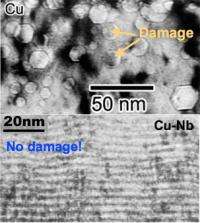
When copper is irradiated, defects form in the metal lattice (top photo). In a nanocomposite of copper and niobium, radiation damage is contained by interfaces between the copper and niobium layers (bottom photo). Courtesy / Michael Demkowicz

(PhysOrg.com) -- Composite materials such as fiberglass, which take on a mix of properties of their constituent compounds, have been around for decades. Now, an MIT materials scientist is taking composites to the nanoscale, where entirely new properties, not found in any of the original compounds, can emerge.

Michael Demkowicz, an assistant professor in MIT's Department of Science and Engineering, is part of a team based at Los Alamos National Laboratory that recently received a federal Energy Frontier Research Centers grant to develop nanocomposite materials that can endure , radiation and extreme mechanical loading. The ultimate goal is to use these materials in energy applications including nuclear power, fuel cells, solar energy and .

"All sectors of energy production need materials that can withstand extreme conditions," says Demkowicz, whose model offers a new approach to designing nanocomposites with desirable traits.

There are many models that can take a proposed material structure and predict how it will behave. However, such trial-and-error approaches still require repeated cycles of manufacture and testing and are "an extremely costly and time-consuming way to come up with a new material," says Demkowicz.

His model tackles what materials scientists call "the inverse problem" -- specifying a desired set of properties and then predicting which structures will deliver them -- and could dramatically speed up the design process.

Radiation resistance

Demkowicz' first target is radiation-resistant materials, which could improve the efficiency and safety of nuclear power plants.

Normally, when metals are exposed to radiation, high-energy particles such as neutrons bump into individual atoms and knock them out of their . Like billiard balls, the displaced atoms bump into neighboring atoms, spreading damage in the form of "vacancies" (holes where an atom is missing), and "interstitials" (an extra atom squeezed in where it shouldn't be). Clusters of these defects can make the material brittle and weak.

This video is not supported by your browser at this time.

In this video, radioactive particles bombarding the interface of a copper-niobium nanocomposite initially damage the material, but the damage is quickly contained. Credit: Courtesy/Michael Demkowicz

The key to making nanocomposite materials resistant to lies in the interfaces between layers of different materials. As the layers become thinner, the interfaces play a more dominant role in the material properties because the ratio of interface area to the material's total volume becomes larger. These interfaces give rise to novel properties not found in the original materials.

In some nanocomposites, vacancies and interstitials can get trapped at interfaces, where they have a higher likelihood of meeting. When that happens, the extra atom fills in the hole and the crystal structure is restored. Under some conditions it can appear as if there was no radiation damage remaining at all, says Demkowicz.

Materials resistant to radiation damage could eventually be used to line nuclear reactors, a function now performed by stainless steel. That could extend the lifetime of nuclear reactors and allow them to operate under higher radiation doses. Whereas current reactors consume only about one percent of their fuel, these improved reactors could burn a higher percentage of nuclear fuel and leave behind less waste.

Demkowicz has used his model, which is based on reproducing the mechanical interactions of groups of atoms, to design a nanocomposite with interfaces that resist radiation. The material, described in Physical Review Letters last year, is a mix of copper and the metal niobium and could not be used in a nuclear reactor because it absorbs neutrons and becomes radioactive. However, now that he knows copper-niobium is resistant to radiation damage, Demkowicz can use his modeling techniques to look for other materials that share that property.

Once a promising candidate is identified, it takes several years of testing before a new material can be approved for use in a nuclear reactor, so it will likely be at least a decade before any of his potential new materials can be used, says Demkowicz.

Provided by Massachusetts Institute of Technology (news : web)

4.7 /5 (3 votes)  

Filter


Move the slider to adjust rank threshold, so that you can hide some of the comments.


Display comments: newest first

Alizee
Jun 27, 2009

Rank: 5 / 5 (1)
Layered structure of Cu-Nb alloy is apparently prepared in the similar way, like damascus steel, because copper and niob metals are inmiscible even at the fluid state.
Ralph
Jul 05, 2009

Rank: not rated yet
Wonderful, almost miraculous, and this demonstrates a move toward materials with resemblances to biological tissues. In the world of biology, of course, there are vanishingly few places where a single atomic species is found clumped or crystallized; instead, everything is layered or twisted.


Could a material such as the one described also repair itself after having undergone some classes of mechanical stress? Long-term, slowly accumulating "metal fatigue" might share some characteristics of radiation damage.
Alizee
Jul 11, 2009

Rank: 5 / 5 (1)
Rank 4.7 /5 (3 votes)
Relevant PhysicsForums posts
  • excited U-236 decay time in the U235 fission chain
    created13 hours ago
  • Polar catastrophe?
    created16 hours ago
  • Large scale field sonication
    created19 hours ago
  • states and energy of paired electrons in BCS
    createdFeb 08, 2012
  • difference between longitudinal and transverse refractive indices
    createdFeb 08, 2012
  • Monte Carlo simulation
    createdFeb 07, 2012
  • More from Physics Forums - Atomic, Solid State, Comp. Physics

More news stories

Explained: Sigma

It's a question that arises with virtually every major new finding in science or medicine: What makes a result reliable enough to be taken seriously? The answer has to do with statistical significance -- but ...

Physics / General Physics

created 23 hours ago | popularity 5 / 5 (13) | comments 32

Borexino Collaboration succeeds in spotting pep neutrinos emitted from the sun

(PhysOrg.com) -- To learn more about how the sun works, scientists study particles that are emitted from it into space due to thermonuclear reactions that occur inside; by applying known physics principles, ...

Physics / General Physics

created 23 hours ago | popularity 4.6 / 5 (7) | comments 0 | with audio podcast report

Physics research suggests new pathways for cancer progression

Observing that certain cancer cells may exhibit greater flexibility than normal cells, some scientists believe that this capability promotes rapid tumor growth. Now computer simulations developed by Boston University Biomedical ...

Physics / General Physics

created 21 hours ago | popularity 5 / 5 (1) | comments 0

Quantum physicist explains $100K offer for proof scaled-up quantum computing is impossible

(PhysOrg.com) -- MIT researcher Scott Aaronson has certainly riled the physics community with his offer this past Friday, of $100,000 to anyone who can prove that scaled-up quantum computing is impossible. ...

Physics / Quantum Physics

created Feb 08, 2012 | popularity 4.1 / 5 (11) | comments 32 | with audio podcast weblog

Physicists 'record' magnetic breakthrough

An international team of scientists has demonstrated a revolutionary new way of magnetic recording which will allow information to be processed hundreds of times faster than by current hard drive technology.

Physics / General Physics

created Feb 07, 2012 | popularity 4.5 / 5 (39) | comments 14 | with audio podcast


Protein libraries in a snap

(PhysOrg.com) -- A Rice University undergraduate will depart with not only a degree but also a possible patent for his invention of an efficient way to create protein libraries, an important component of biomolecular ...

Breastfeeding protects against asthma up to six years of age

(Medical Xpress) -- Research by the University of Otago in Christchurch and Wellington has shown that breastfeeding of infants has a clear protective effect against children developing asthma or wheezing up to six years of ...

Study finds stress hormones fluctuate with mood during pregnancy

(Medical Xpress) -- While pregnant, women pay particular attention to factors such as diet and exercise to ensure their babies are born healthy and develop normally. New research from the University of Calgary’s Faculty ...

Humans may have helped the decline of African rainforests 3000 years ago

(PhysOrg.com) -- Large areas of rainforests in Central Africa mysteriously disappeared over three thousand years ago, to be replaced by savannas. The prevailing theory has been that the cause was a change ...

Japan scientist makes 'Avatar' robot

A Japanese-developed robot that mimics the movements of its human controller is bringing the Hollywood blockbuster "Avatar" one step closer to reality.

Miami battling invasion of giant African snails

No one knows how they got there. But an invasion of African giant snails has southern Florida in a panic over potential crop damage, disease and general yuckiness surrounding the slimy gastropods.