Experts examine risks to birds from wind turbines (w/ Video)
June 24, 2009 By Krishna Ramanujan
(PhysOrg.com) -- Are wind turbines dangerous to billions of migrating birds?
Nobody really knows for sure because two-thirds of migrating bird species fly at night, making direct study of their habits and potential hazards a challenge, said Cornell researchers at the Cornell Workshop on Large-Scale Wind-Generated Power, June 13.
The workshop for U.S. and international experts took place in Hollister Hall, June 12-13 and scientists addressed issues associated with the growing use of wind power to generate electricity in the United States.
This video is not supported by your browser at this time.
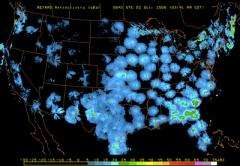
This animation illustrates the use of a network of surveillance weather radar to record nocturnal migrating birds, bats and insects in the continental U.S. from sunset to sunrise Oct. 1, 2008. The blocky green, yellow and red patterns, especially visible on the east coast, represent precipitation; but within an hour after sunset, radar picks up biological activity, as seen in the widening blue and green circles spreading from the east across the country. The birds, bats and insects take off, fly past and get sampled by the radar beam. Note, the black areas on the map do not represent places without birds, necessarily, but rather places where radar does not sample. (Andrew Farnsworth/Lab of Ornithology)
Radar, combined with state-of-the-art bio-acoustic listening devices, could be an effective way to record birds' flight calls at night and then quantify and identify species migrating past potential and existing wind-power sites, asserted Chris Clark, director of the Bioacoustics Research Program at Cornell's Lab of Ornithology, and Andrew Farnsworth, a postdoctoral associate at the lab and an expert on migrating birds, in a presentation. The bioacoustics program has developed such listening devices as well as the software to analyze them, Clark said.Farnsworth showed a brief video of radar data from the network of weather surveillance radars in the continental United States, superimposed over a map of the country, revealing migrations in the night sky between sunset and sunrise on Oct. 1, 2008. The color-coded radar map illustrated areas of precipitation over the coasts as well as vast movements of tens of millions of birds, bats and insects across the entire country. In the densest areas, the color-scales indicated movement of 2,000 birds per cubic kilometer.
"You're talking about a massive movement of birds overnight," Farnsworth said.
Migrating birds evolved with past and present weather patterns, which means migration pathways tend to overlap with high-wind areas that have the greatest potential for wind-energy development, Farnsworth said. Though research shows that windows in tall buildings and housecats ,ay be the greatest threat to migrating birds, the risks that wind turbines pose for these birds are not clear, he added.
Although radar data can show the magnitude, location, timing, speed and direction of migration patterns and provide information on key stopover sites, they do not identify types of birds or accurate flight altitudes, Farnsworth said. But combining radar data with data from flight call recordings and tracking tags on birds could allow researchers to identify many species in key areas.
Clark added that recorders are cost effective, can be automated for many months at remote sites, provide data on many species simultaneously, increase the probability of tracking secretive and endangered species, and could allow regulatory agencies to develop computer models to assess risks to birds from wind turbines.
He acknowledged, however, that using such acoustic technology could produce a massive "data crunch"; a single microphone over a three-to-four-month period can record 120 to 140 gigabytes of data, so data from several hundred microphones would be too much to process without advanced software. Also, researchers would need to better recognize the wide variety of flight calls and learn to integrate data from radar with those from acoustics and tracking tags, he added.
More research is needed, Clark stressed, to determine at what altitudes species tend to fly and whether birds sense turbine blades and avoid them.
Cornell has "opportunities and responsibilities" to make use of its multidisciplinary talents and resources, be proactive and engage the public to "do things today to save tomorrow," Clark asserted.
-
Wind turbines hazardous to birds, bats
Nov 13, 2007 |
not rated yet |
0
-
Birds migrate together at night in dispersed flocks
Jul 07, 2008 |
not rated yet |
0
-
What determines the speed at which birds fly?
Jul 17, 2007 |
not rated yet |
0
-
Texas wind farms deploy radar so birds, not feathers, can fly
Jun 14, 2009 |
not rated yet |
0
-
Parrots may block 2nd Australian wind farm
Apr 12, 2006 |
not rated yet |
0
-
Fast photon control brings quantum photonic technologies closer
1 minute ago |
not rated yet |
0
-
Engineers build first sub-10-nm carbon nanotube transistor
Feb 01, 2012 |
4.9 / 5 (33) |
30
-
Something old, something new: Evolution and the structural divergence of duplicate genes
Jan 31, 2012 |
4.6 / 5 (7) |
1
-
The hidden nanoworld of ice crystals: Revealing the dynamic behavior of quasi-liquid layers
Jan 30, 2012 |
5 / 5 (5) |
1
-
Stock market network reveals investor clustering
Jan 27, 2012 |
3.9 / 5 (23) |
8
-
Factors affecting beet root cell membrane
Feb 12, 2012
-
Stem cell question.
Feb 10, 2012
-
Protease cleavage
Feb 10, 2012
-
Pertubance in a model
Feb 10, 2012
-
Cancer drugs and Alzheimer's, Oh my!
Feb 09, 2012
-
Squishing cells
Feb 09, 2012
- More from Physics Forums - Biology
More news stories
Big Society could threaten biodiversity conservation
A study of the Moray Firth Seal Management Plan (MFSMP), in north-east Scotland, identified four key conditions for long-term success, three of which pointed to the importance of direct government involvement.
10 minutes ago |
not rated yet |
0
Biobased approaches examined in fight against zebra chip
Thanks to investigations by scientists-turned-detectives with the U.S. Department of Agriculture (USDA) and other agencies, potato growers in the western United States and abroad now know the identities of ...
30 minutes ago |
not rated yet |
0
New molecule has potential to help treat genetic diseases and HIV
(PhysOrg.com) -- Chemists at The University of Texas at Austin have created a molecule that's so good at tangling itself inside the double helix of a DNA sequence that it can stay there for up to 16 days before ...
2 hours ago |
5 / 5 (2) |
0
|
Integrated pest management recommendations for the southern pine beetle
The southern pine beetle, Dendroctonus frontalis Zimmermann, is a chronic insect pest within pine forests in the southeastern United States. Under favorable environmental and host conditions, it is an agg ...
5 hours ago |
not rated yet |
0
Germination of Bacillus species which can lead to food poisoning
Some bacteria can form spores (survival capsules) that are particularly resistant to heat. Since sporogenous bacteria can also cause food poisoning and a reduction in food quality, they constitute a significant ...
1 hour ago |
not rated yet |
0
Transforming galaxies
(PhysOrg.com) -- Many of the Universe's galaxies are like our own, displaying beautiful spiral arms wrapping around a bright nucleus. Examples in this stunning image, taken with the Wide Field Camera 3 on ...
'Smart' microcapsules in a single step
(PhysOrg.com) -- A new, single-step method of fabricating microcapsules, which have potential commercial applications in industries including medicine, agriculture and diagnostics, has been developed by researchers ...
New ability to regrow blood vessels holds promise for treatment of heart disease
(Medical Xpress) -- University of Texas at Austin researchers have demonstrated a new and more effective method for regrowing blood vessels in the heart and limbs a research advancement that could have ...
A continent ablaze in auroral and manmade light
The North American continent is literally set ablaze in a confluence of Auroral and Manmade light captured in spectacular new videos snapped by the astronauts serving aboard the International Space Station ...
Ethanol mandate not the best option
Many people are willing to pay a premium for ethanol, but not enough to justify the government mandate for the corn-based fuel, a Michigan State University economist argues.
Nanostructured electrodes for rechargeable sodium-Ion batteries
Highly efficient 3V cathodes for rechargeable sodium-ion batteries have been developed by users from Argonne National Laboratory's Materials Science, Chemical Sciences & Engineering, and X-ray Sciences Divisions, ...
Jun 25, 2009
Rank: not rated yet