New instrument has potential to detect water deep underground on Mars (w/ Video)
June 24, 2009
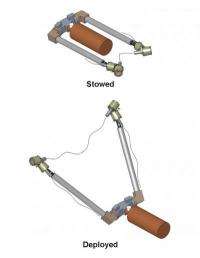
These images show the concept for a flight version of the Mars Time Domain Electromagnetic Sounder (MTDEM), which uses induction to detect groundwater up to 5 km deep. These illustrations show the MTDEM launcher in its stowed (cruise) and deployed (landed) configurations; spooling projectiles are then ejected using compressed gas, forming a large wire loop on the planet's surface. Credit: Credit to SwRI and Ball Aerospace. Video and graphics provided by Ball Aerospace.
(PhysOrg.com) -- With the whoosh of compressed gas and the whir of unspooling wire, a team of Boulder scientists and engineers tested a new instrument prototype that might be used to detect groundwater deep inside Mars.
The Mars Time Domain Electromagnetic Sounder (MTDEM) uses induction to generate electrical currents in the ground, whose secondary magnetic fields are in turn detected at the planetary surface. In this way, the electrical conductivity of the subsurface can be reconstructed.
"Groundwater that has been out of atmospheric circulation for eons will be very salty," says the project's principal investigator Dr. Robert Grimm, a director in the Space Science and Engineering Division at Southwest Research Institute. "It is a near-ideal exploration target for inductive systems."
The inductive principle of the MTDEM is distinct from the wavelike, surface-penetrating radars MARSIS and SHARAD presently orbiting Mars. "The radars have been very useful in imaging through ice and through very dry, low-density rock," says Grimm, "but they have not lived up to expectations to look through solid rock and find water."
This video is not supported by your browser at this time.
This video shows a field test of the Mars Time Domain Electromagnetic Sounder (MTDEM). Credit: Credit to SwRI and Ball Aerospace. Video and graphics provided by Ball Aerospace.
The time-domain inductive method uses a large, flat-lying loop of wire on the ground to generate and receive electromagnetic signals. In order to do this robotically, the team developed a launch system that shoots two projectiles, each paying out spooled wire as they fly."The main challenge was getting the spooling right," says Robert Warden, a mechanical engineer at Ball Aerospace and Technologies Corp., which built the deployment system. "The spools had to be compact yet allow rapid payout of a thin wire at more than 30 meters per second (70 miles per hour)."
Data taken during the test launches allowed Warden and Grimm to scale the system for a flight mission. The MTDEM prototype deployed to a distance of more than 70 meters. For Mars, a system deploying a 200-meter loop would be less than 6 kilograms mass and could detect groundwater at depths up to 5 kilometers (3 miles). Most of the instrument's mass would be in the loop and deployment system. Barry Berdanier, the Ball electrical engineer who built the MTDEM electronics, estimates that the flight electronics would comprise just a few hundred grams.
"Electromagnetic induction methods are widely used in groundwater exploration," says James Pfieffer of Zapata Incorporated, a geophysical firm that provided field support. "We have been mapping groundwater in Hawaii for many years." The main field test of the MTDEM was on Maui, where known performance could be used to calibrate the new prototype.
Grimm adds, "Subsurface, liquid water on Mars could be a habitable zone for microbes. We know that huge volumes of discharged groundwater have shaped Mars' ancient surface. Is that water still locked inside?"
-
Mars echo from Italian radar reported
Sep 19, 2006 |
not rated yet |
0
-
Mars Reconnaissance Orbiter Reveals Rock Fracture Plumbing on Mars
Sep 25, 2008 |
not rated yet |
0
-
Important role of groundwater springs in shaping Mars
Dec 11, 2008 |
not rated yet |
0
-
Deployment of second MARSIS boom delayed
May 09, 2005 |
not rated yet |
0
-
Mars radar opens up a planet’s third dimension
Apr 17, 2008 |
not rated yet |
0
-
Engineers build first sub-10-nm carbon nanotube transistor
Feb 01, 2012 |
4.9 / 5 (31) |
30
-
Something old, something new: Evolution and the structural divergence of duplicate genes
Jan 31, 2012 |
4.6 / 5 (7) |
1
-
The hidden nanoworld of ice crystals: Revealing the dynamic behavior of quasi-liquid layers
Jan 30, 2012 |
5 / 5 (3) |
1
-
Stock market network reveals investor clustering
Jan 27, 2012 |
3.9 / 5 (23) |
8
-
Of microchemistry and molecules: Electronic microfluidic device synthesizes biocompatible probes
Jan 26, 2012 |
5 / 5 (1) |
0
-
Never ending outer space.....
14 hours ago
-
Neutron Star fragments?
16 hours ago
-
stationary or not?
20 hours ago
-
Scale of the Universe
Feb 10, 2012
-
Titan's lack of impact craters
Feb 09, 2012
-
Real pictures of black hole eating a star?
Feb 08, 2012
- More from Physics Forums - General Astronomy
More news stories
Latin America mining boom clashes with conservation
Latin America is experiencing a mining boom as prices rise fuelled by a hike in global demand, but the region is also being hit by a wave of violent protests, strikes and rallies by environmentalists.
7 hours ago |
not rated yet |
0
Political leaders play key role in how worried Americans are by climate change: study
More than extreme weather events and the work of scientists, it is national political leaders who influence how much Americans worry about the threat of climate change, new research finds.
Feb 06, 2012 |
5 / 5 (6) |
73
NASA budget will axe Mars deal with Europe: scientists
US President Barack Obama's budget proposal to be submitted next week for 2013 will cut NASA's budget by 20 percent and eliminate a major partnership with Europe on Mars exploration, scientists said Thursday.
Space & Earth / Space Exploration
Feb 10, 2012 |
5 / 5 (3) |
55
Humans may have helped the decline of African rainforests 3000 years ago
(PhysOrg.com) -- Large areas of rainforests in Central Africa mysteriously disappeared over three thousand years ago, to be replaced by savannas. The prevailing theory has been that the cause was a change ...
Study shows global glaciers, ice caps, shedding billions of tons of mass annually
Earth's glaciers and ice caps outside of the regions of Greenland and Antarctica are shedding roughly 150 billion tons of ice annually, according to a new study led by the University of Colorado Boulder.
Space & Earth / Earth Sciences
Feb 08, 2012 |
4.4 / 5 (9) |
14
|
Injured boomers beware: Know when to see doctor
(AP) -- It happened to nurse Jane Byron years after an in-line skating fall, business owner Haralee Weintraub while doing "men's" push-ups, and avid cyclist Gene Wilberg while lifting a heavy box.
Google might launch Drive for cloud storage soon
(PhysOrg.com) -- Google's next big move, according to the Wall Street Journal, is a cloud storage service called Drive. Hardly first to the plate, Google is simply catching up to introducing its cloud reposi ...
Love a click away in Indonesia's Twitter Republic
He was a geeky kid from Yogyakarta, she a glamorous city girl in Jakarta. In a country with one of the world's most vibrant social networking scenes they fell in love on Twitter.
Europeans protest controversial Internet pact
Tens of thousands of people marched in protests in more than a dozen European cities Saturday against a controversial anti-online piracy pact that critics say could curtail Internet freedom.
Walney offshore wind farm is world's biggest (for now)
(PhysOrg.com) -- The Walney wind farm on the Irish Sea--characterized by high tides, waves and windy weather--officially opened this week. The farm is treated in the press as a very big deal as the Walney ...
Navy to begin tests on electromagnetic railgun prototype launcher
The Office of Naval Research (ONR)'s Electromagnetic (EM) Railgun program will take an important step forward in the coming weeks when the first industry railgun prototype launcher is tested at a facility ...
Jun 25, 2009
Rank: not rated yet