Potential new drugs: 970 million and still counting
June 24, 2009 Potential new drugs: 970 million and still counting

Enlarge

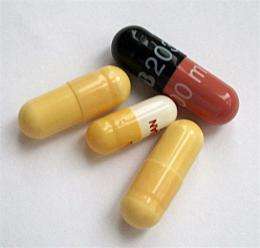
There are more than 970 million chemicals suitable for study as new drugs, according to a new study. Credit: Wikimedia Commons

Like astronomers counting stars in the familiar universe of outer space, chemists in Switzerland are reporting the latest results of a survey of chemical space -- the so-called chemical universe where tomorrow’s miracle drugs may reside. The scientists conclude, based on this phase of the ongoing count, that there are 970 million chemicals suitable for study as new drugs.

Scheduled for the July 1 issue of the , the study represents the largest publicly available database of virtual molecules ever reported, the researchers say.

Jean-Louis Reymond and Lorenz Blum point out that the rules of chemical bonding allow simple elements such as carbon, hydrogen, oxygen, nitrogen and fluorine to potentially form millions of different molecules. This so-called “chemical universe” or “chemical space” has an enormous potential for discovery, particularly for identifying so-called “small molecules” -- made of 10 to 50 atoms. Most of today’s medicines consist of these small molecules. Until now, however, scientists had not attempted a comprehensive analysis of the molecules that populate chemical space.

In the report, Reymond and Blum describe development of a new searchable database, GDB-13, that scientists can use in the quest for new drugs. It consists of all molecules containing up to 13 atoms of carbon, nitrogen, oxygen, sulfur, and chlorine under rules that define chemical stability and synthetic feasibility. The researchers identified more than 970 million possible structures, the vast majority of which have never been produced in the lab. Some of these molecules could lead to the design and production of new drugs for fighting disease, they say.

More information: Journal of the American Chemical Society, Journal Article: “970 Million Druglike Small for Virtual Screening in the Chemical Universe Database GDB-13”

Source: American Chemical Society (news : web)


Rate this story - 3 /5 (2 votes)

Rank Filter

Move the slider to adjust rank threshold, so that you can hide some of the comments.


Display comments: newest first

  • Azpod - Jun 24, 2009
    • Rank: not rated yet
    Brute force method of computer hacking applied to drug discovery. Awesome!

    Now the only question is whether they'll find the miracle immortality drug before they find the miracle drug that kills ya dead with just 1 molecule.

    My money's on the latter!
  • Birthmark - Aug 20, 2009
    • Rank: not rated yet
    We won't need drugs or pills. We'll have chips in our heads to make us intelligent and we'll have nanorobots in our bloodstreams destroying cancerous cells, and viruses, bacteria, and anything harmful to us. Drugs are a thing of the past.

June 24, 2009 all stories

Comments: 2

3 /5 (2 votes)

  • hide
  • Related Stories


  • hide
  • Relevant PhysicsForums posts

Other News

Energy from light and water: New photocatalytic method for the clean production of hydrogen from water

Chemistry / Materials Science

created 19 hours ago | popularity 4.5 / 5 (13) | comments 9 | with audio podcast

(PhysOrg.com) -- Hydrogen-powered fuel cells and solar energy are the best hope for a more environmentally friendly and resource-sparing energy supply in the future. A combination of the two is considered to be particularly ...


New approach to treating breast and prostate cancers

Chemistry / Biochemistry

created 17 hours ago | popularity 2.5 / 5 (2) | comments 0

In a new approach to developing treatments for breast cancer, prostate cancer and enlarged hearts, Loyola University Chicago Stritch School of Medicine researchers are zeroing in on a workhorse protein called RSK.


New research rejects 80-year theory of 'primordial soup' as the origin of life

Chemistry / Biochemistry

created Feb 02, 2010 | popularity 4.3 / 5 (36) | comments 26 | with audio podcast

For 80 years it has been accepted that early life began in a 'primordial soup' of organic molecules before evolving out of the oceans millions of years later. Today the 'soup' theory has been over turned in a pioneering paper ...


It looks, feels and tastes like chicken, but it's made of soy

It looks, feels and tastes like chicken, but it's made of soy

Chemistry / Biochemistry

created Feb 04, 2010 | popularity 4.5 / 5 (18) | comments 14 | with audio podcast

Sure, some delicacies might taste just like chicken, but they usually feel and look much different. Soy meat alternatives, such as the soy burger, have become more popular recently, with increased sales of ...


Compound could become important new antidepressant

Chemistry / Other

created Feb 04, 2010 | popularity 4.9 / 5 (11) | comments 7 | with audio podcast

Chemists at Oregon State University have discovered and synthesized a new compound that in laboratory and animal tests appears to be similar to, but may have advantages over one of the most important antidepressant medications ...