Successful initial safety tests for genetically-modified rice that fights allergy
June 24, 2009 Successful initial safety tests for genetically-modified rice that fights allergy

Enlarge

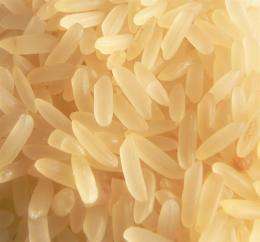
A new transgenic rice designed to fight a common pollen allergy appears safe in animals, scientists in Japan report. Credit: David.Monniaux, Wikimedia Commons

In a first-of-its-kind advance toward the next generation of genetically modified foods -- intended to improve consumers’ health -- researchers in Japan are reporting that a new transgenic rice designed to fight a common pollen allergy appears safe in animal studies. Their report is in the current issue of ACS’ Journal of Agricultural and Food Chemistry.

Fumio Takaiwa and colleagues note that the first generation of genetically-modified crops was designed to help keep crops weed and insect free. The next generation of transgenic crops is being developed to directly benefit human health. This includes veggies and grains that produce higher levels of nutrients, such as vitamins and minerals, or even medicines and vaccines. Like the first generation of transgenic foods, however, researchers are anxiously trying to determine whether foods produced from these “biopharmaceutical” will be safe for humans and the environment.

The scientists describe development of a transgenic rice plant that has been genetically- engineered to fight allergies to Japanese cedar pollen, a growing public health problem in Japan that affects about 20 percent of the population. In laboratory studies, the researchers fed a steamed version of the transgenic rice and a non-transgenic version to a group of monkeys everyday for 26 weeks. At the end of the study period, the test animals did not show any health problems, in an initial demonstration that the allergy-fighting rice may be safe for consumption, the researchers say.

More information: , Journal Article: “26-Week Oral Safety Study in macaques for Transgenic Rice Containing major Human T-Cell Epitope Peptides from Japanese Cedar Pollen Allergens”

Provided by American Chemical Society (news : web)


print this article email this article download pdf blog this article bookmark this article     Stumble it Digg this share on Facebook retweet share on Reddit add to delicious
Rate this story - 1.5 /5 (4 votes)

Rank Filter

Move the slider to adjust rank threshold, so that you can hide some of the comments.


Display comments: newest first

  • Sepp - Jun 25, 2009
    • Rank: not rated yet
    How do we know the rice is indeed "allergy fighting" and what is the mechanism?

June 24, 2009 all stories

Comments: 1

1.5 /5 (4 votes)
  • Stumble this up

  • Digg this

  • share this

  • hide
  • Related Stories

  • A built-in strategy for transgene containment
    created Mar 19, 2008 | popularity not rated yet | comments 0
  • Arkansas rice farmers file a lawsuit
    created Aug 30, 2006 | popularity not rated yet | comments 0
  • Genetically modified rice could pose risks
    created Jun 14, 2005 | popularity not rated yet | comments 0
  • Transgenic Goats' Milk Helps Fend off E. coli-related Illness in Pigs
    created Apr 22, 2008 | popularity not rated yet | comments 0
  • Nothing to sneeze at: Real-time pollen forecasts
    created Dec 22, 2008 | popularity not rated yet | comments 0


  • hide
  • Relevant PhysicsForums posts

Other News

Toward home-brewed electricity with 'personalized solar energy'

Toward home-brewed electricity with 'personalized solar energy'

Chemistry / Materials Science

created Nov 04, 2009 | popularity 3.4 / 5 (9) | comments 4

New scientific discoveries are moving society toward the era of "personalized solar energy," in which the focus of electricity production shifts from huge central generating stations to individuals in their ...


Scientists Reproduce a Building Block of Life in Laboratory

Scientists Reproduce a Building Block of Life in Laboratory

Chemistry / Biochemistry

created Nov 06, 2009 | popularity 4.8 / 5 (23) | comments 0

(PhysOrg.com) -- NASA scientists studying the origin of life have reproduced uracil, a key component of our hereditary material, in the laboratory.


Newly Discovered Fat Molecule: An Undersea Killer with an Upside

Newly Discovered Fat Molecule: An Undersea Killer with an Upside

Chemistry / Biochemistry

created Nov 05, 2009 | popularity 4.8 / 5 (10) | comments 0

(PhysOrg.com) -- A chemical culprit responsible for the rapid, mysterious death of phytoplankton in the North Atlantic Ocean has been found by collaborating scientists at Rutgers University and the Woods Hole ...


CU-Boulder map of human bacterial diversity shows wide interpersonal differences

Map of Human Bacterial Diversity Shows Wide Interpersonal Differences

Chemistry / Biochemistry

created Nov 05, 2009 | popularity 4.7 / 5 (11) | comments 0

(PhysOrg.com) -- A University of Colorado at Boulder team has developed the first atlas of bacterial diversity across the human body, charting wide variations in microbe populations that live in different ...


Mimicking nature, scientists can now extend redox potentials

Mimicking nature, scientists can now extend redox potentials

Chemistry / Biochemistry

created Nov 04, 2009 | popularity 4.8 / 5 (5) | comments 0

(PhysOrg.com) -- New insight into how nature handles some fundamental processes is guiding researchers in the design of tailor-made proteins for applications such as artificial photosynthetic centers, long-range ...