Tiny capsules can deliver drugs to targeted cells

June 25, 2009 By Krishna Ramanujan
Tiny capsules can deliver drugs to targeted cells

Enlarge

This image shows a microtube surface coated with nanocapsules containing a small-interfering RNA (which glows red under a fluorescent microscope). The capsules were targeted to specific circulating cells. (Zhong Huang/Cornell University)

(PhysOrg.com) -- It is now possible to engineer tiny containers the size of a virus to deliver drugs and other materials with almost 100 percent efficiency to targeted cells in the bloodstream.

According to a new Cornell study, the technique could one day be used to deliver vaccines, drugs or to treat cancer and blood and immunological disorders. The research is published today (June 25, 2009) online at the Web site of the journal Gene Therapy.

"This study greatly extends the range of therapies," said Michael King, Cornell associate professor of biomedical engineering, who co-authored the study with lead author Zhong Huang, a former Cornell research associate who is now an assistant professor at the Shenzhen University School of Medicine in China. "We can introduce just about any drug or genetic material that can be encapsulated, and it is delivered to any circulating cells that are specifically targeted," King added.

The technique involves filling the tiny lipid containers, or nanoscale capsules, with a molecular cargo and coating the capsules with adhesive proteins called selectins that specifically bind to target cells. A shunt coated with the capsules is then inserted between a vein and an artery. Much as burrs attach to clothing in a field, the selectin-coated capsules adhere to targeted cells in the .

After rolling along the shunt wall, the cells break free from the wall with the capsules still attached and ingest their contents.
Tiny capsules can deliver drugs to targeted cells

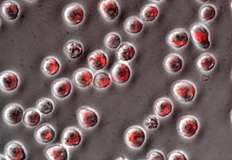
This image shows that after 36 hours nearly every target cell (round gray spheres) has ingested a nanocapsule containing a small-interfering RNA (in red). (Zhong Huang/Cornell University)

The technique mimics a natural immune response that occurs during inflammation, which stimulates cells on blood vessel walls to express selectins, which quickly form adhesive bonds with passing . The white blood cells then stick to the selectins and roll along the vessel wall before leaving the bloodstream to fight disease or infection.

Selectin proteins may be used to specifically target nucleated (cells with a nucleus) cells in the bloodstream.

The study shows that since only the targeted cells ingest the contents of the nanocapsules, the technique could greatly reduce the adverse side effects caused by some drugs.

In a previous paper, King showed how metastasizing circulating in the blood stream can stick to selectin-coated devices containing a second protein that programs cancer cells to self-destruct.

Said King, "We've found a way to disable the function of cancer cells without compromising the immune system," which is a problem with many other therapies directed against metastasis.

The current study demonstrates that can be delivered to targeted cells to turn off specific genes and interfere with processes that lead to disease. The researchers filled nanocapsules with a small-interfering RNA (siRNA) and targeted them to specific circulating cells. When the targeted cells ingested the capsules, the siRNA turned off a gene that produces an enzyme that contributes to the degradation of cartilage in arthritis.

In a similar manner, the method could be used to target the delivery of chemotherapy drugs, vaccine antigens to white blood cells, specific molecules that mitigate auto-immune disorders and more, King said.

More information: The paper is available at: http://www.nature. … 200976a.html

Source: Cornell University (news : web)

3.7 /5 (3 votes)  

Rank 3.7 /5 (3 votes)
Related Stories
Relevant PhysicsForums posts
  • Stem cell question.
    createdFeb 10, 2012
  • Protease cleavage
    createdFeb 10, 2012
  • Pertubance in a model
    createdFeb 10, 2012
  • Cancer drugs and Alzheimer's, Oh my!
    createdFeb 09, 2012
  • Squishing cells
    createdFeb 09, 2012
  • Any books/articles for evolutionary stable strategy models in humans?
    createdFeb 09, 2012
  • More from Physics Forums - Biology

More news stories

New kind of solar cell could capture significantly more energy than current cells

New solar cells could increase the maximum efficiency of solar panels by over 25%, according to scientists from the University of Cambridge.

Nanotechnology / Nanophysics

created Feb 08, 2012 | popularity 4.5 / 5 (12) | comments 14 | with audio podcast

Nanoshell whispering galleries improve thin solar panels

Visitors to Statuary Hall in the U.S. Capitol Building may have experienced a curious acoustic feature that allows a person to whisper softly at one side of the cavernous, half-domed room and for another on ...

Nanotechnology / Nanomaterials

created Feb 07, 2012 | popularity 4.3 / 5 (6) | comments 6 | with audio podcast

'Dark plasmons' transmit energy

Microscopic channels of gold nanoparticles have the ability to transmit electromagnetic energy that starts as light and propagates via "dark plasmons," according to researchers at Rice University.

Nanotechnology / Nanophysics

created Feb 09, 2012 | popularity 4.8 / 5 (9) | comments 1 | with audio podcast

Revealing how a battery material works

Since its discovery 15 years ago, lithium iron phosphate (LiFePO4) has become one of the most promising materials for rechargeable batteries because of its stability, durability, safety and ability to deliver ...

Nanotechnology / Nanomaterials

created Feb 08, 2012 | popularity 5 / 5 (5) | comments 0 | with audio podcast

Harnessing plasmonics, engineers weld nanowires with light

At the nano level, researchers at Stanford have discovered a new way to weld together meshes of tiny wires. Their work could lead to exciting new electronics and solar applications. To succeed, they called ...

Nanotechnology / Nanophysics

created Feb 06, 2012 | popularity 4.8 / 5 (11) | comments 1 | with audio podcast


Google might launch Drive for cloud storage soon

(PhysOrg.com) -- Google's next big move, according to the Wall Street Journal, is a cloud storage service called Drive. Hardly first to the plate, Google is simply catching up to introducing its cloud reposi ...

Latin America mining boom clashes with conservation

Latin America is experiencing a mining boom as prices rise fuelled by a hike in global demand, but the region is also being hit by a wave of violent protests, strikes and rallies by environmentalists.

Love a click away in Indonesia's Twitter Republic

He was a geeky kid from Yogyakarta, she a glamorous city girl in Jakarta. In a country with one of the world's most vibrant social networking scenes they fell in love on Twitter.

Walney offshore wind farm is world's biggest (for now)

(PhysOrg.com) -- The Walney wind farm on the Irish Sea--characterized by high tides, waves and windy weather--officially opened this week. The farm is treated in the press as a very big deal as the Walney ...

GPS court ruling leaves US phone tracking unclear

A US Supreme Court decision requiring a warrant to place a GPS device on the car of a criminal suspect leaves unresolved the bigger issue of police tracking using mobile phones, legal experts say.

Europeans protest controversial Internet pact

Tens of thousands of people marched in protests in more than a dozen European cities Saturday against a controversial anti-online piracy pact that critics say could curtail Internet freedom.