Milky Way's super-efficient particle accelerators caught in the act
June 25, 2009
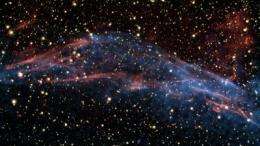
Image of part of a stellar remnant whose explosion was recorded in 185 A.D. By studying this remnant in detail, a team of astronomers was able to solve the mystery of the Milky Way’s super-efficient particle accelerators. The team shows that the shock wave visible in this area is very efficient at accelerating particles and the energy used in this process matches the number of cosmic rays observed on Earth. North is toward the top right and east to the top left. The image is about six arc minutes across. Credit: ESO/E. Helder & NASA/Chandra
Thanks to a unique "ballistic study" that combines data from ESO's Very Large Telescope and NASA's Chandra X-ray Observatory, astronomers have now solved a long-standing mystery of the Milky Way's particle accelerators. They show in a paper published today on Science Express that cosmic rays from our galaxy are very efficiently accelerated in the remnants of exploded stars.
During the Apollo flights astronauts reported seeing odd flashes of light, visible even with their eyes closed. We have since learnt that the cause was cosmic rays — extremely energetic particles from outside the Solar System arriving at the Earth, and constantly bombarding its atmosphere. Once they reach Earth, they still have sufficient energy to cause glitches in electronic components.
Galactic cosmic rays come from sources inside our home galaxy, the Milky Way, and consist mostly of protons moving at close to the speed of light, the "ultimate speed limit" in the Universe. These protons have been accelerated to energies exceeding by far the energies that even CERN's Large Hadron Collider will be able to achieve.
"It has long been thought that the super-accelerators that produce these cosmic rays in the Milky Way are the expanding envelopes created by exploded stars, but our observations reveal the smoking gun that proves it", says Eveline Helder from the Astronomical Institute Utrecht of Utrecht University in the Netherlands, the first author of the new study.
"You could even say that we have now confirmed the calibre of the gun used to accelerate cosmic rays to their tremendous energies", adds collaborator Jacco Vink, also from the Astronomical Institute Utrecht.
For the first time Helder, Vink and colleagues have come up with a measurement that solves the long-standing astronomical quandary of whether or not stellar explosions produce enough accelerated particles to explain the number of cosmic rays that hit the Earth's atmosphere. The team's study indicates that they indeed do and directly tells us how much energy is removed from the shocked gas in the stellar explosion and used to accelerate particles.
"When a star explodes in what we call a supernova a large part of the explosion energy is used for accelerating some particles up to extremely high energies", says Helder. "The energy that is used for particle acceleration is at the expense of heating the gas, which is therefore much colder than theory predicts".
The researchers looked at the remnant of a star that exploded in AD 185, as recorded by Chinese astronomers. The remnant, called RCW 86, is located about 8200 light-years away towards the constellation of Circinus (the Drawing Compass). It is probably the oldest record of the explosion of a star.
Using ESO's Very Large Telescope, the team measured the temperature of the gas right behind the shock wave created by the stellar explosion. They measured the speed of the shock wave as well, using images taken with NASA's X-ray Observatory Chandra three years apart. They found it to be moving at between 10 and 30 million km/h, between 1 and 3 percent the speed of light.
The temperature of the gas turned out to be 30 million degrees Celsius. This is quite hot compared to everyday standards, but much lower than expected, given the measured shock wave's velocity. This should have heated the gas up to at least half a billion degrees.
"The missing energy is what drives the cosmic rays", concludes Vink.
More information: This research was presented in a paper to appear in Science: Measuring the cosmic ray acceleration efficiency of a supernova remnant, by E. A. Helder et al.
-
Chandra discovers relativistic pinball machine
Nov 15, 2006 |
not rated yet |
0
-
Tycho's Remnant Provides Shocking Evidence for Cosmic Rays
Sep 22, 2005 |
not rated yet |
0
-
On the Scent of a Pre-Historic Particle Accelerator?
Feb 09, 2006 |
not rated yet |
0
-
New evidence links stellar remains to oldest-recorded supernova
Sep 18, 2006 |
not rated yet |
0
-
NASA: major step toward knowing origin of cosmic rays
Oct 09, 2007 |
not rated yet |
0
-
Engineers build first sub-10-nm carbon nanotube transistor
Feb 01, 2012 |
4.9 / 5 (30) |
30
-
Something old, something new: Evolution and the structural divergence of duplicate genes
Jan 31, 2012 |
4.6 / 5 (7) |
1
-
The hidden nanoworld of ice crystals: Revealing the dynamic behavior of quasi-liquid layers
Jan 30, 2012 |
5 / 5 (3) |
1
-
Stock market network reveals investor clustering
Jan 27, 2012 |
3.9 / 5 (23) |
8
-
Of microchemistry and molecules: Electronic microfluidic device synthesizes biocompatible probes
Jan 26, 2012 |
5 / 5 (1) |
0
-
Titan's lack of impact craters
22 hours ago
-
Real pictures of black hole eating a star?
Feb 08, 2012
-
Hypothetical way to travel faster than light, but not technically exceed lightspeed
Feb 06, 2012
-
How do scientists monitor the Sun's activity?
Feb 05, 2012
-
Search patterns in observational studies
Feb 05, 2012
-
Derivation of Pogson's law
Feb 03, 2012
- More from Physics Forums - General Astronomy
More news stories
Could Venus be shifting gear?
(PhysOrg.com) -- ESAs Venus Express spacecraft has discovered that our cloud-covered neighbour spins a little slower than previously measured. Peering through the dense atmosphere in the infrared, the ...
Space & Earth / Space Exploration
46 minutes ago |
5 / 5 (1) |
0
|
What does a nebula sound like?
What do things sound like out in the cosmos? Of course, sound waves cant travel through the vacuum of space; however, electromagnetic waves can. These electromagnetic waves can be recorded by devices called spectrographs ...
Space & Earth / Space Exploration
53 minutes ago |
5 / 5 (1) |
0
Two new moons for Jupiter
Advances in technology have lead to the discovery of new planets outside of our Solar System, and now even new moons in our own backyard.
Space & Earth / Space Exploration
51 minutes ago |
not rated yet |
2
Sandy streets over the Atlantic
Thick dust from the Sahara blowing over the ocean off the western coast of Africa encounters the islands of Cape Verde, forming a wake of swirling vortex streets visible by satellite.
Space & Earth / Earth Sciences
18 minutes ago |
not rated yet |
0
Humans may have helped the decline of African rainforests 3000 years ago
(PhysOrg.com) -- Large areas of rainforests in Central Africa mysteriously disappeared over three thousand years ago, to be replaced by savannas. The prevailing theory has been that the cause was a change ...
The power of estrogen -- male snakes attract other males
A new study has shown that boosting the estrogen levels of male garter snakes causes them to secrete the same pheromones that females use to attract suitors, and turned the males into just about the sexiest ...
Experts reveal how plants don't get sunburn
(PhysOrg.com) -- Experts at the University of Glasgow have discovered how plants survive the harmful rays of the sun.
Team isolates nerve cells involved in storing long term memory and gene proteins associated with them
(Medical Xpress) -- A research team in Taiwan has succeeded in isolating two nerve cells in fruit fly brains that are believed to be the major players in allowing for the formation of long term memories. Furthermore, ...
Measurements from high-energy collisions lead to better understanding of why meson particles disappear
For several years, physicists at the Relativistic Heavy Ion Collider (RHIC) at Brookhaven National Laboratory (BNL), USA, have studied an unusual state of matter called the quarkgluon plasma, which they ...
SLAC, Stanford team focuses on high-energy electrons to treat cancer
Accelerator physicists at SLAC and cancer specialists from Stanford are working on a new technology that could dramatically reduce the time needed for cancer radiation treatments. The team ran an initial experiment ...
News of plaque-clearing drug tops week of major advances against Alzheimer's disease
In the last eight days, scientists have delivered a powerful one-two punch in the fight to defeat Alzheimer's disease. At the same time, the White House and members of Congress are proposing increases in Alzheimer's research ...
Jun 25, 2009
Rank: 1.8 / 5 (5)
Supernovae are indeed violent, but what could be accelerating protons to "close to the speed of light" in the SN remnant? The magnetic field of the neutron star?
With kind regards,
Oliver K. Manuel
http://www.omatumr.com
Jun 25, 2009
Rank: 3.8 / 5 (5)
I think it's just unfortunate wording used by the writer of this article that causes some confusion here. As I understood it, what they meant is that the shockwave (as "the remnant") is causing the proton acceleration when it hits the surrounding gas as it propagates. And that it is most probably the reason why the gas is "only" 30M degrees hot after the collision and not the expected 500M, because a part of the energy is used up on that proton acceleration.
Jun 25, 2009
Rank: 3.3 / 5 (3)
If someone has an article addressing the mechanism of the acceleration, please post a link.
Jun 25, 2009
Rank: 2.3 / 5 (3)
They are proposing that (quote) "the super-accelerators that produce these cosmic rays in the Milky Way are the expanding envelopes created by exploded stars" - which should mean that the mechanism that is responsible for the proton acceleration involves the shockwave hitting the (relatively) static gas. The fast propagating shockwave hits the gas at a speed around 3%c, which causes the gas to get highly compressed and heated within a short timeframe of the impact, exciting it and so causing the "emission" of highly energized protons(?). My guess is that there could also be a quite high charge difference between the gas and the shockwave particles and that this could play some role in the whole process. Though I might be completely wrong on everything.. After all I'm just trying to guess here - eg. being "constructive" ;o)
Jun 26, 2009
Rank: 1.8 / 5 (5)
Unfortunately, that is what all of science is though... our best explanation for things is merely our best "guess" based on the evidence, or, at least our most educated one.
Jun 26, 2009
Rank: 2.3 / 5 (6)
The above expresses my conclusion too, based on 50 years of research. E.g., a guess made 34 years ago, when forced to do so by unexpected experimental data:
In 1975 the data showed that all of the primordial Helium-4 in meteorites is closely associated with strange xenon containing excess Xe-136 from rapid neutron capture in a supernova. There is no primordial Helium-4 associated with the normal xenon (Earth-like) in meteorites.
http://tinyurl.com/2cmusk
Dr. D. D. Sabu and I "guessed" that the r-process that made "strange xenon" occurred in the outer Helium-rich region of the supernova that gave birth to the solar system and that "normal xenon" (Earth-like) came from the iron-rich interior of the supernova where fusion reactions had consumed all of the Helium and other lightweight, low-Z elements.
Many other guesses were negated by later research findings. The above guess has survived for 34 years.
With kind regards,
Oliver K. Manuel
http://www.omatumr.com/
Jun 26, 2009
Rank: 1 / 5 (6)
Why Einstein never give that idea for physics of particle?
What a massive/density particle, time is going to be more slow and thats why particle dont emit so fast energy.
When neutrinos come out from sun, they are hot/density. The new neutrinos time is slow. First neutrinos emit energy%uFEFF slow. Later neutrinos emit energy faster. When neutrinos are here, near earth, they give some kineticenergy for our nucleus of atoms. When neutrinos are inside gasplanets, they emit more energy (kineticenergy) for gasplanets nucleus of atoms. This is relativity of real!
Sun exploding and pushing exploding planets far away from exploding Sun!
Space dont expanding or curving. Nucleus of atoms are expanding/exploding and emit energywaves who have a nature of electrons and particle, who also expanding and emit energy. Electrons just move to next exploding nucleus of atoms and get this exploding faster etc. Before that electrons just give some change of pressure for energywaves who pushing themselfs out from exploding nucleus of atoms!
THIS IDEA IS REVOLUTION OF SCIENCE!
http://www.onesim....com/296
Jun 26, 2009
Rank: 1 / 5 (2)
I don't know the method of acceleration being proposed here.
But there are indications that protons produced by neutron decay may be accelerated by the strong magnetic field of a.) a neutron star that remains after supernova explosion or b.) by Bose-Einstein condensation of iron-rich material into a rotating, superfluid, superconductor surrounding the neutron star. http://arxiv.org/.../0501441
With kind regards,
Oliver K. Manuel
http://www.omatumr.com/
Jun 26, 2009
Rank: 1 / 5 (1)
Jun 28, 2009
Rank: 5 / 5 (3)
Just speculating (I haven't looked up any information about the subject recently), but if the shockwave generates temperatures of 30 million degrees (hotter than the center of the Sun) any molecules in its path will be reduced to their constituent atoms, and those atoms will be stripped of all their electrons. The electrons, being much lighter than the nuclei, will be imparted with a much higher velocity than the associated protons and neutrons of their former nuclei producing a large difference in charge between two regions (a region essentially within the shock of negative charge and a region behind it (with respect to the propagation direction of the wave) with a corresponding positive charge) leading to a large difference in electrical potential (aka a large electric field) that would produce a large acceleration. Since hydrogen is the most common element in the universe, and since its nucleus is the lightest of any element, consisting as it does of a single proton, it would make sense that this would be a method for explaining the production of high energy protons using a supernova shockwave. (Indeed, I think it would require extremely artificial circumstances for such a shockwave not to accelerate some protons in the way just described.)
Jun 28, 2009
Rank: not rated yet
"The researchers looked at the remnant of a star that exploded in AD 185, as recorded by Chinese astronomers. The remnant, called RCW 86, is located about 8200 light-years away."
???
Am I the only one to see a problem here?
Let me spell it out.
How can you see something that happened a little over two thousand years ago at a location that is Eight Thousand light-years away?
Can someone please try to explain this to me?
Jun 28, 2009
Rank: not rated yet
Correction, I just now noticed the AD.
We are talking about light travelling at nearly 4.5 times the speed of light.
Jun 29, 2009
Rank: 5 / 5 (1)
As the quote you cited implies, the Chinese astronomers saw the star explode in 185 AD. Assuming the star is/was 8200 light-years away, the explosion happened around 8016 BC (not 8015 since there was no year zero.)
On second (or so) look, the (first) sentence you quoted is a little unclear in its wording. One interpretation of the sentence is that the star exploded in 185 AD. However, there probably should not be a comma after "AD 185" since the adjectival phrase "as recorded by Chinese astronomers" describes "a star that exploded in AD 185", which in turn describes what kind of remnant "the remnant" was at which "The researchers looked". Thus, when the sentence is properly written and understood, one sees that it is meant that the Chinese astronomers recorded the explosion in 185 AD, the first sentence gives no clue as to when the star actually exploded.
Jun 30, 2009
Rank: 5 / 5 (1)
http://arxiv.org/pdf/0906.4553 in which they elaborate on their reasoning and mathematically present the equations. My understanding of the paper, (which I freely admit is less than perfect) is that the energetics they are looking at involve actual thermal shock from the supernova material hitting the cavity wall, not linear acceleration from remnant magnetic fields.
Exciting material; kudos to PhysOrg for publishing the summary!
Jun 30, 2009
Rank: 1 / 5 (5)
How is it possible that Relativity can be true at the macroscopic level, and yet at the nano-scale quantum theory holds.
Relativity requires all constants to be continuous for all space and time and for all reference frames on ther intervale from V=0 to V -> c. (i.e. "arbitrarily close to.)
Quantum theory on the other hand claims that everything must exist in discreet packets of exact whole integer values or exact rational fractional values.
Thus, it would seem contradictory that anything "continuous" could exist at a macroscopic level when the underlying quantum level is non-continuous.
How then does a proton accelerate from 0 to 0.9c?
Quantum theory requires that the velocity of a particle be equal to that given by the sum of an arbitrary number of "quanta" of momentum, but in relativity this number (i.e. the number of quanta) would be different for all unigue reference frames.
Paradoxically, any object would then be composed of a different number of particles, depending on which reference frame it is viewed from.
This implies that, in this above problem, and really in all the universe, protons are NOT particles of the same type which move at velocities from 0->c, but rather, there is an entire family of unique particles all called "protons" which appear identical in every respect except that each succssive particle contains one extra quantum unit of momentum.
Thus, if I observe two "protons", one at rest relative to me, the other moving at 0.9c, then in the quantum sense, it actually is not technically correct to say that proton 1 is the same as proton 2 except momentum, not at all.
The first proton has a positive charge and a molar mass of approximately 1g/mol. Its momentum relative to me is zero, and its velocity is zero.
The second proton also has a positive charge, but has a very different mass(due to the relativity of maass), velocity, and momentum(due to the change in both velocity and mass).
Thus, the second particle is actually a completely different particle than the first, even though it has many of the same electrical and nuclear properties. The reason is that it must contain some extra "quanta" of one type or another to explain the extra mass and the velocity.
Jul 02, 2009
Rank: 5 / 5 (1)