DNA patterns of microbes
June 25, 2009 DNA patterns of microbes

Enlarge

Photo: Stein Marvold

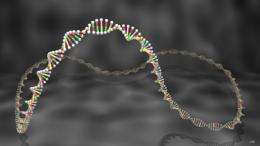
(PhysOrg.com) -- The genomes or DNA of microbes contain defined DNA patterns called genome signatures. Such signatures may be used to establish relationships and to search for DNA from viruses or other organisms in the microbes' genomes. Foreign DNA in bacteria has often been associated with disease-causing abilities.

In his doctorate, Jon Bohlin studied methods for examining the signatures of . Since foreign DNA in the genomes of bacteria often give the bacteria disease-causing abilities, part of his work was aimed at developing fast and simple methods for finding foreign DNA.

The explosive development in technology for sequencing DNA molecules has made enormous amounts of available for analysis. This has both led to an upheaval in biological research and simultaneously created a great need for fast and effective methods of interpreting the steadily increasing amounts of information.

To solve the challenges that these large amounts of information present, bioinformational research is utilising techniques taken from statistical, mathematical and information technologies. Most of the methods that were used in this project were originally established in the field of theoretical bioinformation. However, because of insufficient information, it was not previously possible to investigate the methods properly.

Bioinformational methods reveal a complex picture of the microbial genome

The increasing number of sequenced genomes that has become available during recent years has made it possible to test the methods' advantages and disadvantages, possibilities and limitations. This has given us more reliable information on how different microbes' DNA composition is influenced by environment and lifestyle.

The methods can also be used to deepen our understanding of the evolutionary development that follows natural selection at the DNA level. Such knowledge is absolutely necessary to understand mechanisms leading to becoming pathogenic (disease-producing) and resistant to antibiotics.

This doctorate comprises analyses of the genome signatures of microbes, and describes how genome signatures vary in the genomes of both closely-related microbes and among different microbial genomes. One of the central questions is how environment influences the genome signatures and if this influence may be may be linked to different characteristics of the microbes, such as size, composition, lifestyle and niche.

Cand. scient. Jon Bohlin defended his Ph. D. thesis, entitled "Genomic signatures in prokaryotic genomes", at the Norwegian School of Veterinary Science, on June 5, 2009.

Source: Norwegian School of Veterinary Science (news : web)


Rate this story - 3.5 /5 (2 votes)


June 25, 2009 all stories

Comments: 0

3.5 /5 (2 votes)

  • hide
  • Related Stories

  • Blending bacterial genomes for megacloning
    created Oct 18, 2005 | popularity not rated yet | comments 0
  • Bigelow laboratory scientists doach to study marine microbes
    created May 21, 2007 | popularity not rated yet | comments 0
  • New tool cracks genomic code quicker than ever
    created Jul 11, 2006 | popularity not rated yet | comments 0
  • Massive reanalysis of genome data solves case of the lethal genes
    created Oct 18, 2007 | popularity not rated yet | comments 0
  • On the trail of rogue genetically modified pathogens
    created Mar 18, 2008 | popularity not rated yet | comments 0


  • hide
  • Relevant PhysicsForums posts

  • Do we lose weight by respiration ? (Losing carbons)
    created 2 hours ago
  • Sleeping habits and the risk of cancer
    created Feb 08, 2010
  • Pressure in chambers of the heart
    created Feb 07, 2010
  • Primordial soup canned?
    created Feb 07, 2010
  • More from Physics Forums - Biology

Other News

Scientists crash test DNA's replication machinery

Biology / Cell & Microbiology

created 1hour ago | popularity 5 / 5 (1) | comments 0 | with audio podcast

(PhysOrg.com) -- Important molecular machines routinely crash into one another while plying their trades on DNA. New research shows that the enzymes that copy DNA before cell division, called replisomes, are the kings of ...


giant oarfish

Bizarre giant oarfish filmed (w/ Video)

Biology / Plants & Animals

created 2 hours ago | popularity 4 / 5 (3) | comments 0 | with audio podcast report

(PhysOrg.com) -- A rare giant oarfish, probably the largest bony fish in the ocean, has been filmed off the Gulf of Mexico. This is possibly the first time the fish has been observed in its natural environment.


Benefits of badger culling not long lasting for reducing cattle TB, says study

Benefits of badger culling not long lasting for reducing cattle TB, says study

Biology / Ecology

created 1hour ago | popularity not rated yet | comments 0

(PhysOrg.com) -- Badger culling is unlikely to be a cost-effective way of helping control cattle TB in Britain, according to research published today in PLoS ONE.


Scientists release Key Largo wood rats in first test of restocking experiment

Biology / Ecology

created 2 hours ago | popularity not rated yet | comments 0

The seven pioneers spent the week preparing for their upcoming ordeal in North Key Largo, sampling berries and other local fare, redecorating homes with sticks, leaves and whatever else they got their little paws on, and ...


Great tits: birds with character

Great tits: birds with character

Biology / Plants & Animals

created 15 hours ago | popularity 5 / 5 (3) | comments 3 | with audio podcast

(PhysOrg.com) -- In humans and animals alike, individuals differ in sets of traits that we usually refer to as personality. An important part of the individual difference in personality is due to variation ...